

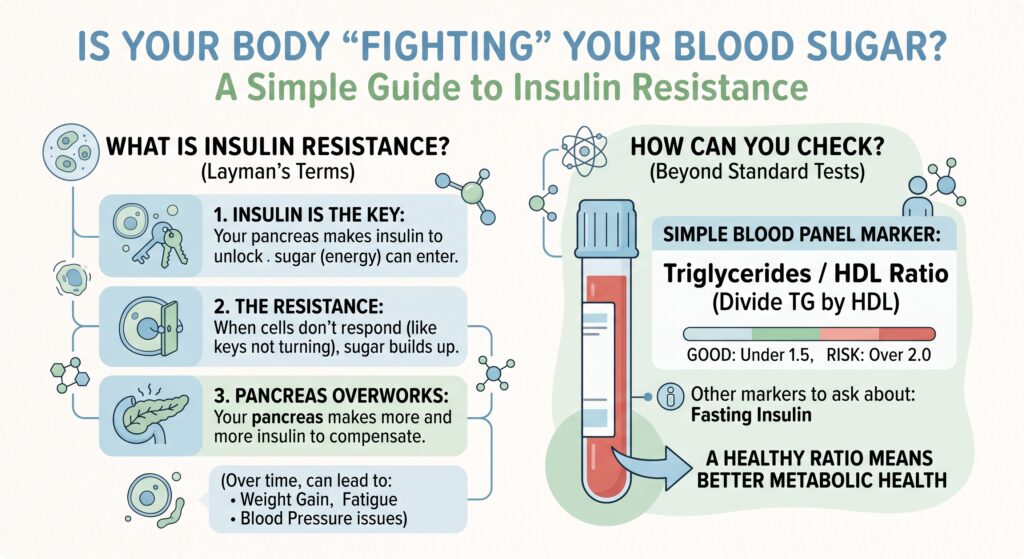
Insulin resistance occurs when cells in muscle, fat, and liver tissue fail to respond normally to insulin. To compensate, the pancreas overproduces insulin (hyperinsulinemia). Over time, chronic hyperinsulinemia, elevated blood glucose, and systemic inflammation trigger a cascade of multi-organ dysfunctions.
Metabolic & Endocrine Disorders
- Prediabetes & Type 2 Diabetes: Pancreatic b-cells eventually become exhausted and can no longer produce enough insulin to overcome peripheral resistance, causing fasting and postprandial hyperglycemia.
- Metabolic Syndrome: A cluster of risk factors driven by insulin resistance, including visceral obesity, elevated fasting triglycerides, low HDL, elevated blood pressure, and impaired fasting glucose.
Cardiovascular & Vascular Conditions
- Hypertension: High circulating insulin stimulates renal sodium reabsorption and activates the sympathetic nervous system. It also impairs nitric oxide (NO) production in the endothelium, leading to vasoconstriction and arterial stiffness.
- Atherosclerosis & Coronary Artery Disease: Insulin resistance drives atherogenic dyslipidemia (elevated small dense LDL, elevated triglycerides, reduced HDL) and systemic vascular inflammation, accelerating plaque formation.
- Peripheral Artery Disease (PAD) & Stroke: Microvascular and macrovascular damage increases the risk of ischemic events throughout the circulatory tree.
Hepatic & Digestive Issues
- Metabolic Dysfunction-Associated Steatotic Liver Disease (MASLD / NAFLD): Unchecked lipolysis in adipose tissue floods the liver with free fatty acids, while hyperinsulinemia accelerates de novo lipogenesis in hepatocytes, leading to hepatic steatosis, non-alcoholic steatohepatitis (NASH), fibrosis, and cirrhosis.
- Gallstones: Insulin resistance alters bile composition by increasing biliary cholesterol saturation and reducing gallbladder motility.
Hormonal & Reproductive Health
- Polycystic Ovary Syndrome (PCOS): In women, hyperinsulinemia stimulates the ovaries to overproduce androgens (testosterone), resulting in anovulation, irregular cycles, cysts, hirsutism, and infertility.
- Erectile Dysfunction & Hypogonadism: In men, endothelial dysfunction reduces penile arterial blood flow, and visceral adiposity coupled with hyperinsulinemia suppresses luteinizing hormone and lowers serum testosterone.
Neurological & Cognitive Decline
- Alzheimer’s Disease & Cognitive Impairment: Often termed “Type 3 Diabetes,” impaired cerebral insulin signaling reduces brain glucose metabolism, impairs synaptic plasticity, and accelerates amyloid-beta plaque and tau protein accumulation.
- Vascular Dementia: Chronic microvascular injury in cerebral vessels compromises brain perfusion.
Cellular Proliferation & Cancer Risk
- Elevated insulin and insulin-like growth factor 1 (IGF-1) stimulate cell proliferation and inhibit apoptosis, significantly increasing the risk of colorectal, endometrial, breast, pancreatic, and liver cancers.
Dermatological & Renal Manifestations
- Skin Markers: Acanthosis nigricans (dark, velvety hyperpigmentation in skin folds) and skin tags (acrochordons) develop due to insulin-driven epidermal keratinocyte and fibroblast proliferation.
- Chronic Kidney Disease (CKD): Hyperinsulinemia induces glomerular hyperfiltration, podocyte injury, and renal fibrosis.
Can a Blood Test Determine Insulin Resistance?
Because the pancreas can overproduce insulin for years to force normal glucose levels into cells, fasting blood glucose and HbA1c are late-stage markers of metabolic dysfunction. Detecting insulin resistance early relies on measuring direct insulin output, dynamic tolerance curves, and secondary lipid or inflammatory markers.
Primary Fasting Markers & Indices
- Fasting Serum Insulin: The most direct indicator of baseline compensatory hyperinsulinemia.
- Optimal: 2 to 6 IU/mL
- Early Resistance: >8 to 10 IU/mL (even with normal fasting glucose)
- HOMA-IR (Homeostatic Model Assessment of Insulin Resistance): Calculated as (Fasting Insulin IU/mL) x (Fasting Glucose mg/dL)\405. It quantifies how hard the pancreas is working to maintain fasting glycemia.
- Optimal: <1.0
- Mild / Early Resistance: 1.0 to 1.9
- Significant Resistance: < 2.0
- Fasting C-Peptide: Cleaved equimolarly from proinsulin alongside insulin. Because it bypasses first-pass hepatic clearance and has a longer half-life than insulin, it provides a stable metric of total endogenous pancreatic secretion.
Dynamic Functional Testing
- 2-Hour OGTT with Insulin (Kraft Test): Measures both glucose and insulin at fasting, 30, 60, and 120 minutes following a 75 g glucose load.
- Identifies “occult” insulin resistance where fasting numbers appear normal, but postprandial insulin spikes severely (>50-100 IU/mL) or fails to clear back toward baseline within 2 hours.
Lipid-Derived & Advanced Biomarkers
- Triglyceride-to-HDL Ratio (TG\HDL): When measured in mg/dL, this serves as an accessible surrogate for atherogenic dyslipidemia and hepatic insulin resistance.
- Optimal: <1.5
- Suspect Resistance: >2.0
- Strong Indicator: >3.0
- TyG Index (Triglyceride-Glucose Index): Calculated as Fasting Triglycerides (mg/dL) x Fasting Glucose (mg/dL)\2. It correlates with peripheral and hepatic insulin resistance without requiring a direct insulin assay.
- LP-IR Score (Lipoprotein Insulin Resistance Score): An NMR-derived composite score (0–100) based on 6 lipoprotein parameters: large VLDL-P, small LDL-P, large HDL-P, VLDL size, LDL size, and HDL size. Scores above 45 indicate insulin resistance.
Adjunct Hepatic & Inflammatory Biomarkers
- ALT & GGT (Alanine Aminotransferase & Gamma-Glutamyl Transferase): Unexplained elevations (even within high-normal lab ranges: ALT >25-30U/L) frequently signal early hepatic steatosis and hepatic insulin resistance.
- Adiponectin / Leptin-to-Adiponectin Ratio: Adiponectin is an insulin-sensitizing adipokine. Low circulating adiponectin directly correlates with visceral adiposity and diminished insulin sensitivity.
Summary:
Insulin resistance develops when muscle, fat, and liver cells become less responsive to insulin, prompting the pancreas to overproduce the hormone to keep blood sugar under control. While this compensatory hyperinsulinemia can mask underlying dysfunction for years by maintaining normal fasting glucose and HbA1c levels, the chronic elevation of insulin and systemic inflammation drives wide-ranging health complications. Over time, it accelerates vascular stiffening, hypertension, and plaque formation, promotes metabolic dysfunction-associated steatotic liver disease (MASLD), disrupts reproductive hormones leading to conditions like PCOS, and increases the long-term risk of type 2 diabetes, cognitive decline, and cardiovascular disease.
Because standard glucose testing detects dysfunction only after pancreatic b-cells begin to fail, early identification relies on assessing direct insulin secretion, dynamic tolerance, and lipid surrogates. Key markers include fasting serum insulin, C-peptide, and calculated scores like HOMA-IR, as well as dynamic 2-hour oral glucose tolerance tests with insulin. A practical and accessible screening surrogate is the Triglyceride-to-HDL ratio (TG/HDL) from a standard lipid panel, where a ratio under 1.5 indicates optimal metabolic health, while values above 2.0 to 3.0 strongly point to atherogenic dyslipidemia and hepatic insulin resistance alongside secondary markers like elevated ALT, high-sensitivity CRP, and advanced lipoprotein profiles.
Leave a Reply