

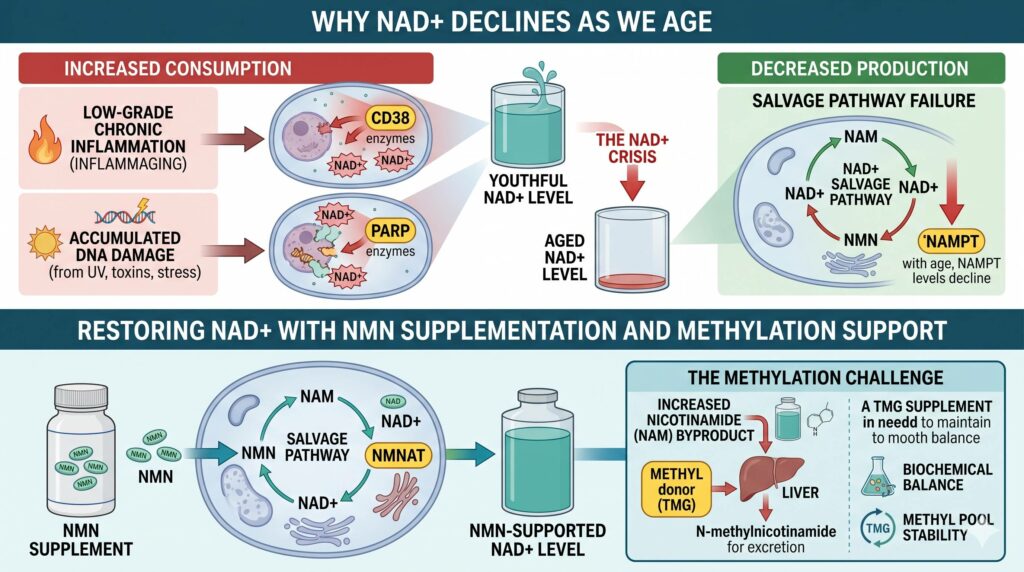
The decline of Nicotinamide Adenine Dinucleotide NAD+ is a hallmark of biological aging. It is essentially the “cellular currency” for energy metabolism and DNA repair. As we age, we face a double-edged sword: we produce less of it, and we consume it at a much higher rate.
Why NAD+ Levels Drop
The decline isn’t caused by a single failure but rather a systemic shift in how the body manages this coenzyme.
1. Increased Consumption (The “Overactive” Enzymes)
As cellular damage accumulates over decades, certain enzymes become hyperactive and “drain” the NAD+ pool:
- CD38: This is a primary culprit. CD38 is an enzyme involved in immune response and inflammation. As we age, low-grade chronic inflammation (often called “inflammaging”) causes CD38 levels to rise, which aggressively breaks down NAD+.
- PARPs (Poly ADP-Ribose Polymerases): These are the “first responders” for DNA repair. As DNA damage increases with age (due to UV light, toxins, and metabolic stress), PARPs work overtime. Because they require NAD+ to function, they can significantly deplete cellular reserves.
2. Decreased Production (The Salvage Pathway Failure)
Most NAD+ in the body is recycled through the Salvage Pathway. A key enzyme in this process is NAMPT.
- NAMPT is the rate-limiting enzyme that converts Nicotinamide (NAM) back into NMN, which then becomes NAD+.
- With age, NAMPT levels decline, meaning the body becomes less efficient at “recycling” its existing NAD+, leading to a slow but steady deficit.
Can NMN Help Restore NAD+ Levels?
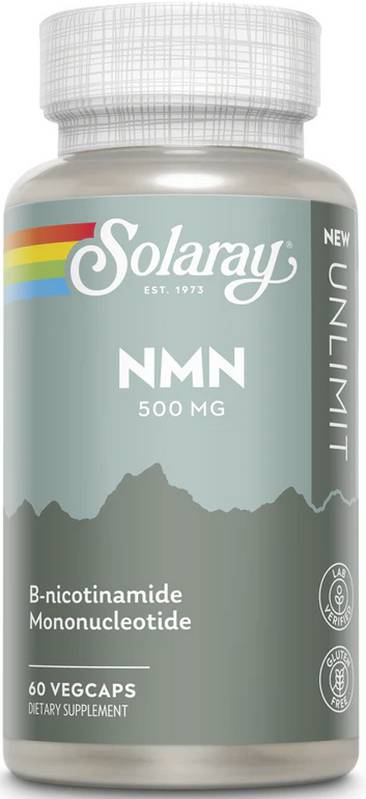
Nicotinamide Mononucleotide (NMN) is a direct precursor to NAD+. Research suggests that supplementation can indeed influence systemic levels, but the “normalcy” of those levels depends on several factors.
How it Works
When ingested, NMN is rapidly absorbed. It enters cells – partially through a specific transporter called Slc12a8 – where it is converted directly into NAD+ via the enzyme NMNAT.
What the Science Says
- Bioavailability: Clinical trials in humans have demonstrated that oral NMN supplementation safely and effectively raises NAD+ levels in the blood.
- Functional Improvements: Some studies suggest improvements in insulin sensitivity, aerobic capacity, and muscle function in older adults or athletes.
- The “Normal” Level: While NMN can bring NAD+ back toward youthful levels, it is not a “permanent fix.” Because the underlying consumption (CD38 and DNA damage) continues, levels usually return to baseline once supplementation stops.
Technical Considerations: The Methylation Connection
When the body processes high levels of NAD+ precursors, it produces Nicotinamide (NAM) as a byproduct. To clear excess NAM, the liver must methylate it to form N-methylnicotinamide, which is then excreted.
- This process consumes methyl groups.
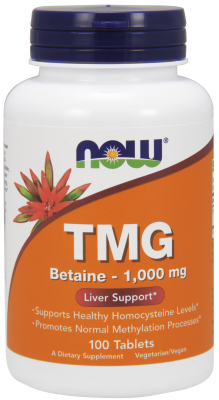
- For individuals focused on biochemical efficiency, many choose to pair NMN with a methyl donor like TMG (Trimethylglycine) to ensure that the increased demand for methylation doesn’t deplete the body’s methyl pool, which is also needed for neurotransmitter synthesis and homocysteine regulation.
Summary of NAD+ Management Strategies
| Strategy | Mechanism |
| NMN / NR Supplements | Provides the raw materials (precursors) to “top off” the NAD+ tank. |
| Exercise | Naturally boosts NAMPT activity, enhancing the body’s internal recycling system. |
| Caloric Restriction | Activates sirtuins and reduces the metabolic demand on energy pathways. |
| Inhibiting CD38 | Emerging research looks at natural compounds (like Apigenin) that may slow down the “drain” by inhibiting the CD38 enzyme. |
The decline of NAD+ with age is primarily driven by a systemic imbalance where cellular consumption begins to outpace natural production. This “drain” is largely caused by the increasing activity of enzymes like CD38 and PARPs, which are triggered by chronic, low-grade inflammation and the accumulation of DNA damage over time. Simultaneously, the body’s internal recycling mechanism, known as the salvage pathway, becomes less efficient as the levels of its rate-limiting enzyme, NAMPT, naturally diminish. This dual-threat of higher demand and lower supply leads to the characteristic drop in cellular energy and repair capacity seen in biological aging.
Supplementing with NMN can help restore these levels by acting as a direct precursor that bypasses the sluggish recycling enzymes to boost NAD+ concentrations within the cells. Research indicates that this can effectively raise systemic levels and support metabolic functions like insulin sensitivity and muscle performance. However, because the body must methylate and excrete the byproducts of increased NAD+ metabolism, high-dose supplementation can place a heavy burden on the body’s methylation pool. Pairing precursors with a methyl donor like TMG is often recommended to maintain biochemical balance and ensure that the liver can process these compounds without depleting the methyl groups required for other vital biological processes.
Leave a Reply