

Can High Cortisol Indicate Under Methylation?
The relationship between methylation and cortisol is a “two-way street” involving the clearance of stress hormones and the epigenetic regulation of the stress response.
How Under-Methylation Influences Cortisol
Under-methylation can lead to elevated cortisol levels through two primary biochemical mechanisms:
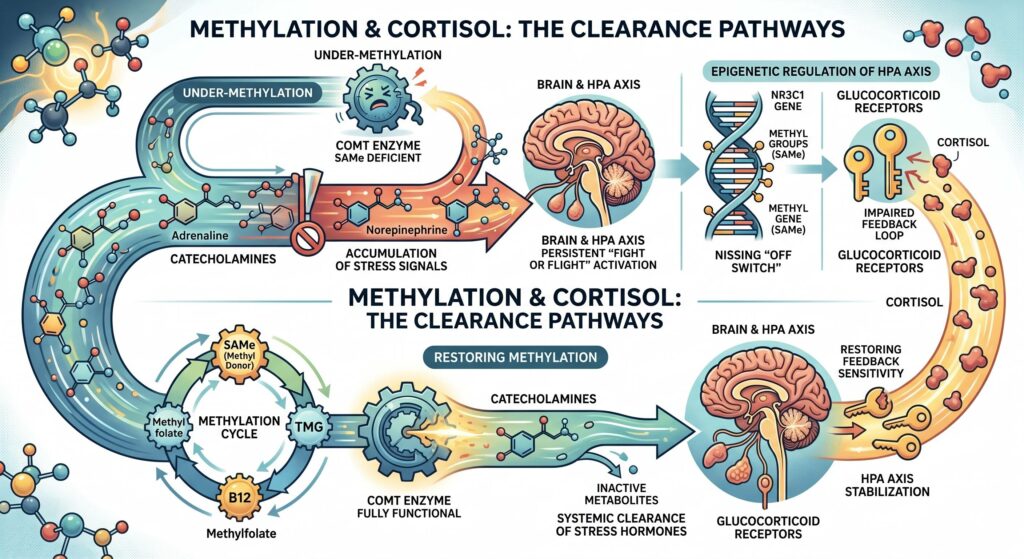
- Failure of Catecholamine Clearance: The enzyme Catechol-O-methyltransferase (COMT) is responsible for breaking down “stress chemicals” like adrenaline (epinephrine) and norepinephrine. COMT requires a methyl group (donated by SAMe) to function. When methylation is sluggish, these catecholamines can linger in the system, keeping the body in a prolonged “fight or freedom” state. This chronic stimulation signals the adrenal glands to keep cortisol production high.
- Epigenetic Regulation of the HPA Axis: Methylation acts as an “off switch” for certain genes. Specifically, the methylation of the NR3C1 gene (which codes for glucocorticoid receptors) determines how sensitive the body is to cortisol. If the promoter regions of these receptors are under-methylated, the feedback loop that tells the brain to “stop producing cortisol” can become impaired, leading to a state of functional cortisol resistance or overproduction.
Can Restoring Methylation Lower Cortisol?
Improving methylation efficiency often helps stabilize the hypothalamic-pituitary-adrenal (HPA) axis, though it is usually one piece of a larger puzzle.
- Buffering the Stress Response: By providing the necessary methyl donors (such as methylfolate, Methyl B12, and TMG) to support COMT activity, the body can more effectively “clear” the signal to produce cortisol.
- Restoring Feedback Sensitivity: Proper methylation helps maintain the correct density of receptors in the brain that sense cortisol. When these receptors work efficiently, the brain can shut down the stress response more quickly once a perceived threat has passed.
Impact on Overall Health
Restoring this balance typically results in systemic improvements because cortisol affects nearly every tissue in the body. Potential benefits include:
- Metabolic Health: Lowering chronically high cortisol can improve insulin sensitivity and reduce the tendency for the liver to engage in excessive gluconeogenesis (creating blood sugar from non-carbohydrate sources).
- Immune Modulation: Chronic high cortisol suppresses the immune system and increases inflammation. Balancing this through methylation support can help the body transition from a “survival” mode to a “repair” mode.
- Neurotransmitter Balance: Since methylation is also required to synthesize serotonin and melatonin, restoring the cycle often improves sleep quality and mood stability, which further lowers the physiological demand for cortisol.
Note: While methylation is a critical lever, cortisol is also heavily influenced by circadian rhythms, gut inflammation (which can trigger cortisol via the Vagus nerve), and mineral balances (specifically magnesium and sodium). Addressing methylation is most effective when paired with adequate sleep and stress management.
Under-methylation contributes to chronically elevated cortisol primarily through the impairment of the COMT enzyme and epigenetic dysregulation. When the body lacks sufficient methyl donors, the COMT enzyme cannot efficiently neutralize catecholamines like adrenaline and norepinephrine. This leaves the system in a persistent state of physiological arousal that triggers the adrenal glands to continuously release cortisol.
Furthermore, under-methylation can affect the NR3C1 gene, which manages glucocorticoid receptors; without proper “off-switch” signaling via methylation, the hypothalamic-pituitary-adrenal (HPA) axis fails to recognize when cortisol levels are already high, resulting in a broken feedback loop and sustained hormonal elevation.
Restoring methylation efficiency through the strategic use of methyl donors helps stabilize the HPA axis and facilitates the systemic clearance of stress hormones. By providing the biochemical tools necessary for neurotransmitter breakdown and receptor sensitivity, the body can shift from a state of chronic “survival” to one of “recovery.” This transition typically yields broad health benefits, including improved insulin sensitivity, reduced systemic inflammation, and enhanced sleep quality. As the metabolic demand for constant cortisol production diminishes, the body is better able to prioritize repair processes, leading to improved overall hormonal and metabolic resilience.
Leave a Reply