

Can I have insulin resistance with out knowing it?
Yes, you can have insulin resistance for 10 to 15 years without knowing it. It is one of the most common undiagnosed metabolic conditions because standard routine health screenings rarely test for it directly.
Why It Goes Undetected
Routine blood tests typically measure Fasting Blood Glucose and Hemoglobin A1c (HbA1c). In the early and moderate stages of insulin resistance:
- Pancreatic compensation hides the problem: As muscle, liver, and fat cells become less responsive to insulin, the pancreas compensates by secreting higher amounts of it (hyperinsulinemia).
- Normal blood sugar on paper: This massive surge of insulin successfully forces glucose out of the bloodstream and into cells, keeping fasting blood sugar and HbA1c in the “normal” range on standard lab work for years – even while fasting insulin levels and insulin resistance are high.
- Subtle, non-specific signs: Early clues often look like everyday fatigue, including post-meal energy crashes, brain fog, intense carbohydrate cravings, increased abdominal (visceral) fat, skin tags, or darkened patches of skin (acanthosis nigricans).
How Insulin Resistance Causes Weight Gain & Blocks Fat Loss
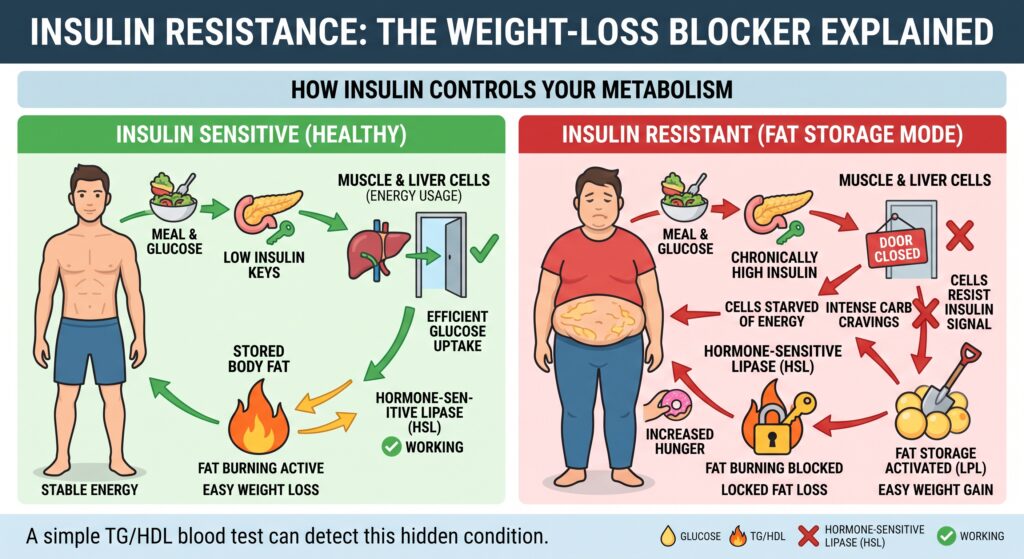
Insulin is the body’s primary energy-storage hormone. When baseline circulating insulin remains chronically elevated, it fundamentally alters how the body partitions and burns fuel.
- Shuts down fat burning (inhibits HSL): To burn body fat, triglycerides stored in fat cells must be broken down into free fatty acids by enzymes like hormone-sensitive lipase (HSL). High circulating insulin acts as a biochemical one-way valve – it potently suppresses HSL, making it biochemically difficult to access and oxidize stored body fat, even in a caloric deficit.
- Accelerates fat storage (activates LPL): High insulin stimulates lipoprotein lipase (LPL) on the surface of adipose tissue. LPL pulls circulating fatty acids and triglycerides out of the bloodstream and packs them into fat cells for long-term storage, especially around the abdominal organs.
- Triggers cellular hunger and cravings: Because muscle and liver cells resist insulin’s signal, they struggle to absorb glucose efficiently. Despite having plenty of energy stored as fat, the cells experience an intracellular energy deficit. The brain interprets this as starvation, increasing appetite and driving cravings for fast-acting carbohydrates.
- Destroys metabolic flexibility: A healthy metabolism easily switches between burning carbohydrates and burning fat. Chronically high insulin traps the body in glucose-burning mode, preventing the metabolic switch to fat oxidation.
High Fasting Insulin Can Cause Systemic Damage Over Time
Chronically high fasting insulin (hyperinsulinemia) is an active driver of systemic pathology across multiple organ systems, not merely a passive marker of poor glucose control.
Pathologies Driven by High Fasting Insulin
- Cardiovascular Damage and Hypertension: High circulating insulin stimulates the sympathetic nervous system and signals the kidneys to reabsorb sodium and water, elevating blood volume and blood pressure. It also impairs endothelial nitric oxide production, preventing arterial walls from relaxing properly.
- Metabolic Dysfunction-Associated Steatotic Liver Disease (MASLD): Insulin promotes hepatic de novo lipogenesis (fat creation). When insulin remains constantly elevated, the liver continuously converts excess substrate into fat, overwhelming its export capacity.
- Vascular Remodeling and Atherosclerosis: Insulin stimulates vascular smooth muscle cell proliferation and activates pro-inflammatory pathways inside the endothelial lining, creating an environment primed for plaque buildup.
- Cellular Proliferation and Hormonal Imbalance: Insulin cross-reacts with insulin-like growth factor 1 (IGF-1) receptors, stimulating abnormal cell growth. In women, this drives ovarian theca cells to overproduce androgens (the primary driver of polycystic ovary syndrome, or PCOS).
The Simplest Proxy Test: The TG/HDL Ratio
Standard fasting glucose tests can stay “normal” for over a decade while insulin climbs to toxic levels. The most accessible proxy for insulin resistance without a specialized fasting insulin draw is the Triglyceride-to-HDL ratio, calculated directly from a standard lipid panel.
TG/HDL Ratio = Triglycerides (mg/dL)/HDL (mg/dL)
| TG/HDL Ratio (mg/dL) | Metabolic Indication |
| < 1.5 (ideal = 1.0) | High Insulin Sensitivity: Low risk of atherogenic particle formation. |
| 1.5 – 3.0 | Early / Moderate Resistance: Emerging clearance defect in triglyceride-rich lipoproteins. |
| > 3.0 | Significant Insulin Resistance: Strongly correlates with high fasting insulin, elevated small dense LDL (sdLDL), and metabolic dysfunction. |
Why this ratio works: Under normal conditions, insulin activates lipoprotein lipase to clear triglycerides from circulation into fat cells. When muscle and liver tissues become insulin resistant, the liver ramps up VLDL (triglyceride) synthesis, and HDL clearance accelerates, driving triglycerides up and HDL down in tandem.
Summary:
Insulin resistance often develops undetected for over a decade because the pancreas compensates by chronically overproducing insulin to keep standard fasting glucose and HbA1c levels within normal ranges. This elevated baseline insulin locks the body into fat-storage mode by suppressing hormone-sensitive lipase to block fat burning while actively stimulating lipoprotein lipase to store triglycerides. Beyond stalling weight-loss efforts and triggering carbohydrate cravings due to impaired cellular energy uptake, chronically high insulin actively damages multiple organ systems – promoting hypertension through renal sodium retention and endothelial stiffness, accelerating hepatic fat accumulation into fatty liver disease, and driving vascular remodeling that leads to atherosclerosis.
Because conventional metabolic panels frequently miss early-stage hyperinsulinemia, the triglyceride-to-HDL (TG/HDL) ratio calculated from a standard lipid panel serves as a reliable, accessible proxy test. When muscle and liver cells become insulin resistant, the liver ramps up triglyceride synthesis while protective HDL particles are cleared more rapidly, skewing the two numbers in opposite directions. A calculated ratio below 1.5 indicates optimal insulin sensitivity, whereas a ratio exceeding 3.0 strongly correlates with significant insulin resistance, elevated small dense LDL particles, and systemic metabolic dysfunction.
Leave a Reply