

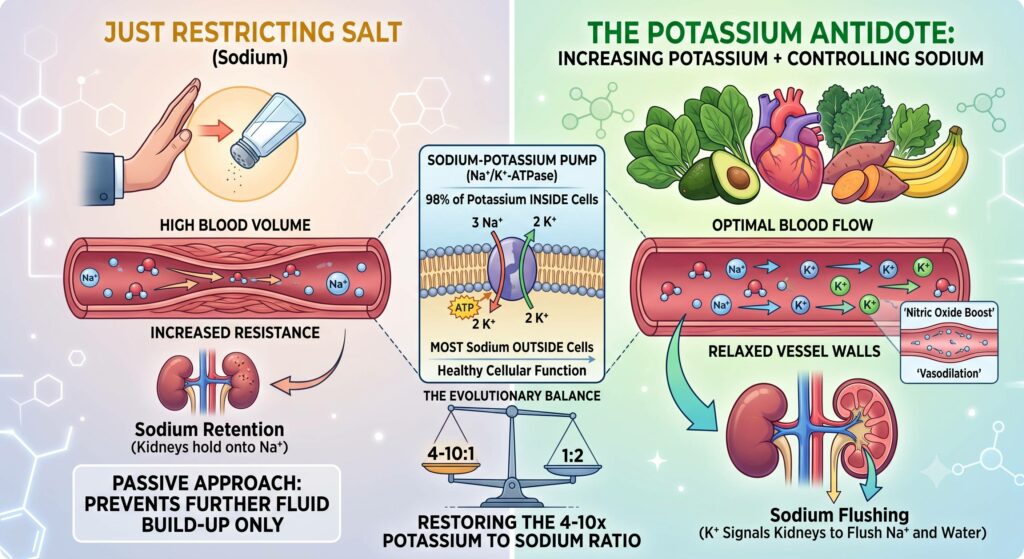
For decades, standard medical advice for high blood pressure was simple: put down the salt shaker. But focusing entirely on cutting sodium misses half the equation – and arguably the more dynamic half.
While reducing sodium helps prevent fluid retention, increasing potassium actively pushes your cardiovascular system into a lower-pressure state. In fact, research shows that the ratio of sodium to potassium in your diet is a far stronger predictor of heart disease and blood pressure spikes than sodium intake alone.
3 Reasons Potassium Outperforms Sodium Restriction
1. Potassium Forces Your Kidneys to Excrete Sodium
When you eat salt, sodium enters your bloodstream and draws water with it, increasing blood volume and raising pressure against arterial walls.
Potassium acts as the biological antidote. When serum potassium rises, it signals special channels in your kidneys (specifically the sodium-chloride cotransporter, or NCC) to turn down. This prevents your renal tubules from reabsorbing sodium, causing your body to flush excess sodium and water out through your urine. Without adequate potassium, your kidneys stubbornly hold onto sodium regardless of how little salt you eat.
2. It Actively Relaxes Your Arterial Walls
Cutting salt is a passive strategy – it prevents further vessel constriction by lowering fluid volume. Potassium, on the other hand, triggers an active physical change in your blood vessels:
- Hyperpolarization: Potassium ions hyperpolarize vascular smooth muscle cells, causing calcium channels to close.
- Direct Vasodilation: Less intracellular calcium allows the muscular walls around your arteries to relax and widen immediately, lowering systemic vascular resistance.
- Nitric Oxide Boost: High-potassium environments stimulate endothelial cells to release nitric oxide, keeping vessels elastic and supple.
3. It Restores Our Evolutionary Balance
Historically, human diets consisted of whole plants, tubers, and lean meats, providing roughly 4 to 10 times more potassium than sodium. Modern processed foods completely inverted this ratio to about 1:2 (twice as much sodium as potassium).
Your cells rely on the sodium-potassium pump to keep 98% of your body’s potassium inside cells and most sodium outside cells. When potassium is scarce, cells accumulate internal sodium, causing vascular cells to swell, stiffen, and resist blood flow.
Salt Cutting vs. Potassium Boosting
| Biological Mechanism | Slashing Sodium Alone | Raising Potassium |
| Primary Action | Reduces total fluid volume | Actively flushes excess sodium via kidneys (natriuresis) |
| Arterial Impact | Prevents further vessel tightness | Directly dilates and relaxes arterial walls |
| Nervous System | Minimal direct impact | Suppresses overactive sympathetic (stress) signaling |
| Dietary Approach | Subtractive (restricting processed foods) | Additive (focusing on whole, nutrient-dense foods) |
The Target Numbers: The average adult consumes around 3,400 mg of sodium but only 2,500 mg of potassium daily. Reversing that balance – aiming for 3,500 to 4,700 mg of potassium while keeping sodium under 2,300 mg – produces significantly greater drops in systolic blood pressure than sodium restriction alone.
While traditional blood pressure management focuses primarily on reducing salt intake, increasing potassium offers a far more dynamic strategy to lower hypertension. Sodium retention draws fluid into the bloodstream and increases arterial pressure, but potassium acts as a biological antidote by signaling the kidneys to flush excess sodium and water out through urine. Beyond fluid balance, potassium actively relaxes vascular smooth muscle cells, stimulates nitric oxide production to keep arterial walls elastic, and helps restore the high potassium-to-sodium ratio that human physiology naturally requires for optimal cardiovascular health.
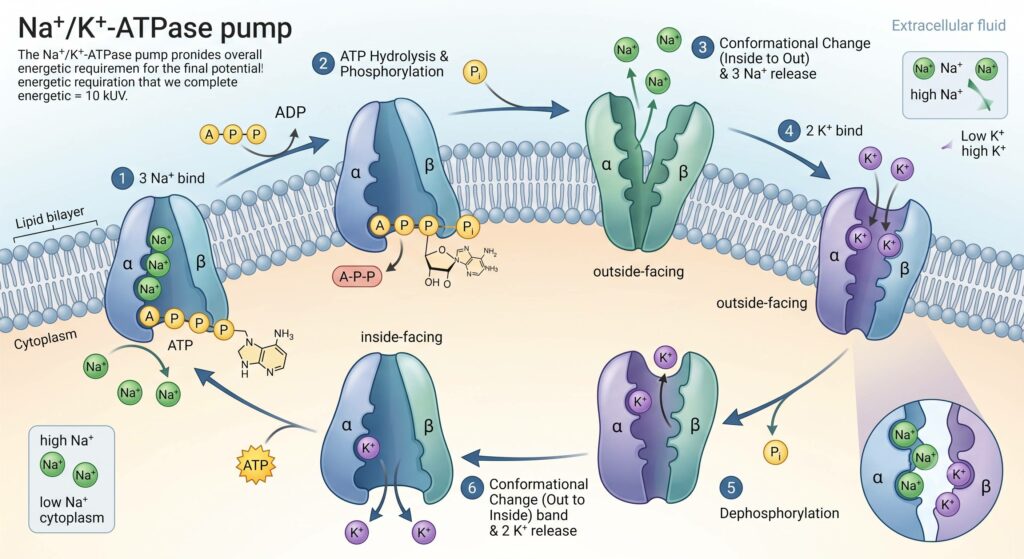
At the cellular level, this process is governed by the Na⁺/K⁺-ATPase (sodium-potassium) pump, an ATP-powered mechanism that maintains essential electrolyte gradients across cell membranes. By repeatedly exchanging three intracellular sodium ions for two extracellular potassium ions, the pump ensures that the vast majority of the body’s potassium remains inside cells. Maintaining adequate intracellular potassium prevents vascular cells from accumulating excess sodium – a key driver of cellular swelling, arterial stiffness, and elevated systemic resistance – making targeted potassium intake far more impactful than passive salt restriction alone.
Leave a Reply