

 Can Berberine Disrupt Biofilm?
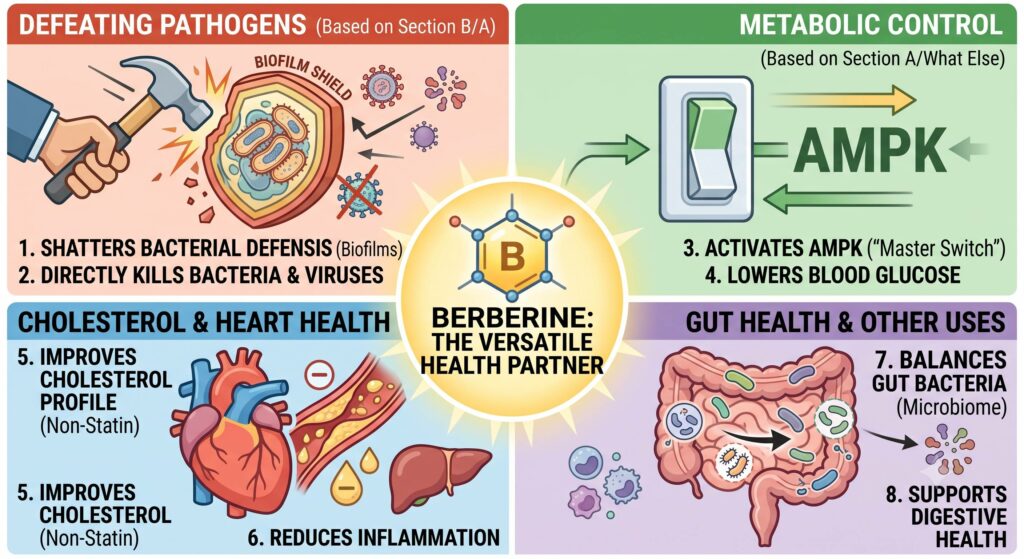
Yes, berberine is highly regarded in contemporary pharmacology precisely because it acts as a potent biofilm disruptor and a broad-spectrum antimicrobial agent against both bacteria and viruses. Rather than just targeting free-floating (planktonic) microbes, it fundamentally dismantles the structural defenses and metabolic machinery that pathogens use to survive and evade the immune system.
The Dual-Action Antimicrobial Landscape of Berberine
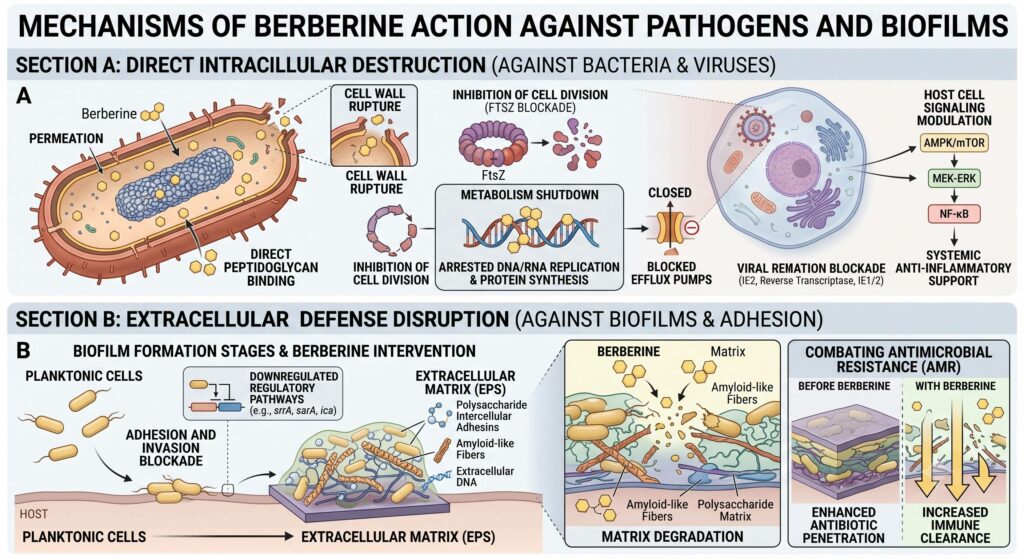
As illustrated in the pharmacological breakdown above, berberine operates via two distinct pathways: direct intracellular destruction (Section A) and extracellular defense disruption (Section B).
1. Extracellular Strategy: Biofilm Disruption & Adhesion Blockade
When bacteria colonize tissues, they often form a biofilm – a structured community enclosed in a self-produced matrix of sugars, proteins, and extracellular DNA. This shield makes them up to 1,000 times more resistant to traditional treatments. Berberine attacks this structure at multiple stages:
- Blocks Adhesion and Invasion: Before a biofilm can form, individual bacterial cells must stick to host tissues. Berberine interferes with quorum sensing (cellular communication) and downregulates regulatory pathways (such as the srrA, sarA, or ica gene complexes), stopping planktonic cells from anchoring themselves.
- Dismantles the Shield: For bacteria that have already established a colony, berberine downregulates the synthesis of polysaccharide intercellular adhesins and alters the aggregation of amyloid-like fibers. Without these structural scaffolds, the matrix loses its physical stability.
- Combats Antimicrobial Resistance (AMR): Because it degrades this physical barrier, berberine is widely studied as an antibiotic adjuvant. It breaks down the biofilm armor, allowing the body’s immune cells or conventional antibiotics to penetrate and clear out the infection.
2. Intracellular Strategy: Direct Antibacterial Destruction
When dealing with active bacterial cells, berberine achieves Cell membrane and wall rupture through several highly targeted mechanisms:
- Wall Permeation: It undergoes rapid Permeation across the outer protective layers of the bacteria through Direct binding to peptidoglycan.
- Disruption of Proton Dynamics: Once inside the membrane, it alters transmembrane potential (Delta\Psi\m), causing a collapse of the cellular proton-motive force and disrupting energy production.
- Metabolism & Division Arrest: Berberine binds directly to the FtsZ protein to Inhibit cell division. Concurrently, it binds to nucleic acids to arrest DNA replication, RNA transcription, and Protein synthesis – effectively causing an absolute shutdown that Inhibits overall metabolism.
- Efflux Pump Subversion: To keep the bacteria from simply pumping the compound out, berberine blocks cellular Efflux pumps, short-circuiting the pathogen’s primary resistance mechanism.
3. How Berberine Attacks Viral Pathogens
While biofilm disruption is unique to bacterial and fungal networks, berberine uses an entirely different set of tools to target viral replication inside host cells. Rather than acting as a simple passive compound, it alters the specific cellular environments that viruses hijack to reproduce:
- Halting the Viral Replication Cycle: Berberine can intercalate into nucleic acids, disrupting viral DNA/RNA synthesis and reverse transcriptase activity. In specific double-stranded viruses (like human cytomegalovirus), it interferes with immediate-early viral protein transactivation (such as the IE2 protein), freezing the virus’s life cycle before it can synthesize early structural components.
- Host Signaling Modulation: Viruses rely on host metabolic pathways to assemble and exit cells. Berberine regulates central metabolic and signaling pathways – specifically AMPK/mTOR, MEK-ERK, and NF-κB cascades. Turning these dials changes the intracellular environment, preventing viral particles from correctly assembling or exiting the host cell.
- Mitigating Hyper-Inflammation: In many severe viral infections (like influenza or coronaviruses), the greatest tissue damage isn’t caused by the virus itself, but by an overreactive immune response. Berberine acts on immune cells to suppress the overproduction of pro-inflammatory cytokines (such as IL-6, IL-8, and TNF-α), providing strong systemic anti-inflammatory support while the body clears the pathogen.
Other Benefits of Berberine!
Beyond its role as a potent antimicrobial and biofilm disruptor, berberine acts as a powerful systemic alkaloid with extensive metabolic, cardiovascular, and cellular targets. Because it interfaces directly with several core enzymatic pathways, its physiological impacts are broad and highly analytical.
4. Master Metabolic Regulation: The AMPK Switch
- Mitochondrial Complex I Inhibition: At the cellular level, berberine acts as a temporary metabolic brake by inhibiting mitochondrial respiratory complex I.
- AMPK Activation: This direct mitochondrial inhibition alters the intracellular AMP-to-ATP ratio, triggering the rapid phosphorylation and activation of Adenosine Monophosphate-Activated Protein Kinase (AMPK).
- Downstream Signaling Control: Through the activation of AMPK, berberine plays a critical role in downregulating overactive mTOR pathways while cross-talking with SIRT1, effectively orchestrating a systemic shift toward cellular cleanup, repair, and energy homeostasis.
5. Glycemic Control & Hepatic Gluconeogenesis
- Metformin-like Efficacy: In numerous clinical trials, berberine demonstrates blood-glucose-lowering capabilities comparable in efficacy to standard metabolic pharmaceuticals like metformin.
- Insulin Sensitivity Upregulation: It increases the expression of insulin receptors on peripheral tissues, directly combating insulin resistance and helping clear glucose from the bloodstream.
- Hepatic Suppression: In the liver, berberine significantly downregulates gluconeogenesis (the production of new glucose) while accelerating glycolysis to optimize carbohydrate oxidation.
6. Advanced Lipid Optimization & Cardiovascular Protection
- PCSK9 Inhibition: Unlike statins, which lower cholesterol by blocking the HMG-CoA reductase enzyme, berberine operates via a distinct, non-statin pathway by acting as a natural PCSK9 inhibitor.
- LDLR mRNA Stabilization: It enhances the clearance of low-density lipoproteins by increasing the stability of low-density lipoprotein receptor (LDLR) mRNA transcripts. By prolonging the life of these transcripts, hepatocytes can express a higher volume of active surface receptors to pull LDL cholesterol out of circulation.
- Triglyceride Suppression: Through both peripheral and central nervous system signaling, berberine downregulates key hepatic lipogenic genes, contributing to significant drops in serum triglycerides and apolipoprotein B.
7. Adipose Tissue Browning & Thermogenesis
- UCP1 and PGC-1α Induction: Berberine accelerates metabolic expenditure by driving the “browning” of white adipose tissue.
- Energy Dissipation: Via the AMPK pathway, it upregulates mitochondrial uncoupling protein 1 (UCP1) and peroxisome proliferator-activated receptor gamma coactivator-1 alpha (PGC-1α). This process uncouples mitochondrial respiration, causing cells to dissipate stored energy as heat rather than storing it as chemical energy or fat.
8. Gut Microbiome Remodeling
- Firmicutes-to-Bacteroidetes Shift: Because oral berberine features a naturally low bioavailability (roughly 0.5% to 5%), a substantial portion of its systemic efficacy occurs directly within the gut lumen.
- Dysbiosis Correction: It acts as a selective prebiotic modulator, shifting the gut microbiota away from a high-Firmicutes composition (frequently observed in metabolic syndrome) toward a healthier Bacteroidetes balance.
- Bile Acid & FXR Modulation: This microbial restructuring fundamentally shifts downstream microbial bile acid metabolism and intestinal FXR signaling, optimizing lipid and glucose absorption from the digestive tract upward.
9. Systemic Anti-Inflammatory Cascades
- Enzyme Blocker: Berberine downregulates chronic, low-grade metabolic inflammation by stalling the expression of cyclooxygenase-2 (COX-2) and prostaglandin E2 (PGE2).
- Cytokine Suppression: Within macrophages and endothelial walls, it blocks the nuclear factor kappa B (NF-κB) cascade, halting the overproduction of pro-inflammatory cytokines such as IL-6, IL-8, and TNF-α.
Berberine acts as a potent, broad-spectrum antimicrobial agent capable of dismantling both bacterial defenses and viral replication machinery. As a biofilm disruptor, it prevents bacterial adhesion and quorum sensing by downregulating key regulatory pathways like srrA and sarA, which destabilizes the protective polysaccharide matrix and helps overcome antimicrobial resistance. Intracellularly, berberine permeates bacterial cell walls by binding to peptidoglycan, collapses transmembrane potential, and halts replication and metabolism by blocking the FtsZ protein and arresting nucleic acid synthesis. Furthermore, it combats viral pathogens by directly interrupting their replication cycles, modifying host cellular signaling pathways, and suppressing overactive pro-inflammatory cytokines to mitigate tissue-damaging systemic inflammation.
Beyond its antimicrobial capabilities, berberine serves as a powerful metabolic and cardiovascular regulator primarily driven by mitochondrial complex I inhibition and the subsequent activation of the AMPK pathway. This enzymatic switch downregulates overactive mTOR signaling, enhances peripheral insulin sensitivity, and suppresses hepatic gluconeogenesis to achieve glycemic control comparable to traditional metabolic options. Additionally, it optimizes lipid profiles through a distinct non-statin mechanism that inhibits PCSK9 and stabilizes LDLR mRNA transcripts, allowing the liver to clear circulating LDL cholesterol more efficiently. These systemic benefits are further supported by its ability to drive adipose tissue browning and thermogenesis via UCP1 induction, favorably remodel the gut microbiome’s Firmicutes-to-Bacteroidetes ratio, and block chronic inflammatory cascades like NF-κB and COX-2.
Leave a Reply