

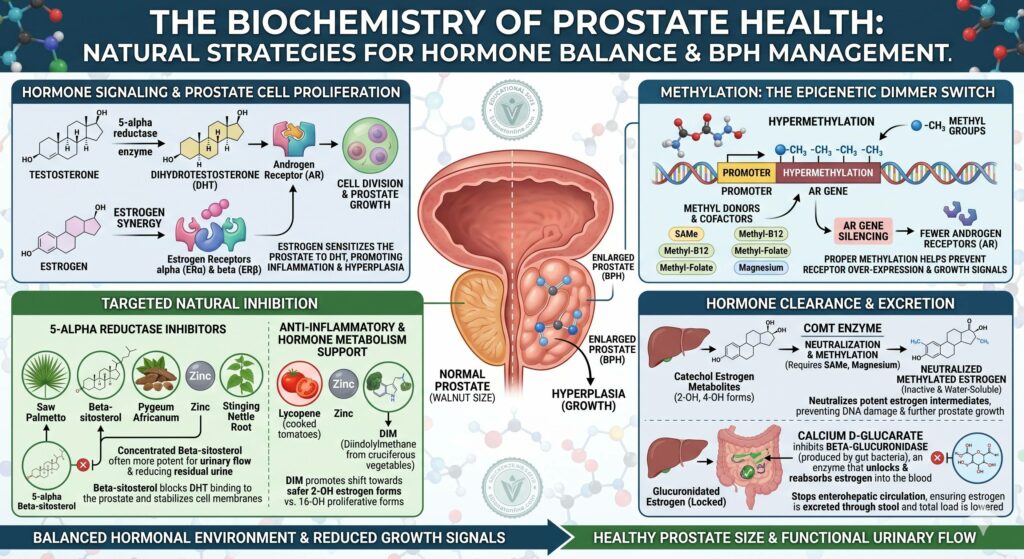
The prostate is a small, walnut-sized gland that plays a crucial role in the male reproductive system, primarily by producing the fluid that nourishes and transports sperm. As men age, the prostate often undergoes a non-cancerous growth known as Benign Prostatic Hyperplasia (BPH).
Understanding how to manage this growth involves looking at the intersection of hormonal signaling and epigenetic “switches” like methylation.
The Hormonal “Double Whammy”: DHT and Estrogen
Prostate growth is largely driven by the hormonal environment. While testosterone is the primary male sex hormone, its metabolites are the real “gasoline” for prostate enlargement.
1. Dihydrotestosterone (DHT)
DHT is a potent androgen derived from testosterone. In the prostate, the enzyme 5-alpha reductase converts testosterone into DHT.
- The Mechanism: DHT has a much higher affinity for androgen receptors (AR) than testosterone. When DHT binds to these receptors, it signals the prostate cells to divide and proliferate.
- The Reaction:
- Testosterone –> 5-alpha reductase –> Dihydrotestosterone (DHT)
2. The Role of Estrogen
As men age, testosterone levels often decline while estrogen levels may remain stable or even increase (often due to increased activity of the aromatase enzyme in fat tissue).
- Synergy: Estrogen can increase the number of androgen receptors in the prostate, making the gland more sensitive to even low levels of DHT.
- Direct Growth: Estrogen receptors (ER-alpha and ER-beta) are present in the prostate. Activation of ER-a is generally associated with inflammation and hyperplasia (growth).
Methylation: The Epigenetic Dimmer Switch
Methylation is a biochemical process where a methyl group (one carbon and three hydrogen atoms) is added to DNA. In the context of the prostate, methylation acts like a “dimmer switch” for gene expression.
Downregulating Receptors
If the promoter region of a gene – like the one for the Androgen Receptor (AR) – becomes “hypermethylated,” the gene is effectively silenced or turned down.
- The Theory: By supporting healthy methylation cycles, the body can potentially maintain the “silencing” of growth-promoting genes.
- Cofactors: This process relies on methyl donors and cofactors, including Methyl-B12, Methyl-Folate, and Trimethylglycine (TMG).
- The Goal: Proper methylation helps ensure that cells follow their correct “instruction manual,” preventing the over-expression of receptors that would otherwise catch DHT and trigger growth.
Natural Strategies to Reduce Prostate Size
Managing prostate health naturally involves inhibiting the enzymes that create DHT and supporting the metabolism of estrogen.
Targeted Nutritional Support
- Saw Palmetto: One of the most well-studied botanicals for BPH, it acts as a natural inhibitor of the 5-alpha reductase enzyme, reducing the conversion of testosterone to DHT.
- Beta-Sitosterol: A plant sterol that can improve urinary flow and reduce the amount of residual urine left in the bladder.
- Pygeum Africanum: Derived from the bark of the African cherry tree, it helps reduce inflammation and can inhibit growth factors in the prostate.
- Stinging Nettle Root: Often used in combination with Saw Palmetto, it may prevent DHT from binding to the prostate and helps regulate estrogen levels by influencing Sex Hormone Binding Globulin (SHBG).
Hormonal & Metabolic Balance
- Zinc: The prostate has the highest concentration of zinc in the human body. Zinc is a potent inhibitor of 5-alpha reductase and is necessary for healthy androgen metabolism.
- Lycopene: Found in high concentrations in cooked tomatoes, this antioxidant is specifically protective of prostate tissue and may slow the progression of BPH.
- DIM (Diindolylmethane): Found in cruciferous vegetables like broccoli, DIM helps the liver metabolize “strong” estrogens into weaker, less proliferative forms.
Lifestyle Factors
- Insulin Management: High insulin levels (hyperinsulinemia) are strongly linked to prostate enlargement. Reducing refined sugars and processed carbohydrates can lower systemic inflammation and growth signaling.
- Pelvic Floor Exercises: While they don’t shrink the gland itself, “Kegels” for men can significantly improve the urinary symptoms associated with an enlarged prostate.
Shrinking the Prostate with COMT Enzyme optimization and Managing Estrogen
Efficiently clearing estrogen and managing potent androgens like DHT are two of the most effective ways to support prostate health and potentially manage its size. When the body’s “exit ramps” for estrogen are blocked, levels can rise, sensitizing the prostate to DHT and fueling growth.
Here is how the COMT enzyme, Calcium D-Glucarate, and Beta-sitosterol work together to manage this balance.
1. The COMT Enzyme: The Estrogen “Neutralizer”
The Catechol-O-methyltransferase (COMT) enzyme is a critical player in Phase II liver detoxification. It is responsible for neutralizing “catechol estrogens,” which are the intermediate metabolites of estrogen.
- The Mechanism: Estrogen (estradiol and estrone) is first broken down by the liver into 2-hydroxy (2-OH) or 4-hydroxy (4-OH) estrogens. COMT then attaches a methyl group to these metabolites, converting them into water-soluble “methoxy” forms (like 2-methoxyestrone).
- The Benefit: Once methylated, these estrogens are inactive and ready for excretion. Without enough COMT activity, these metabolites can stay in the body longer and potentially cause DNA damage or signal further prostate cell proliferation.
- Support Factors: Because COMT is a methylation-dependent enzyme, it requires specific cofactors to run efficiently:
- SAMe: The universal methyl donor.
- Magnesium: COMT is highly dependent on magnesium to function.
- Methyl-B12 and Methyl-Folate: To keep the underlying methylation cycle spinning.
2. Calcium D-Glucarate: Preventing Estrogen Reabsorption
Even if the liver successfully processes estrogen, it can still be “recycled” back into the bloodstream from the gut – a process called enterohepatic circulation. This is where Calcium D-Glucarate becomes essential.
- The Glucuronidation Pathway: One way the liver packages estrogen for “trash pickup” is through a process called glucuronidation. It attaches a glucuronic acid molecule to the estrogen, making it safe for the intestines to move out.
- The “Unlock” Problem: Certain “unfriendly” gut bacteria produce an enzyme called Beta-glucuronidase. This enzyme acts like a locksmith, uncoupling the glucuronic acid from the estrogen while it’s still in your colon. This “free” estrogen is then reabsorbed back into the blood.
- The Solution: Calcium D-Glucarate is a potent inhibitor of Beta-glucuronidase. By blocking this enzyme, it ensures that the estrogen stay “locked” in its package and is successfully excreted through the stool, effectively lowering the total estrogen load on the prostate.
3. Beta-Sitosterol: The High-Potency Alternative
If Saw Palmetto has been tried without significant results, Beta-sitosterol is often the next logical step. While Saw Palmetto contains a small amount of various fatty acids and sterols, Beta-sitosterol is a concentrated plant sterol that works via multiple pathways.
Why it is often more effective:
- Concentrated Action: Many clinical trials have shown that purified Beta-sitosterol is significantly more effective at improving urinary flow rates and reducing residual urine volume compared to whole-herb Saw Palmetto.
- 5-Alpha Reductase Inhibition: Like Saw Palmetto, it helps inhibit the enzyme that converts testosterone into DHT, but it may have a higher affinity for the receptors in the prostate.
- Direct Membrane Support: It may help stabilize the cell membranes of the prostate, reducing the inflammatory signaling that causes the gland to swell.
- Cholesterol Connection: Because it is structurally similar to cholesterol, it may interfere with the prostate’s ability to use cholesterol as a precursor for hormone synthesis within the gland itself.
Summary of the “Clearance” Protocol
| Compound | Primary Role | Target |
| COMT Support | Neutralizes estrogen intermediates | Liver Phase II |
| Calcium D-Glucarate | Stops estrogen recycling | Gut Health |
| Beta-sitosterol | Inhibits DHT & improves flow | Prostate Tissue |
| DIM / I3C | Shifts metabolism toward “safe” 2-OH estrogen | Liver Phase I |
By combining COMT support (methylation) and Calcium D-Glucarate (excretion), you address the hormonal environment that causes the prostate to grow. Adding Beta-sitosterol then addresses the symptoms and direct growth signals within the gland itself.
Managing prostate health involves a sophisticated dual-track approach that focuses on both the neutralization of hormones and their successful elimination from the body. The COMT enzyme acts as a critical biochemical “exit ramp” during Phase II liver detoxification, using methyl groups to deactivate estrogen metabolites. This methylation process effectively “dims” the hormonal signals that can increase the prostate’s sensitivity to DHT, the primary driver of tissue enlargement. By ensuring the COMT enzyme has sufficient cofactors – such as magnesium and methyl donors – the body can prevent the accumulation of proliferative estrogen intermediates that would otherwise fuel gland growth.
Once the liver has processed these hormones, Calcium D-Glucarate provides a final safeguard in the digestive tract by inhibiting the enzyme beta-glucuronidase. This prevents neutralized estrogen from being “unlocked” and reabsorbed into the bloodstream, ensuring it is permanently excreted. While these detoxification pathways manage the systemic environment, Beta-sitosterol offers direct tissue support as a potent alternative to Saw Palmetto. It works by inhibiting the 5-alpha reductase enzyme to lower DHT levels within the gland and improving urinary flow. Together, these mechanisms create a comprehensive strategy for regulating hormonal balance and maintaining healthy prostate size.
Leave a Reply