

Can L-Carnitine Tartrate Upregulate Androgen Receptors?
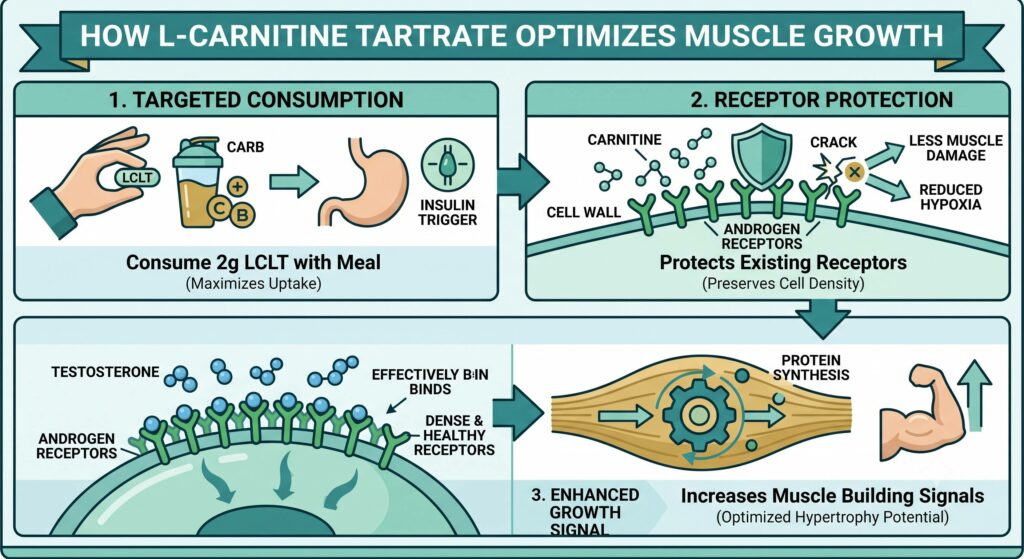
Yes, L-carnitine tartrate (LCLT) can absolutely upregulate androgen receptors (AR) in skeletal muscle tissue. However, to keep it completely real: it doesn’t directly force massive muscle growth on its own. Instead, it acts as a powerful cellular optimizer that prevents tissue breakdown, clearing the path for enhanced recovery and hypertrophy.
Here is exactly how the science breaks down and how it connects to your training.
The Mechanism: Preserving the Receptors
The concept comes from a series of landmark clinical studies led by Dr. William J. Kraemer. In these trials, resistance-trained individuals took 2 grams of L-carnitine tartrate daily for 3 weeks. Muscle biopsies revealed a significant increase in baseline androgen receptor density compared to a placebo.
The mechanism isn’t that carnitine magically creates new receptors out of thin air. Rather, it operates via tissue protection:
- Reducing Hypoxic Stress: Intense weightlifting temporarily restricts oxygen delivery to the working muscle, triggering hypoxic stress and biochemical cellular damage.
- Preventing Receptor Degradation: LCLT improves blood flow at the capillary level and acts as a metabolic buffer inside the mitochondria. By dramatically reducing post-exercise muscle damage (measured by lower levels of creatine kinase and myoglobin), it preserves the structural integrity of the muscle cells. Less damage means fewer existing androgen receptors are degraded during training.
The Hypertrophy Connection
Androgen receptors are the literal “docking stations” for anabolic hormones like testosterone. When testosterone binds to an AR inside a muscle fiber, it translocates to the cell nucleus to initiate gene transcription.
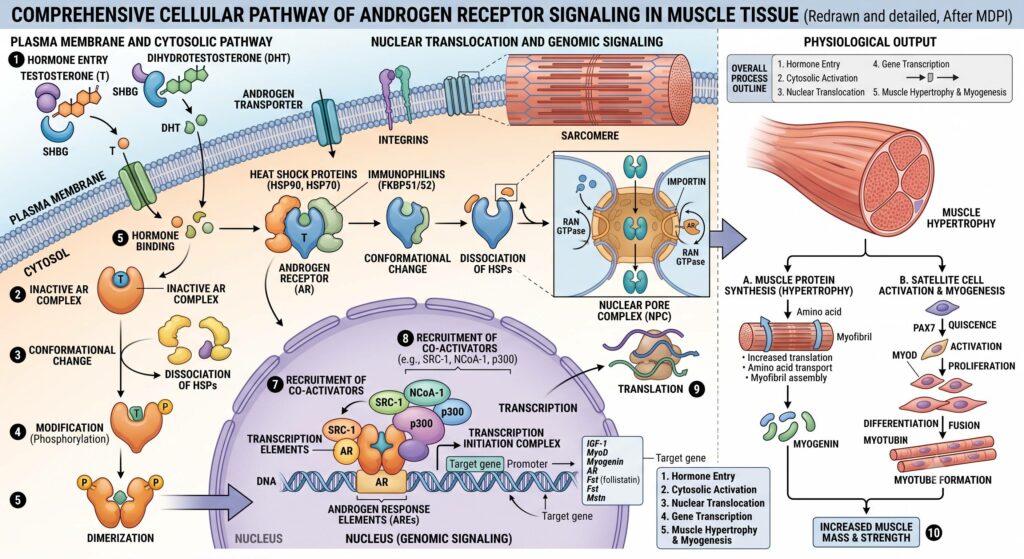
As illustrated in the cellular pathway above, maximizing the density and availability of these receptors accelerates the entire muscle-building loop:
- Greater Anabolic Signaling: Higher receptor density means the muscle tissue has a greater total capacity to bind circulating hormones, maximizing the anabolic signal from a workout.
- Protein Synthesis: This signaling directly drives myofibrillar protein synthesis (the repair and thickening of the actual contractile fibers) and improves nitrogen retention.
- The Feeding Synergy: The research also highlighted that combining LCLT with post-workout feeding (protein and carbohydrates) creates an even greater upregulation of AR content. The insulin response helps shuttle the amino acids and carnitine into the tissue concurrently.
Practical Application
To replicate the results found in the clinical literature, the protocol requires specificity regarding form, dosage, and delivery:
- The Right Form: Stick strictly to L-carnitine tartrate. While Acetyl-L-Carnitine (ALCAR) is fantastic for cognitive focus because it crosses the blood-brain barrier easily, the tartrate version is highly bioavailable and preferentially utilized by skeletal muscle tissue.
- Dosing and Saturation: The clinical sweet spot is 2 grams per day. Carnitine is not an acute stimulant; it requires cellular saturation. Expect it to take 2 to 3 weeks of daily use to fully elevate muscle carnitine pools and shift receptor density.
- Shuttling with Insulin: Carnitine relies on specific sodium-dependent transporters (OCTN2) to enter muscle cells. This transport mechanism is highly stimulated by insulin, meaning LCLT is significantly more effective when consumed with a meal containing carbohydrates or protein rather than taken on an empty stomach.
Ultimately, LCLT won’t replace the foundational requirements of progressive overload and a caloric surplus, but it is a thoroughly verified tool for optimizing the intramuscular environment to get a higher return on investment from every hard set.
Summary of L-Carnitine Tartrate Mechanics
L-carnitine tartrate (LCLT) functions primarily as a potent cellular optimizer and tissue protector rather than a direct stimulator of muscle hypertrophy. During intense resistance training, muscle cells experience localized hypoxic stress and structural damage that typically degrades existing androgen receptors (AR). LCLT intervenes by improving microvascular blood flow and acting as a mitochondrial buffer, which significantly blunts this exercise-induced breakdown. By safeguarding the structural integrity of the muscle tissue, LCLT preserves and upregulates baseline androgen receptor density, ensuring more of these critical hormonal “docking stations” remain available.
This preservation directly amplifies the body’s hypertrophic potential by maximizing the efficiency of circulating anabolic hormones like testosterone. When these hormones successfully bind to the dense, protected pool of androgen receptors, they trigger the nuclear translocation necessary to accelerate myofibrillar protein synthesis and muscle repair. To practically unlock these benefits, a daily protocol of 2 grams of LCLT is required for two to three weeks to achieve full cellular saturation. Furthermore, because carnitine relies on sodium-dependent transporters stimulated by insulin, it must be consumed alongside a meal containing carbohydrates or protein to be effectively shuttled into the skeletal muscle.
Leave a Reply