

Can Nattokinase Unblock Arteries?
Clinical data indicates that nattokinase – a proteolytic serine protease derived from fermented soybeans (natto) – can assist in regressing arterial plaque and reducing intima-media thickness (IMT, the thickness of the innermost artery layers). However, there is a massive catch: the standard “maintenance” doses found in most commercial supplements are generally ineffective for this purpose. Plaque regression requires significantly higher clinical dosing sustained over several months to a year.
While pharmaceutical therapies like statins remain the gold standard for stabilizing plaque and reducing inflammation, human clinical trials show that nattokinase works via entirely distinct, complementary enzymatic pathways.
The Anatomy of the Blockage
To understand how nattokinase interacts with vascular blockages, it helps to look at what an advanced plaque actually looks like. Atherosclerosis isn’t just loose fat stuck to an arterial wall; it is an active, complex structure embedded deep within the vessel layers.
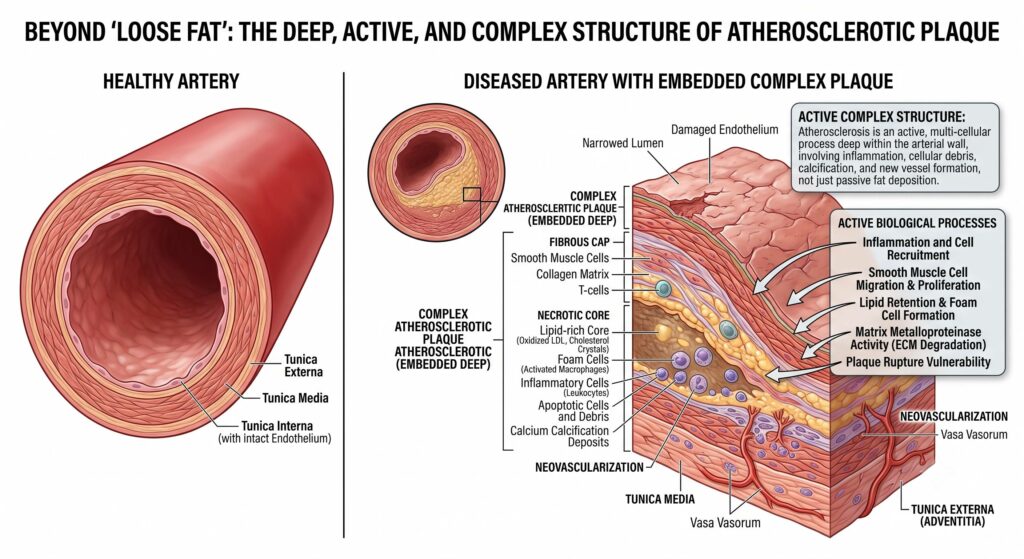
As seen in the visual, a chronic blockage consists of a core of lipids, calcium, and cellular debris trapped behind a fibrous cap. This cap is structurally stabilized by a dense mesh of a tough protein called fibrin. When a plaque becomes unstable or inflamed, the body rapidly deploys more fibrin to form microscopic local clots, further narrowing or entirely blocking blood flow.
How It Works: The Fibrinolytic Mechanism
Nattokinase targets the structural integrity of these blockages. Rather than just modulating cholesterol synthesis in the liver like traditional options, it acts as a systemic “clot-buster” through both direct and indirect pathways in the bloodstream.
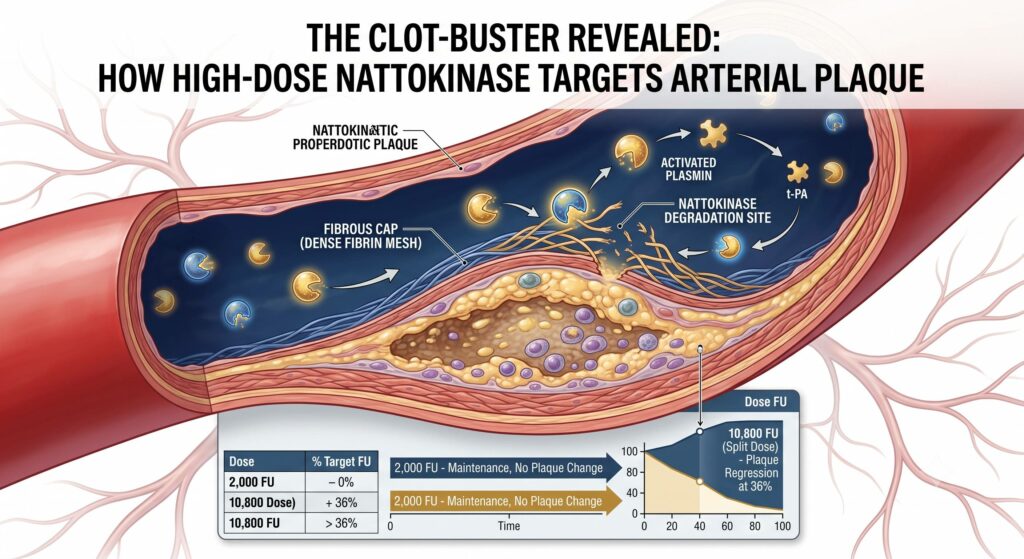
The enzyme breaks down arterial blockages through several primary mechanisms highlighted in the pathway cascade:
- Direct Fibrin Degradation: Nattokinase directly cleaves the cross-linked fibrin protein bonds that hold the structural mesh of clots and advanced plaques together, breaking them down into manageable fragments.
- Upregulating Endogenous Clot-Busting: It inactivates PAI-1 (Plasminogen Activator Inhibitor-1). Because PAI-1 normally suppresses our body’s built-in defense mechanism, blocking it allows a natural increase in active t-PA (tissue plasminogen activator).
- Plasmin Activation: It converts pro-urokinase into active urokinase and prompts the conversion of endogenous plasminogen into plasmin – the body’s master enzyme responsible for digesting fibrin strings.
- Secondary Lipid Optimization: Beyond direct fibrinolysis, nattokinase activates hormone-sensitive lipase (HSL) and mildly inhibits HMG-CoA reductase, helping to lower circulating triglycerides and LDL-C while nudging HDL upward to slow down new plaque deposition.
What the Research Says About Effective Dosages
Potency for this enzyme is measured strictly in Fibrinolytic Units (FU) rather than milligrams, as milligram weight does not accurately reflect actual enzymatic activity.
Data from major clinical trials (including a landmark trial tracking over 1,000 patients) demonstrate a clear dose-response threshold for altering plaque area:
| Daily Dosage | Primary Target / Outcome | Clinical Efficacy for Plaque Reduction |
| 2,000 FU | General cardiovascular maintenance; basic systemic support. | Ineffective for regression. Multi-year trials show this standard dose does not measurably regress established arterial plaque or reduce IMT. |
| 4,000 – 6,000 FU | Mild antithrombotic support; reduction of circulating clotting factors (fibrinogen, Factor VII/VIII) by 7% to 19%. | Moderate. Shows potential to slow progression or achieve minor regression when combined with optimized lifestyle interventions over 6 months. |
| 10,800 FU | Targeted plaque regression and hyperlipidemia management. | Highly Effective. In a 12-month trial, this specific high dose led to an average 36% reduction in carotid plaque size and a 22% reduction in arterial wall thickness (IMT). Doses below 3,600 FU in this cohort failed to show regression. |
Critical Pharmacokinetic Note: Nattokinase has an oral absorption half-life of roughly 8 hours, peaking around 2 to 4 hours post-ingestion. To maintain consistent systemic fibrinolytic activity, larger clinical doses (like 6,000 or 10,800 FU) are ideally split into two or three smaller doses taken throughout the day (e.g., morning and bedtime).
Safety & Practical Application
Because nattokinase is highly effective at reducing clotting factors and breaking down fibrin, it must be handled with a high degree of care:
- Empty Stomach Protocol: For maximum systemic enzymatic activity, it must be taken on an empty stomach (either 30 to 60 minutes before a meal or at least 2 hours after). Taking it with food causes it to act primarily as a digestive enzyme to break down dietary proteins instead of entering the bloodstream intact.
- Bleeding Risk & Contraindications: Because of its antiplatelet and fibrin-busting properties, it can drastically amplify the effects of pharmaceutical blood thinners (like aspirin, warfarin, Eliquis, or Plavix). Combining high-dose nattokinase with these medications introduces a severe risk of spontaneous bleeding or bruising and requires strict medical supervision.
- Vitamin K2 Formulations: Whole natto food is packed with Vitamin K2, which assists in blood clotting. For therapeutic plaque-clearing benefits, look for specialized Vitamin K-free or Vitamin K-stripped extracts to guarantee that the anti-clotting benefits aren’t accidentally countered by high levels of circulating Vitamin K.
Summary:
Atherosclerosis is not merely a superficial accumulation of fat, but a highly active pathology embedded deep within the arterial wall’s tunica interna. A mature plaque consists of a necrotic core filled with lipids, cellular debris, and calcium calcifications, all structurally stabilized by a dense fibrous cap made of fibrin, collagen, and smooth muscle cells. Nattokinase, a proteolytic enzyme derived from fermented soybeans, actively dismantles these blockages by directly cleaving cross-linked fibrin bonds. It further accelerates this “clot-busting” process indirectly by inhibiting PAI-1 – which elevates the body’s natural tissue plasminogen activator (t-PA) – and activating plasmin to digest the structural mesh holding the blockage together.
Achieving measurable plaque regression requires strict adherence to clinical dosing protocols, as standard maintenance doses of 2,000 FU are completely ineffective for clearing arterial blockages. High clinical doses ranging up to 10,800 FU daily are required to actively reduce carotid plaque size and arterial wall thickness, and this total should be split into multiple doses throughout the day to accommodate the enzyme’s 8-hour half-life. To ensure nattokinase enters the bloodstream intact rather than acting as a simple digestive aid, it must be taken strictly on an empty stomach. Finally, due to its potent anti-clotting mechanisms, it is critical to use Vitamin K-free formulations and avoid combining high doses with pharmaceutical blood thinners to prevent severe bleeding risks.
Leave a Reply