

The Hidden Web: How Metabolic Health Impacts Your Joints, Sleep, and Muscles
When most people hear about metabolic health or high insulin levels, they immediately think of blood sugar, weight gain, or diabetes. But the human body doesn’t operate in isolated departments. Every organ, joint, and muscle tissue is constantly listening to hormonal signals flowing through the bloodstream.
When your body produces too much insulin over long periods – a condition known as hyperinsulinemia, often driven by insulin resistance – it triggers a chain reaction across systems you might never expect.
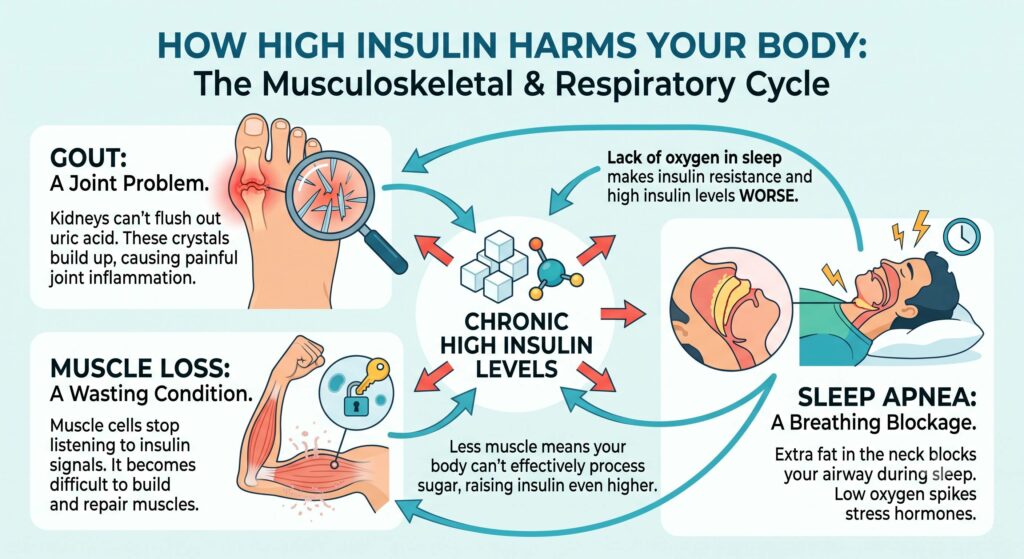
Here is a plain-English breakdown of how chronic metabolic strain directly fuels three debilitating conditions: gout, obstructive sleep apnea, and premature muscle loss (sarcopenia) – and how they lock together in a vicious cycle.
1. Gout: When Kidney Plumbing Traps Microscopic Glass
The Medical Jargon:
“Hyperinsulinemia suppresses the excretion of uric acid in the renal tubules, predisposing joints to painful urate crystal accumulation.”
What It Actually Means
Your body constantly breaks down naturally occurring compounds called purines (found in your own cells and in certain foods like red meat, seafood, and alcohol). A normal byproduct of this breakdown is uric acid. Under healthy conditions, your kidneys act like a water filtration plant: they pull uric acid out of the blood and flush it away in your urine.
When insulin levels are consistently elevated, insulin sends a biochemical signal directly to the kidney’s filtering tubes: it tells them to reabsorb uric acid rather than flush it out.
Because the kidneys are effectively ordered to close the drain, uric acid backs up in the bloodstream (a condition called hyperuricemia).
Once the blood becomes oversaturated with uric acid – much like trying to stir too much sugar into a glass of iced tea until solid crystals fall out of solution – it precipitates into microscopic, needle-sharp crystals.
Because extremities are naturally cooler and subject to gravity, these crystals settle into joints, most notoriously the base of the big toe. Your immune system spots these jagged crystals, mistakes them for a dangerous bacterial invasion, and launches a ferocious inflammatory attack. The result is a gout flare: sudden, red-hot, throbbing joint agony so severe that even a bedsheet resting on your toe can feel unbearable.
2. Obstructive Sleep Apnea: The Midnight Suffocation Loop
The Medical Jargon:
“Upper-airway tissue enlargement and visceral fat exacerbate airway collapse; the resulting nocturnal hypoxia sharply degrades cellular insulin sensitivity further.”
What It Actually Means
Obstructive Sleep Apnea (OSA) occurs when the soft tissues in your throat relax during sleep and physically block your breathing passage. While many view sleep apnea as purely a mechanical snoring issue, its relationship with metabolic health is a two-way street:
Metabolic Fat Accumulation (Neck & Airway)
↓
Airway Collapses During Sleep (Apnea)
↓
Oxygen Drops + Adrenaline Spikes (Nocturnal Hypoxia)
↓
Cells Become More Insulin Resistant
↓
Higher Insulin Levels & Further Weight Gain
The Two Halves of the Problem
- The Physical Blockage: Deep visceral fat doesn’t just deposit around your waistline; it deposits around the neck, pharynx, and base of the tongue. When you fall asleep, gravity and muscle relaxation cause these enlarged, heavier tissues to collapse inward, choking off airflow.
- The Hormonal Shockwave: When your breathing stops, your blood oxygen plunges (nocturnal hypoxia). Your brain enters emergency survival mode. It hits the panic button, dumping adrenaline and cortisol (the primary stress hormones) into your bloodstream to jolt you awake just enough to gasp for air. This can occur dozens – or even hundreds – of times a night without you fully remembering it.
Why It Makes Insulin Worse
Adrenaline and cortisol have an evolutionary job: prepare your body to fight or flee by dumping sugar into your blood and ordering your cells to ignore insulin. When your body is subjected to a constant barrage of midnight adrenaline rushes, your cells become profoundly resistant to insulin. The worse your sleep apnea, the worse your insulin resistance becomes – which in turn promotes more weight gain and makes the airway even narrower.
3. Sarcopenia: When Muscle Cells Become “Deaf” to Growth
The Medical Jargon:
“Blunted insulin signaling impairs muscle protein synthesis, accelerating the age-related decline of functional muscle mass.”
What It Actually Means
Sarcopenia is the progressive loss of muscle mass, strength, and physical function that often comes with aging. However, chronic metabolic dysfunction dramatically accelerates this process.
Think of your muscles not just as tools for lifting heavy objects, but as your body’s largest metabolic engine and primary “carb sink.” Healthy muscle tissue absorbs roughly 70% to 80% of the glucose you eat.
Every single day, your body engages in a constant tug-of-war between two processes:
- Muscle Protein Synthesis (MPS): Building and repairing new muscle fibers.
- Muscle Protein Breakdown (MPB): Disassembling damaged, worn-out muscle fibers.
Healthy State:
Adequate Protein + Active Insulin Signal ───► Muscle Protein Synthesis (Rebuilding)
Insulin Resistant State:
Adequate Protein + Blunted Insulin Signal ───► Muscle Protein Breakdown Wins (Sarcopenia)
The “Broken Antenna” Problem
Insulin isn’t just a sugar delivery hormone; it is also a vital anabolic growth signal. When insulin attaches to a muscle cell, it instructs the cell to draw in amino acids and kickstart the rebuilding process.
When you develop insulin resistance, the receptors on your muscle cells act like broken antennas. They become “deaf” to insulin’s signal (blunted insulin signaling). Even if you eat plenty of protein, your muscle cells cannot efficiently switch on the repair cycle. Muscle breakdown outpaces muscle creation, causing your functional muscle mass to waste away year after year.
As your muscle mass shrinks, your body loses its primary reservoir for soaking up blood sugar. With fewer muscle cells available to handle incoming carbohydrates, blood sugar spikes higher, forcing your pancreas to pump out even more insulin – speeding up muscle loss even further.
At a Glance: The Three Complications Compared
| Complication | The Mechanism at Play | Why It Matters for Daily Health |
| Gout & Hyperuricemia | High insulin stops kidneys from clearing uric acid, causing needle-like crystals to form in joints. | Sudden, agonizing joint pain, restricted mobility, and chronic joint damage over time. |
| Sleep Apnea (OSA) | Airway tissues collapse, cutting off oxygen and spiking stress hormones that worsen insulin resistance. | Chronic fatigue, cardiovascular strain, high blood pressure, and an intensifying metabolic spiral. |
| Sarcopenia | Muscle cells ignore insulin’s rebuild signal, causing muscle breakdown to outpace repair. | Loss of strength, slower metabolism, higher risk of falls, and diminished metabolic flexibility. |
How to Break the Cycle
Because all three conditions stem from the same root metabolic dysfunction, taking targeted steps to improve your insulin sensitivity can yield improvements across all three systems simultaneously:
- Build Muscle with Resistance Training: Lifting weights, using resistance bands, or doing bodyweight exercises forces muscle cells to absorb glucose directly – without needing insulin. This takes the workload off your pancreas and helps preserve your lean muscle.
- Lower Baseline Insulin: Prioritize whole, nutrient-dense foods, adequate protein at every meal, and fewer ultra-processed carbohydrates and liquid sugars (especially high-fructose corn syrup, which directly drives uric acid production in the liver).
- Protect Your Airway: If you snore loudly, wake up gasping, or feel exhausted despite eight hours in bed, get screened for sleep apnea. Utilizing CPAP therapy or an oral appliance immediately eliminates nighttime oxygen drops, reducing cortisol and improving insulin sensitivity within days.
- Hydrate Consistently: Drinking plenty of water helps your kidneys efficiently dilute and flush out uric acid before it can form crystals in your joints.
Targeted supplements can improve insulin sensitivity by activating cellular metabolic switches (like AMPK), enhancing insulin receptor responsiveness, or aiding intracellular glucose transport.
| Supplement | Primary Mechanism | Typical Daily Dose | Key Practical Note |
| Berberine | Activates AMPK; increases GLUT4 glucose transporters | 500 mg, 2-3x daily (with meals) | Can cause GI upset; inhibits CYP enzymes (check prescription interactions). |
| Alpha-Lipoic Acid (ALA) | Reduces oxidative stress; enhances insulin receptor signaling | 300-600 mg daily | Best taken 30 minutes before a meal; forms with R-ALA are more bioavailable. |
| Chromium Picolinate | Enhances insulin binding and tyrosine kinase activity | 200-1,000 mcg daily | Best suited for individuals with baseline micronutrient insufficiencies. |
| Ceylon Cinnamon | Mimics insulin action; slows gastric emptying | 1,000-3,000 mg daily | Use Ceylon cinnamon rather than Cassia to avoid liver-toxic coumarin. |
| Magnesium (Glycinate or Malate) | Essential cofactor for insulin receptor phosphorylation | 200-400 mg elemental Mg | Highly deficient in insulin-resistant populations; avoid oxide due to poor absorption. |
| Inositol (Myo- & D-Chiro) | Acts as a second messenger in the insulin signaling cascade | 2,000–4,000 mg (40:1 ratio) | Exceptionally effective for insulin-driven conditions like PCOS. |
| Vitamin D3 (+ K2) | Stimulates insulin receptor expression on target cells | 2,000-5,000 IU daily | Fat-soluble; take with a fat-containing meal and verify blood levels via 25(OH)D testing. |
How Each Works in the Body
Berberine
Often compared to the prescription drug metformin, this plant alkaloid works downstream of insulin. By activating AMPK (your cell’s master energy regulator), berberine prompts muscle cells to pull glucose out of the blood stream even when insulin signaling is impaired. It also alters the gut microbiome in favor of short-chain fatty acid-producing bacteria that regulate metabolism.
Chronic high blood sugar generates reactive oxygen species that damage insulin receptors. ALA is a unique antioxidant that operates in both water- and fat-based environments inside the cell. It neutralizes free radicals in cell membranes and directly stimulates the migration of GLUT4 glucose transporters to the cell surface.
Chromium (Picolinate)
Chromium is a trace mineral that works as part of “chromodulin,” an intracellular oligopeptide that binds to stimulated insulin receptors. Once bound, it amplifies the receptor’s internal kinase activity, essentially turning up the volume on a faint insulin signal.
Cinnamon contains water-soluble polyphenol polymers (like MHCP) that act as insulin mimetics, stimulating cellular glucose uptake and glycogen synthesis. It also slows down digestive enzymes in the small intestine, flattening the post-meal blood sugar curve.
Every molecule of ATP (cellular energy) must bind to a magnesium ion to be active, and the tyrosine kinase enzyme on every insulin receptor requires magnesium to function. Low intracellular magnesium directly blunts the cell’s response to insulin, creating a vicious cycle because elevated insulin causes the kidneys to excrete magnesium faster.
Inositol (Myo-Inositol + D-Chiro-Inositol)
Myo + D-Chiro Inositol are vitamin-like compounds that act as secondary messengers inside the cell. When insulin docks onto a cell receptor, inositol derivatives convey the message to process glucose and manage ovarian hormone production. A 40:1 ratio of Myo to D-Chiro reflects the body’s natural physiological balance in plasma.
Practical Considerations Before Starting
- Hypoglycemia Risk: If combined with prescription glucose-lowering drugs (metformin, sulfonylureas, GLP-1 agonists, or insulin), potent supplements like berberine and ALA can drive blood sugar lower than intended.
- Cycling Berberine: Because berberine possesses mild antimicrobial activity in the gut, many practitioners suggest an 8- to 12-week cycle followed by a 2- to 4-week break.
- Foundational Hierarchy: Supplements yield modest, single-digit percentage improvements in sensitivity. They amplify – but cannot replace – the profound metabolic clearance provided by progressive resistance training, adequate dietary protein, and restorative sleep.
Summary:
Chronic insulin resistance and persistently elevated insulin levels trigger a destructive cascade across multiple organ systems, binding seemingly unrelated conditions into a self-reinforcing cycle. When circulating insulin remains chronically high, it commands the kidneys to reabsorb uric acid rather than excrete it, saturating the bloodstream and causing needle-sharp crystals to settle painfully into joints as gout. Simultaneously, metabolic visceral fat accumulates around the upper airway, causing nocturnal tissue collapse and obstructive sleep apnea; the resulting midnight oxygen drops flood the bloodstream with adrenaline and cortisol, sharply worsening cellular insulin resistance. Compounding this strain, muscle cells become “deaf” to insulin’s anabolic growth signals, causing muscle protein breakdown to outpace repair. This accelerated muscle wasting (sarcopenia) shrinks the body’s primary reservoir for disposing of dietary glucose, driving insulin levels higher and intensifying the metabolic spiral.
Breaking this interconnected loop requires restoring cellular insulin sensitivity through foundational lifestyle habits reinforced by targeted biochemical support. While progressive resistance training serves as the primary defense by forcing muscle cells to absorb glucose without needing insulin, specific nutraceuticals can amplify cellular responsiveness. Compounds like berberine activate the metabolic master switch AMPK to bypass sluggish insulin pathways, alpha-lipoic acid reduces oxidative stress to facilitate glucose transporter migration, and essential cofactors such as magnesium, chromium, inositol, and Ceylon cinnamon restore proper intracellular signaling. When combined with restorative sleep and whole-food nutrition, these interventions lower baseline insulin, enabling the kidneys to flush uric acid effectively, easing airway inflammation, and preserving functional muscle mass.
Leave a Reply