

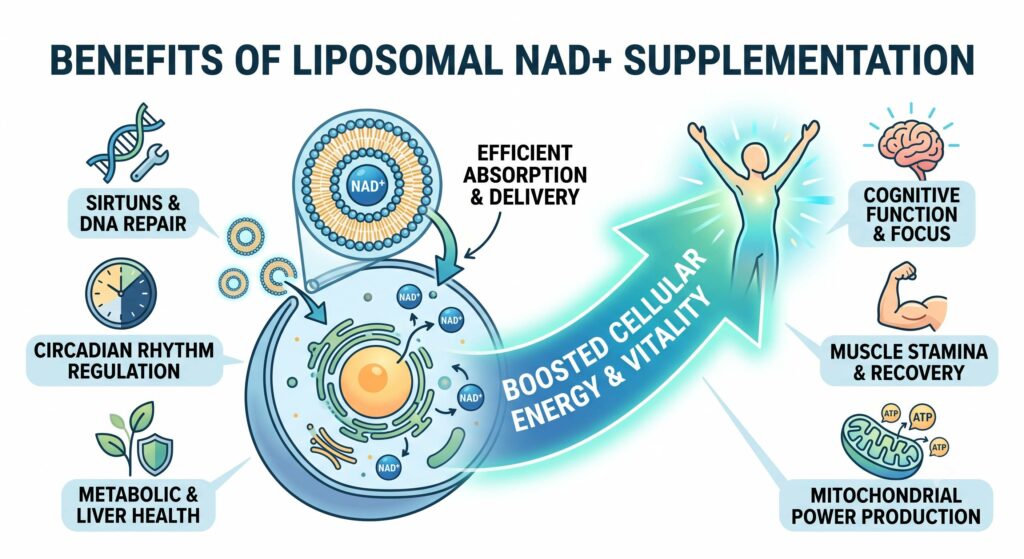
Yes, Liposomal NAD+ directly supports cellular energy levels by restoring the core coenzyme required for mitochondrial ATP production.
NAD+ (Nicotinamide Adenine Dinucleotide) acts as an essential electron carrier in glycolysis, the Krebs cycle, and the mitochondrial electron transport chain. Without adequate NAD+, cells cannot efficiently convert nutrients (carbohydrates and fats) into ATP, leading to cellular fatigue.
Because systemic NAD+ levels naturally decline by up to 50% between youth and middle age, supplementing helps optimize mitochondrial output. The liposomal delivery method encapsulates the NAD+ molecule inside protective phospholipid spheres, preventing it from being broken down in the digestive tract and significantly improving cellular absorption across cell membranes compared to standard oral NAD+.
Key Benefits of NAD+ Beyond Energy Production
In addition to driving mitochondrial power generation, NAD+ serves as a critical substrate for enzymes that regulate cellular repair, longevity, and metabolic homeostasis:
1. Sirtuin Activation & DNA Repair
NAD+ is the obligate fuel for Sirtuins (SIRT1–SIRT7) – a family of enzymes that regulate epigenetic expression, DNA repair, inflammation, and cellular stress resistance. It also powers PARP enzymes (like PARP-1), which detect and repair single-strand DNA breaks caused by oxidative stress and environmental toxins.
2. Skeletal Muscle & Exercise Recovery
- Mitochondrial Biogenesis: Activates PGC-1-alpha via SIRT1, stimulating the creation of new mitochondria in muscle tissue.
- Mitophagy: Facilitates the cleanup and clearance of damaged, dysfunctional mitochondria, improving muscle stamina, contractile efficiency, and post-exertion recovery.
3. Cognitive Health & Neuroprotection
Neurons are high-energy consumers heavily dependent on steady ATP supply. NAD+ protects brain tissue by maintaining mitochondrial density in nerve cells, suppressing neuroinflammation, and supporting synaptic plasticity necessary for memory and processing speed.
4. Metabolic & Insulin Sensitivity Optimization
NAD+ regulates lipid metabolism and glucose tolerance. Higher intracellular NAD+ levels promote fatty acid oxidation (fat breakdown) in the liver and improve insulin signaling pathways in peripheral skeletal muscle tissue.
5. Cardiovascular & Endothelial Function
SIRT1 activation driven by NAD+ promotes the expression of endothelial nitric oxide synthase (eNOS), which helps blood vessels dilate, maintains arterial flexibility, and supports healthy vascular blood flow.
Beyond ATP generation and primary sirtuin activation, NAD+ acts as a systemic master regulator involved in several additional physiological processes:
6. Circadian Rhythm Synchronization
NAD+ drives the body’s internal clock through a reciprocal feedback loop. SIRT1 deacetylates key circadian proteins – specifically BMAL1 and PER2 – in the suprachiasmatic nucleus of the brain and in peripheral organs.
Because intracellular NAD+ concentrations naturally peak and trough on a 24-hour cycle, maintaining healthy NAD+ pools keeps metabolic gene expression synchronized with the day/night cycle, supporting natural sleep architecture, body temperature regulation, and nocturnal growth hormone release.
7. Mitigation of Cellular Senescence (SASP)
When cells undergo severe stress or reach their replicative limit, they can enter senescence – a “zombie” state where they stop dividing but remain metabolically active. Senescent cells secrete a toxic mix of pro-inflammatory cytokines, chemokines, and matrix-degrading enzymes known as the Senescence-Associated Secretory Phenotype (SASP).
Sustained intracellular NAD+ keeps SIRT1 and SIRT6 bound to chromatin, where they suppress NF-kB signaling. This inhibits the transcription of SASP genes, curbing localized tissue inflammation and slowing the spread of senescence to neighboring healthy cells.
8. Immune System Balance & Immunosenescence
Innate and adaptive immune cells require substantial energy during an immune response. However, chronic inflammation causes immune cells to overexpress CD38, a cell-surface enzyme that rapidly consumes and degrades NAD+.
- Macrophage Polarization: Adequate NAD+ supports the transition of macrophages from the hyper-inflammatory M1 state to the anti-inflammatory, tissue-repairing M2 state.
- T-Cell Fitness: Prevents premature T-cell exhaustion and preserves naive T-cell pools, helping counter age-related immune decline (immunosenescence).
9. Adult Stem Cell Renewal
Stem cell populations across various tissues – including satellite cells in skeletal muscle, neural stem cells in the hippocampus, and hematopoietic stem cells in bone marrow – depend on functional mitochondria to maintain quiescence and self-renewal.
When NAD+ drops, stem cells undergo mitochondrial dysfunction and lose their capacity to divide and repair damaged tissue. Restoring the NAD+/NADH ratio reawakens dormant stem cells, facilitating faster tissue repair following physical stress or micro-trauma.
10. Hepatic Health & Lipid Cleansing
The liver maintains one of the highest metabolic demands in the body and relies heavily on a high NAD+/NADH ratio to drive fatty acid oxidation and metabolic clearance:
- Fat Accumulation: NAD+ deficiency impairs mitochondrial beta-oxidation, causing fatty acids to back up into liver cells (hepatic steatosis). Elevated NAD+ activates SIRT1 and AMPK, promoting lipid breakdown.
- Detoxification: Essential enzymes like alcohol dehydrogenase (ADH) and aldehyde dehydrogenase (ALDH), as well as Phase I cytochrome P450 pathways, require NAD+ as an obligate cofactor to neutralize endogenously produced aldehydes and external toxins.
11. Dermal Integrity & Photoprotection
Ultraviolet (UV) radiation creates single-strand DNA breaks in dermal keratinocytes and fibroblasts. Repairing this radiation damage forces PARP-1 into hyperdrive, rapidly depleting cutaneous NAD+ stores.
Replenishing NAD+ levels in skin tissue:
- Preserves cellular energy required for structural repair.
- Maintains the integrity of collagen and elastin fibers in the extracellular matrix.
- Enhances the survival and barrier function of UV-exposed skin cells.
12. Joint & Cartilage Matrix Preservation
In articular cartilage, chondrocytes rely on SIRT1 to suppress catabolic enzymes like matrix metalloproteinases (MMP-1, MMP-13) and ADAMTS, which actively break down the type II collagen and proteoglycan matrix of joints. Adequate NAD+ helps maintain this enzymatic suppression, protecting joint cushion density and cartilage resilience over time.
Summary:
Nicotinamide Adenine Dinucleotide (NAD+) is an essential coenzyme required for cellular energy production, serving as a primary driver of mitochondrial ATP synthesis during carbohydrate and fat metabolism. Because systemic NAD+ levels decline significantly with age, supplementation using liposomal delivery – which encapsulates the molecule in protective phospholipid spheres to bypass digestive degradation – significantly improves cellular absorption and restores mitochondrial capacity. Beyond fueling physical energy, NAD+ functions as an indispensable substrate for Sirtuins (SIRT1–SIRT7) and PARP repair enzymes. These pathways coordinate single-strand DNA repair, synchronize central and peripheral circadian clocks, reawaken dormant stem cell populations, and inhibit the NF-kB signaling pathways that drive chronic, systemic inflammation.
Across broader organ systems, maintaining healthy intracellular NAD+ pools protects tissues against functional decay and oxidative stress. In skeletal muscle and nerve tissue, NAD+ promotes mitochondrial biogenesis and mitophagy (the targeted clearance of damaged mitochondria), boosting exercise recovery, contractile efficiency, and cognitive processing. Within the cardiovascular and hepatic systems, it enhances endothelial nitric oxide production for vascular flexibility while accelerating liver fatty acid oxidation and metabolic detoxification pathways. Additionally, maintaining optimal NAD+ balances suppresses the toxic secretory signals of senescent “zombie” cells, aids immune cell transition from inflammatory to tissue-repair states, and shields structural collagen and cartilage matrix proteins from enzymatic breakdown.
Leave a Reply