

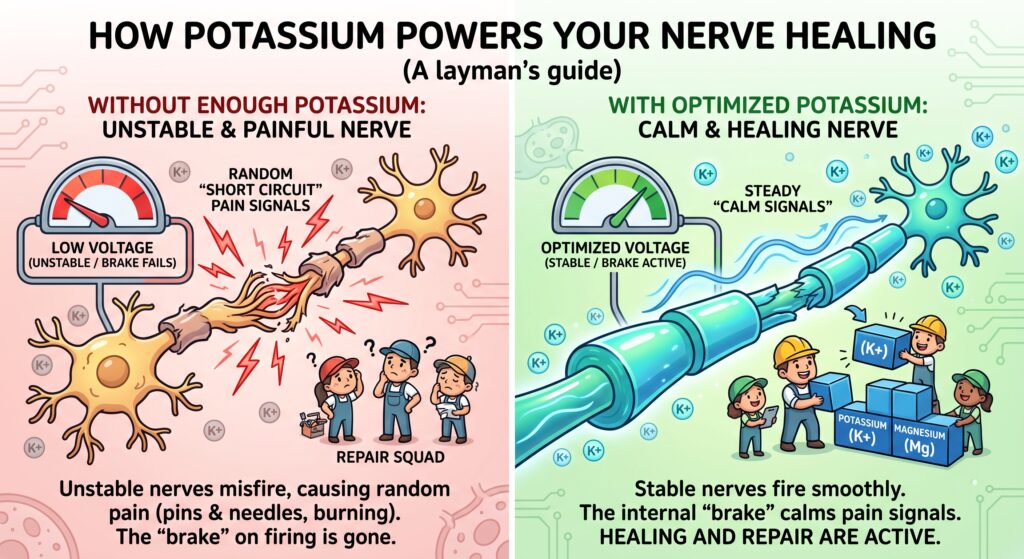
Does Low Potassium Slow Nerve Regrowth and Health?
Low potassium (hypokalemia) does not directly halt the physical regrowth of severed axons, but it creates an unfavorable cellular environment that impairs functional recovery, delays healing, and worsens nerve pain.
1. How Low Potassium Affects Nerve Healing and Regeneration
For a damaged peripheral nerve to regenerate, its growth cone must synthesize proteins, generate ATP, and maintain a stable ionic gradient:
- Disrupted Ionic Microenvironment: Neuronal recovery depends heavily on maintaining precise intra- and extracellular ion concentrations. Severe ionic imbalance impairs cell membrane stability and increases metabolic stress on regenerating tissue.
- Exhaustion of the Sodium-Potassium Pump: Repairing an axon requires tremendous cellular energy. If intracellular potassium is depleted, the Na+/K+-ATPase pump struggles to maintain the resting membrane potential, leading to cellular exhaustion and delayed recovery.
- Impaired Schwann Cell Function: Supporting glial cells (Schwann cells) rely on potassium buffering to facilitate remyelination (rebuilding the protective sheath around nerves).
2. Can Low Potassium Cause or Worsen Nerve Pain?
Potassium channels (Kv) act as the body’s physiological “brakes” on nerve firing.
- Ectopic (Spontaneous) Firing: When extracellular potassium drops, the resting membrane potential becomes unstable. Without the regular stabilizing outward flow of potassium ions, damaged or irritated nerve fibers fire spontaneous electrical impulses without an external trigger.
- Symptoms of Low Potassium in Nerves: This hyperexcitability directly triggers neuropathic symptoms, including paresthesia (tingling, pins-and-needles), burning sensations, numbness, and severe muscle cramping.
- Pain Amplification: In pre-existing conditions (e.g., sciatica, diabetic neuropathy, or post-surgical nerve damage), low potassium lowers the threshold for pain signaling, making mild nerve irritation feel intense and persistent.
3. Does Increasing Potassium Relieve Nerve Pain?
- If Pain Is Caused or Exacerbated by Deficiency: Restoring healthy serum and tissue potassium levels stabilizes the nerve membrane, stops spontaneous ectopic discharges, and eliminates deficiency-related tingling and spasms.
- For Structural/Mechanical Damage: Potassium is not a standalone analgesic (painkiller) and will not instantly cure a physically compressed or severed nerve. However, maintaining optimal potassium -alongside magnesium (which regulates potassium transport) and B-vitamins (which support myelin synthesis) – provides the baseline electrical stability needed for rehabilitation.
While low potassium (hypokalemia) does not outright halt the physical regrowth of damaged nerve fibers, it significantly undermines the metabolic environment required for structural healing. Axonal regeneration is an energy-intensive process that depends on a stable resting membrane potential to drive protein synthesis and cellular repair. When potassium is depleted, the sodium-potassium pump (Na+/K+-ATPase) is strained, increasing metabolic stress and impairing the supportive function of Schwann cells, which are responsible for remyelinating and insulating recovering nerves.
From a pain perspective, potassium channels serve as the physiological “brakes” on electrical signaling, so a deficit causes nerve membranes to become unstable and hyperexcitable. This instability triggers spontaneous ectopic firing, manifesting as paresthesias, burning sensations, numbness, and heightened pain sensitivity in previously damaged or compressed pathways. Restoring normal potassium levels eliminates these abnormal electrical discharges and calms hyperactive firing, though it acts as a cellular stabilizer rather than a direct analgesic. For meaningful nerve recovery, potassium must be paired with synergistic cofactors – particularly magnesium to manage ion channels and B-vitamins to fuel myelin synthesis – to re-establish both electrical stability and tissue repair.
Recharge Your Nervous System at the Source
Don’t let your cellular batteries run on empty. Sustained, bioavailable potassium provides the continuous electrical charge your nerves need to stop misfiring, quiet spontaneous pain signals, and accelerate repair.
Upgrade your daily wellness routine with high-absorption potassium citrate to lock in stable -70 mV cellular voltage, protect your nerve pathways, and keep your nervous system firing with razor-sharp precision all day long.
Leave a Reply