

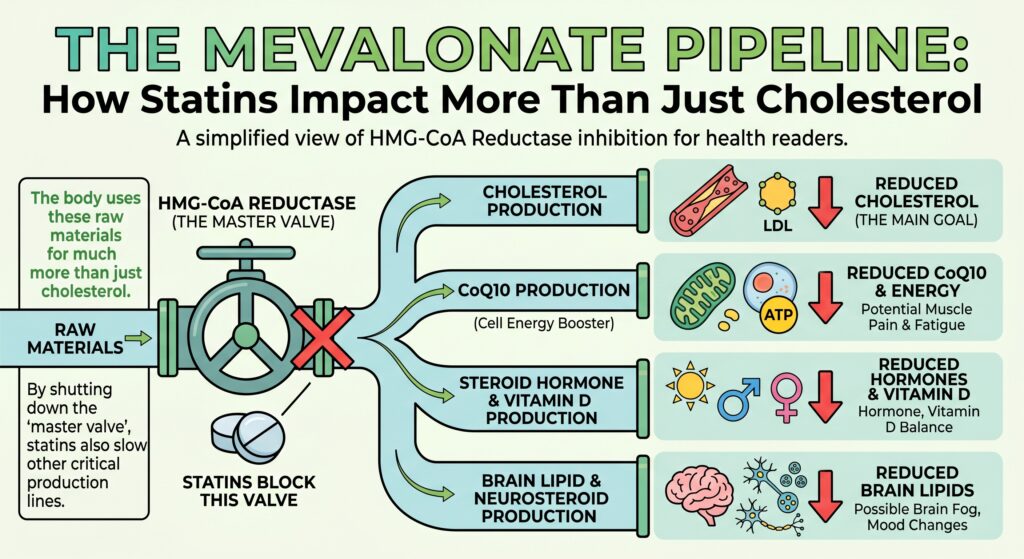
 Inhibiting HMG-CoA reductase acts like shutting off a master water valve at the very top of a branched pipeline known as the mevalonate pathway. Because this pathway produces foundational building blocks called isoprenoids rather than just cholesterol, blocking it at the top reduces the production of several critical downstream molecules throughout the body.
Key Downstream Bottlenecks
- Coenzyme Q10 (Ubiquinone) & Cellular Energy
- The Pathway: Downstream of mevalonate, the body produces farnesyl pyrophosphate (FPP) and geranylgeranyl pyrophosphate (GGPP). These molecules supply the lipid “tail” required to synthesize CoQ10.
- The Issue: CoQ10 transfers electrons within the mitochondria to generate ATP (cellular energy) and acts as a potent antioxidant inside cell membranes. Depleting CoQ10 starves high-energy tissues – particularly skeletal muscle and cardiac tissue – of optimal ATP, which is a leading contributor to statin-associated muscle symptoms (SAMS) such as soreness, weakness, and cramping.
- Steroid Hormones, Vitamin D, and Bile Acids
- The Pathway: Cholesterol itself serves as the starting raw material for all steroid hormones, bile acids, and Vitamin D.
- The Issue:
- Hormones: The adrenal glands and gonads convert cholesterol into pregnenolone, which cascades into testosterone, estrogen, progesterone, cortisol, and aldosterone. Severe cholesterol suppression can challenge steroidogenesis under high metabolic demand.
- Bile Acids: The liver converts cholesterol into bile salts needed to emulsify and absorb dietary fats and fat-soluble vitamins (A, D, E, K).
- Vitamin D: 7-Dehydrocholesterol in the skin requires this pathway; sunlight converts it into active Vitamin D3.
- Dolichol & Protein Glycosylation
- The Pathway: FPP also branches into dolichol, a specialized lipid carrier.
- The Issue: Dolichol is required for N-linked glycosylation – the process of attaching carbohydrate chains to newly synthesized proteins in the endoplasmic reticulum. Without adequate dolichol, cell receptors, enzymes, and structural proteins cannot fold or anchor correctly, impairing cell-to-cell communication and cellular repair.
- Protein Prenylation (Cellular Signaling & Muscle Integrity)
- The Pathway: FPP and GGPP attach lipid tails to intracellular signaling proteins (such as Rho, Ras, and Rac) in a process called prenylation, allowing them to anchor to cell membranes.
- The Issue: While inhibiting prenylation helps reduce vascular inflammation and stabilize arterial plaques (one of the primary cardiovascular benefits of statins), it also disrupts normal intracellular transport and repair pathways in muscle tissue, further increasing susceptibility to muscle breakdown and rhabdomyolysis in rare cases.
- Selenoprotein Synthesis (Antioxidant Defense)
- The Pathway: Isopentenyl pyrophosphate (IPP), an intermediate right below mevalonate, is required for the chemical maturation of selenocysteine tRNA (Sec-tRNA).
- The Issue: Sec-tRNA allows the body to build selenoproteins, including glutathione peroxidase (a primary cellular antioxidant enzyme) and thioredoxin reductase. Lower levels can lead to increased oxidative stress inside muscle cells.
- Glucose Regulation & Insulin Sensitivity
- The Pathway: Suppressing cellular isoprenoids and cholesterol content alters cell membrane fluidity and signaling cascades in pancreatic beta-cells and skeletal muscle.
- The Issue: This can impair the translocation of GLUT4 glucose transporters to cell surfaces and reduce insulin secretion, leading to mild increases in blood glucose or HbA1c in susceptible individuals.
What Else Does Your Body Stop Making When Cholesterol Synthesis Is Blocked?
Beyond energy production and steroid synthesis, inhibiting HMG-CoA reductase impacts several other specialized pathways, ranging from vascular mineral balance to brain lipids and muscle calcium regulation.
Additional Downstream Pathways & Effects
- Vitamin K2 (MK-4) Synthesis & Vascular Calcification
- The Pathway: The body converts dietary Vitamin K1 into Vitamin K2 (menaquinone-4 or MK-4) inside extrahepatic tissues using an enzyme called UBIAD1. This enzyme requires geranylgeranyl pyrophosphate (GGPP) as a donor molecule to attach a side chain.
- The Issue: Depleting GGPP reduces local MK-4 synthesis. MK-4 is required to carboxylate (activate) Matrix Gla Protein (MGP), the primary molecular brake preventing calcium from depositing in arterial walls. When inactive, calcium can bind more freely to vascular smooth muscle, contributing to increased coronary artery calcium (CAC) density over time.
- Local Brain Cholesterol & Neurosteroids
- The Pathway: Circulating cholesterol cannot cross the blood-brain barrier. As a result, the central nervous system must synthesize 100% of its own cholesterol locally within astrocytes and glial cells via the mevalonate pathway.
- The Issue: Lipophilic statins (such as simvastatin and atorvastatin) cross the blood-brain barrier and can slow astrocyte cholesterol synthesis. Brain cholesterol is required for:
- Myelin sheath integrity: Insulating nerve axons for rapid electrical transmission.
- Synaptic vesicles: Packaging and releasing neurotransmitters like serotonin and dopamine.
- Neurosteroids: Synthesizing local calming neurosteroids such as allopregnanolone, which modulate GABA receptors. This pathway is frequently studied in relation to reversible brain fog and mood alterations.
- Mitochondrial Complex IV & Heme A Synthesis
- The Pathway: While CoQ10 handles electron transfer at complexes I, II, and III, the final step of the electron transport chain (Complex IV / Cytochrome c oxidase) relies on a specialized cofactor called Heme A.
- The Issue: Converting Heme O to Heme A requires farnesyl pyrophosphate (FPP). Statin-induced FPP reduction can directly impair Complex IV activity, creating a secondary bottleneck in cellular oxygen consumption alongside CoQ10 depletion.
- Sarcoplasmic Reticulum Calcium Leakage
- The Pathway: Muscle contraction depends on strictly managed calcium gradients within the sarcoplasmic reticulum.
- The Issue: Statins can directly destabilize ryanodine receptors (RyR1) – the calcium release channels on muscle cells – causing a low-level continuous leak of calcium ions into the intracellular space. Combined with reduced ATP from CoQ10/Heme A bottlenecks, muscle cells struggle to pump calcium back into storage. This persistent intracellular calcium activates calpains (calcium-activated proteases) that break down structural muscle fibers, contributing to exercise intolerance and soreness.
- Membrane Fluidity & Lipid Rafts
- The Pathway: Cholesterol integrates directly into the phospholipid bilayer, stabilizing rigid signaling hubs known as lipid rafts (or caveolae).
- The Issue: Reducing free cholesterol content alters the mechanical stiffness and fluidity of the plasma membrane. This destabilizes embedded ion channels, insulin signaling platforms, and membrane-bound transport enzymes (such as the (sodium-potassium) Na+K+-ATPase pump), making the outer membrane more fragile during heavy mechanical strain.
Summary:
Inhibiting HMG-CoA reductase acts like shutting off a main valve at the top of the mevalonate pathway – a master biochemical pipeline that manufactures far more than just cholesterol. When this enzyme is blocked, the body experiences a shortage of foundational intermediate molecules, particularly farnesyl pyrophosphate (FPP) and geranylgeranyl pyrophosphate (GGPP). Without these building blocks, cells cannot properly synthesize Coenzyme Q10 or Heme A, both of which are required by mitochondria to generate ATP (cellular energy). This energy bottleneck, combined with microscopic calcium leaks in muscle cells (destabilized ryanodine receptors) and impaired protein repair pathways (dolichol and prenylation), is the primary driver behind statin-induced muscle soreness, weakness, and exercise intolerance.
Further downstream, suppressing cholesterol and its branching pathways creates ripple effects across hormonal, vascular, and neurological health. Because cholesterol is the starting raw material for all steroid hormones (such as testosterone, estrogen, and cortisol), bile acids for digestion, and Vitamin D, lowering its synthesis can challenge hormone production and nutrient absorption. Additionally, the shortage of GGPP halts the local production of Vitamin K2 (MK-4), an essential cofactor needed to activate the protein “brakes” (Matrix Gla Protein) that prevent calcium from calcifying arterial walls. Finally, because the brain must manufacture all of its own cholesterol locally to insulate nerves with myelin and package neurotransmitters, statins that cross the blood-brain barrier can slow central nervous system lipid synthesis, contributing to issues like brain fog or mood changes.
Should You Be Taking A Statin?
Leave a Reply