

Can Aspirin Cause Blurry Vision? Causes, Red Flags, and When to Seek Emergency Care
Medically Reviewed by: Clinical Pharmacology & Ophthalmology Editorial Board
Last Updated: October 2026
Reading Time: 5 minutes
Key Takeaway: While blurry vision is not a common side effect of standard, short-term aspirin use, aspirin can cause vision loss and blurring through microvascular retinal bleeding, tear-film instability, systemic salicylate toxicity, or the aggravation of wet macular degeneration. Sudden visual changes while taking aspirin require immediate medical triage to rule out intraocular hemorrhage or retinal detachment.
The Biological Link: How Aspirin Affects Your Eyes
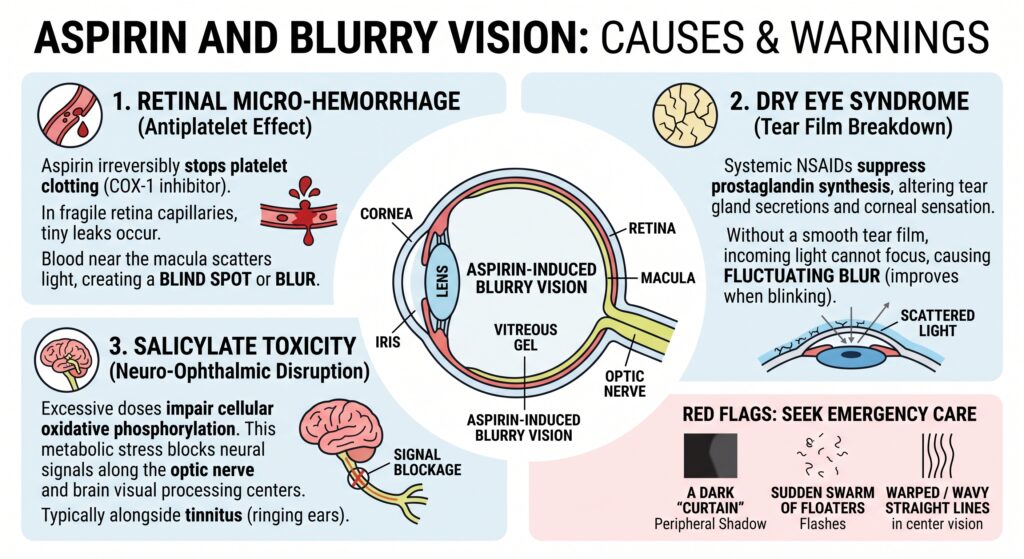
Aspirin (acetylsalicylic acid) is among the most widely used nonsteroidal anti-inflammatory drugs (NSAIDs) and antiplatelet agents in the world. While its primary functions are pain reduction and cardiovascular protection, its systemic biochemical actions can impact ocular structures in four distinct ways:
1. Retinal Microvascular Hemorrhage (Antiplatelet Action)
Aspirin works by permanently inactivating the cyclooxygenase-1 (COX-1) enzyme inside platelets. This stops platelets from synthesizing thromboxane $A_2$, the chemical messenger responsible for platelet aggregation and blood clot formation.
The retina contains some of the thinnest, most fragile capillaries in the human body. In individuals with preexisting microvascular stress—such as those with diabetic retinopathy, uncontrolled hypertension, or retinal vein occlusions—aspirin impairs normal micro-clotting. Even microscopic breaches in these vessels can lead to blood leaking into the retina or vitreous cavity. When blood enters the central macula (the retina’s high-resolution center), light cannot focus onto photoreceptor cells, creating sudden blurriness or dark visual patches.
2. Salicylate Toxicity (Salicylism)
When aspirin is ingested in excessive amounts—or accumulates due to impaired kidney function or high chronic doses—it causes a systemic metabolic disturbance known as salicylism.
Salicylic acid crosses the blood-brain barrier and disrupts cellular oxidative phosphorylation (energy production) in neural tissue. This metabolic interruption impacts both the optic nerve and the visual cortex in the brain. Patients suffering from salicylate toxicity frequently experience:
-
Blurry vision or generalized dimming of sight
-
Bilateral, high-pitched ringing in the ears (tinnitus)
-
Rapid, deep breathing (tachypnea)
-
Nausea, vomiting, and confusion
3. Tear Film Disruption and Dry Eye Syndrome
Clear vision depends directly on a smooth, uniform tear film coating the cornea. Prostaglandins play an active role in maintaining ocular surface health and lacrimal gland function. Systemic inhibition of prostaglandin synthesis by NSAIDs like aspirin can alter tear composition and decrease basal tear volume.
Without an adequate tear film, the cornea develops microscopic irregularities that scatter incoming light. This produces a fluctuating visual haze that often worsens during prolonged screen use or reading and briefly clears after blinking.
4. Progression of Neovascular (“Wet”) Macular Degeneration
Large-scale clinical studies have identified an association between long-term daily aspirin use (typically five or more consecutive years) and an increased risk of complications from neovascular age-related macular degeneration (nAMD).
In wet AMD, fragile, abnormal blood vessels grow underneath the retina from the choroid layer. Because aspirin reduces platelet plugging, these abnormal vessels are substantially more prone to leaking serous fluid, lipids, and blood beneath the macula. This leakage distorts straight lines and rapidly obscures central reading vision.
Symptom Triage: Common Side Effects vs. Ophthalmic Emergencies
Differentiating between minor surface irritation and a vision-threatening event is critical for preventing irreversible sight loss.
| Symptom Presentation | Likely Mechanism | Urgency Level | Recommended Action |
| Fluctuating haze that clears temporarily with blinking | Ocular surface dryness / tear film evaporation | Non-Emergency | Use preservative-free lubricating drops; consult optometrist if persistent. |
| Dark curtain or veil falling over side or top of vision | Retinal detachment or dense vitreous hemorrhage | Medical Emergency | Immediate emergency room or eye trauma clinic evaluation. |
| Sudden swarm of floaters or flashes of light | Vitreous hemorrhage / retinal tear | Medical Emergency | Same-day evaluation by a retina specialist or ophthalmologist. |
| Warped, wavy, or broken lines in central vision | Subretinal hemorrhage / active wet AMD leakage | Urgent (24–48 hrs) | Dilated retinal exam and Optical Coherence Tomography (OCT). |
| Vision changes with ringing ears and rapid breathing | Systemic salicylate toxicity | Life-Threatening Emergency | Call emergency medical services (911) or proceed to the nearest ER. |
| Visible blood pooling in the colored part of the eye | Anterior chamber bleed (hyphema) | Medical Emergency | Immediate evaluation to manage intraocular pressure spikes. |
6 Red-Flag Symptoms Requiring Immediate Medical Attention
If you take aspirin – either low-dose (81 mg) or high-dose – seek immediate care from an ophthalmologist or hospital emergency department if you develop any of the following:
-
A Dark “Curtain” or Peripheral Shadow: A gray, dark, or translucent shadow spreading across your visual field indicates that fluid or blood is pulling the retina away from the back of the eye, or that a dense pool of blood has formed inside the vitreous body.
-
A Sudden “Shower” of Spots or Flashes: While a single drifting floater is common with aging, dozens of sudden dark specks or cobwebs – especially accompanied by camera-flash sensations – signal red blood cells actively spilling into the vitreous fluid from a broken retinal vessel.
-
Distorted Straight Lines (Metamorphopsia): If door frames, bathroom tiles, or lines of text look bent, wavy, or missing chunks, fluid or blood has accumulated directly beneath the macula.
-
Sudden, Painless Drop in Vision in One Eye: A dramatic loss of visual clarity over seconds to hours often reflects an acute retinal vascular event or significant submacular bleeding.
-
Visible Blood in the Front of the Eye (Hyphema): A layer of red blood collecting between the cornea and the colored iris is an ophthalmic emergency. This differs from a subconjunctival hemorrhage (a harmless red patch on the white sclera) and can cause dangerous spikes in intraocular pressure.
-
Blurriness Paired with Ringing Ears and Vertigo: This constellation of symptoms indicates systemic toxicity rather than an isolated eye condition and requires prompt blood testing and medical stabilization.
What Patients Should Do
-
Do Not Stop Prescribed Aspirin Abruptly: If your doctor prescribed daily aspirin following a heart attack, coronary stent placement, or ischemic stroke, do not stop taking it on your own. Abruptly discontinuing antiplatelet therapy can cause a rebound hypercoagulable state, significantly increasing your risk of a blood clot, heart attack, or stroke.
-
Get an Urgent Dilated Fundus Examination: General urgent care centers often lack the specialized equipment (such as slit-lamp biomicroscopes, indirect ophthalmoscopes, and optical coherence tomography scanners) needed to visualize the peripheral retina. Contact an on-call ophthalmologist, a dedicated retina clinic, or go to a comprehensive emergency department.
-
Disclose All Blood-Thinning Agents: Inform your evaluating physician of your exact daily aspirin dosage and whether you concurrently use prescription blood thinners (e.g., apixaban, clopidogrel, warfarin), other NSAIDs (e.g., ibuprofen, naproxen), or supplements with mild antiplatelet effects (such as high-dose omega-3s, ginkgo biloba, or vitamin E).
Frequently Asked Questions
Can baby aspirin (81 mg) cause blurry vision?
Yes, though it is uncommon. Even low-dose (81 mg) aspirin permanently blocks platelet COX-1 activity throughout the 7-to-10-day lifespan of exposed platelets. In people with fragile retinal blood vessels – such as those with proliferative diabetic retinopathy or wet AMD – an 81 mg dose is sufficient to increase the likelihood and severity of microvascular bleeding.
Is aspirin-induced blurry vision permanent?
It depends on the cause:
-
Temporary: Vision changes caused by dry eye syndrome or acute, mild salicylate toxicity typically resolve once the ocular surface is rehydrated or salicylate levels return to normal.
-
Potentially Permanent: Blurring caused by subretinal bleeding, dense vitreous hemorrhage, or macular detachment can lead to permanent photoreceptor scarring and central blind spots if not diagnosed and treated promptly.
What is the difference between a subconjunctival hemorrhage and an intraocular bleed?
A subconjunctival hemorrhage occurs when a broken vessel bleeds beneath the clear conjunctive tissue on the white of the eye (sclera). While it looks alarming, it does not enter the eye’s optical path, causes no pain, and does not alter vision. An intraocular bleed (such as a hyphema or vitreous hemorrhage) occurs inside the eye, directly interfering with light transmission and threatening eyesight.
Disclaimer: This article is intended for educational purposes only and does not constitute formal medical diagnosis or treatment advice. If you are experiencing sudden vision changes, pain, or severe systemic symptoms, contact emergency medical services or consult an eye care specialist immediately.
Leave a Reply