

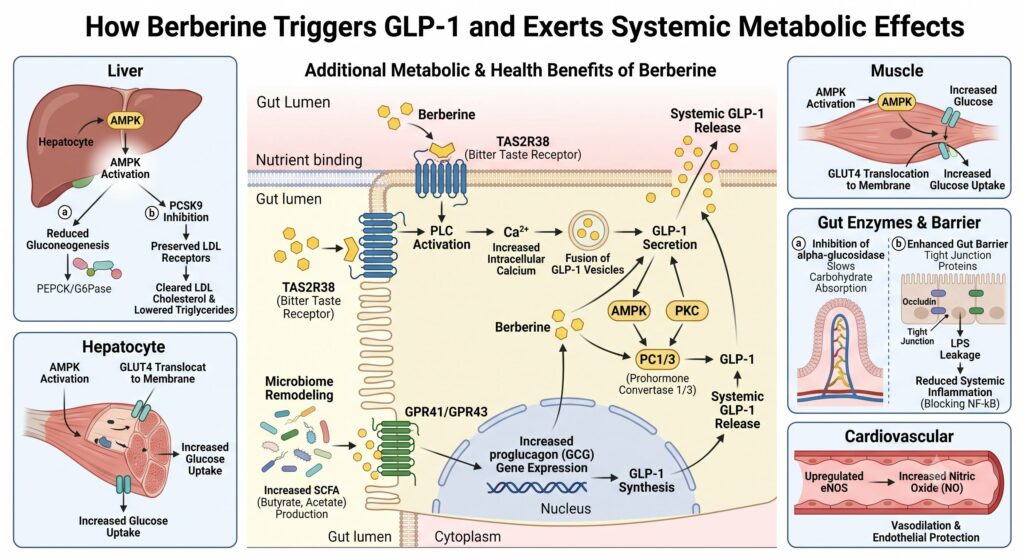
Berberine stimulates gut GLP-1 (glucagon-like peptide-1) release through three primary mechanisms: bitter taste receptor activation, gut microbiome modulation, and intracellular energy-sensing pathways.
How Berberine Stimulates GLP-1 Release
- Activation of Intestinal Bitter Taste Receptors (TAS2Rs): Berberine is an isoquinoline alkaloid with an intensely bitter profile. On entering the small and large intestines, it binds directly to bitter taste receptors – specifically TAS2R38 – expressed on the surface of enteroendocrine L-cells. This binding triggers a Phospholipase C (PLC) signaling cascade, releasing stored calcium (Ca2+) inside the cell and triggering the exocytosis of GLP-1 storage vesicles into the bloodstream.
- Microbiome Remodeling & Short-Chain Fatty Acid (SCFA) Production: Because berberine has low oral bioavailability, over 90-95% of an ingested dose remains inside the gut lumen. There, it acts as a selective antimicrobial, shifting the microbiome to favor short-chain fatty acid–producing species (such as Faecalibacterium and Roseburia). The resulting increase in butyrate and acetate binds to G-protein-coupled receptors (GPR43 and GPR41) on L-cells, upregulating the proglucagon (GCG) gene and increasing sustained GLP-1 production.
- Intracellular AMPK & PC1/3 Activation: Inside L-cells, berberine activates 5′-AMP-activated protein kinase (AMPK) and Protein Kinase C (PKC). This increases the activity of prohormone convertase 1/3 (PC1/3) – the enzyme responsible for converting proglucagon into active GLP-1 – ensuring higher rates of hormone synthesis alongside secretion.
Additional Metabolic & Health Benefits
Beyond its effect on intestinal GLP-1, berberine acts on multiple organ systems through systemic signaling:
- Systemic AMPK Activation (“Metabolic Master Switch”): Activates AMPK in liver, skeletal muscle, and fat tissue. This promotes GLUT4 receptor translocation to cell membranes, driving insulin-independent glucose uptake into muscle tissue.
- Lipid Management via PCSK9 Inhibition: Suppresses PCSK9 expression in the liver, preserving hepatic LDL receptors. This increases clearance of circulating LDL cholesterol, total cholesterol, and triglycerides from the blood.
- Inhibition of Carbohydrate Absorption: Inhibits intestinal alpha-glucosidase enzymes, slowing down carbohydrate breakdown and blunting postprandial blood sugar spikes.
- Suppression of Hepatic Gluconeogenesis: Downregulates rate-limiting liver enzymes (like PEPCK and G6Pase), restricting the liver’s overproduction of glucose during fasting states.
- Cardiovascular & Endothelial Support: Upregulates endothelial nitric oxide synthase (eNOS), increasing nitric oxide (NO) availability to promote vasodilation and protect arterial walls against oxidative stress.
- Gut Barrier Improvement & Anti-Inflammatory Action: Enhances intestinal tight-junction proteins, reducing lipopolysaccharide (LPS) leakage into the bloodstream and inhibiting systemic NF-kappa B inflammatory signaling.
Berberine drives gut GLP-1 release through a combination of direct receptor activation, microbiome modification, and intracellular enzyme regulation. Upon ingestion, its intensely bitter profile binds directly to TAS2R38 taste receptors on enteroendocrine L-cells, triggering an intracellular calcium cascade that prompts the exocytosis of stored GLP-1 vesicles into the bloodstream. Because over 90% of berberine remains unabsorbed in the intestinal tract, it selectively alters the microbiome to increase short-chain fatty acid production (such as butyrate and acetate). These fatty acids bind G-protein coupled receptors on L-cells to upregulate proglucagon gene expression, while intracellular AMPK and PKC activation boosts prohormone convertase 1/3 (PC1/3) activity to accelerate the synthesis of active GLP-1.
Beyond its localized action in the gut, berberine exerts systemic metabolic and cardiovascular effects throughout the body. By activating systemic AMPK in muscle, liver, and adipose tissues, it promotes GLUT4 receptor translocation to enhance insulin-independent glucose uptake, while simultaneously suppressing hepatic gluconeogenesis and inhibiting intestinal alpha-glucosidase to flatten postprandial blood sugar spikes. Systemically, berberine lowers circulating LDL cholesterol and triglycerides by suppressing hepatic PCSK9 to preserve LDL receptors. It also improves endothelial function by upregulating nitric oxide synthase and strengthens the intestinal mucosal barrier, preventing bacterial endotoxin leakage and blunting systemic inflammatory cascades.
Leave a Reply