

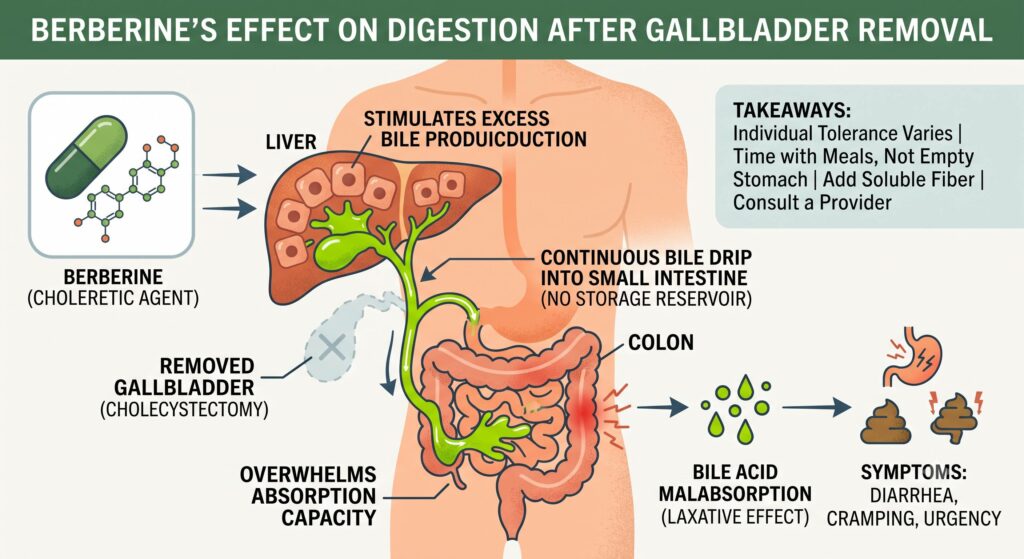
Yes, berberine can cause or worsen gastrointestinal issues – most notably loose stools, sudden diarrhea, abdominal cramping, and nausea – in people who have had their gallbladder removed (a cholecystectomy). While berberine is not strictly toxic or contraindicated for everyone without a gallbladder, its physiological effects on bile production frequently aggravate the digestive changes caused by the surgery.
Why Berberine Causes Digestive Issues Post-Cholecystectomy
1. Berberine Stimulates Excess Bile Production (Choleretic Effect)
Berberine is a strong choleretic compound – it directly stimulates liver hepatocytes to synthesize and secrete higher volumes of bile acids into the biliary tract.
2. Loss of the Bile Storage Reservoir
In a person with an intact gallbladder, bile produced by the liver is stored and concentrated in the gallbladder until a fat-containing meal triggers its release.
After a cholecystectomy, there is no storage reservoir. Bile produced by the liver drips directly and continuously into the small intestine (duodenum) through the common bile duct, regardless of whether food is present.
3. Bile Acid Malabsorption & the “Laxative Effect”
When berberine forces the liver to output extra bile acids without a gallbladder to store them, the continuous surge overpowers the terminal ileum’s ability to reabsorb bile acids.
When excess, unabsorbed bile acids enter the large intestine (colon), they act as osmotic and secretory irritants:
- Water Draw: They draw water and sodium into the colonic lumen.
- Increased Motility: They stimulate rapid contractions of the colon walls.
This mechanism mimics or triggers bile acid diarrhea (also known as post-cholecystectomy diarrhea), resulting in watery stools, sudden fecal urgency, and painful cramping.
4. Direct Gut Mucosa Irritation & Microbiome Shifts
Even in people with intact gallbladders, berberine commonly causes local gastrointestinal irritation, bloating, and changes in gut motility. Because gallbladder removal already shifts the composition and balance of the gut microbiome (due to constant bile exposure), adding berberine can trigger or worsen intestinal dysbiosis and mucosal sensitivity.
Key Takeaways
- Tolerance Varies: Some individuals without a gallbladder tolerate small doses of berberine fine, while others experience severe diarrhea even at low doses.
- Timing: Taking berberine on an empty stomach often accentuates bowel irritation because there is no food matrix to bind the increased bile acids.
- Mitigation: If berberine is medically necessary, starting with a very low dose with meals, incorporating soluble fiber (like psyllium husk) to bind excess bile acids, or consulting a healthcare provider about bile acid sequestrants (like cholestyramine) is standard practice.
Berberine can cause or intensify gastrointestinal symptoms like loose stools, diarrhea, and abdominal cramping in individuals who have had their gallbladder removed. This occurs primarily because berberine acts as a choleretic agent, stimulating the liver to synthesize higher volumes of bile acids. Without a gallbladder to store and regulate bile release in response to meals, this extra bile drains continuously into the small intestine, ultimately overwhelming the gut’s capacity to reabsorb it in the terminal ileum.
Once excess, unabsorbed bile acids reach the large intestine, they draw water into the colonic lumen and stimulate rapid bowel contractions, aggravating post-cholecystectomy bile acid diarrhea. While individual tolerance varies, taking berberine on an empty stomach tends to amplify these digestive issues because there is no food matrix to bind the increased bile flow. To minimize discomfort, strategies often include taking smaller doses alongside meals, incorporating soluble fiber to trap surplus bile acids, or consulting a physician about bile acid sequestrants.
Leave a Reply