

Can Taking TMG/Methyl B12/Methyl Folate boost creatine production, energy, and muscle recovery in the body?
This is a fascinating dive into the “metabolic budget.” To answer your question: Yes, supplementing with TMG, Methyl-B12, and Methyl-folate can theoretically restore methylation capacity and support endogenous creatine production. However, there is a clever “bio-hack” nuance here regarding how these pieces fit together.
1. The Methylation Bottleneck
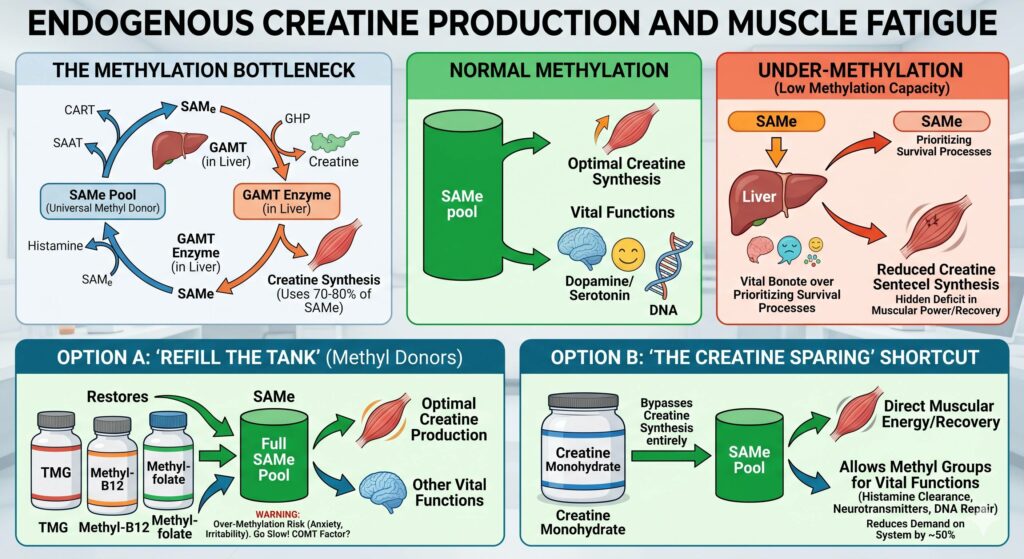
The enzyme responsible for the final step of creatine synthesis is GAMT (guanidinoacetate N-methyltransferase). This enzyme is a “methyl hog.” Because the body views creatine as essential for cellular energy (ATP) recycling, it will drain your methyl pool to keep the lights on.
If you are an under-methylator (often due to MTHFR polymorphisms, high homocysteine, or nutrient deficiencies), your body faces a Sophie’s Choice:
- Option A: Make creatine for muscle power and brain function.
- Option B: Methylate DNA, detoxify histamines, and produce neurotransmitters (dopamine/serotonin).
When the methyl pool is shallow, Option B often gets sidelined, leading to brain fog, fatigue, and poor recovery.
2. How the “Big Three” Help
By introducing TMG, Methyl-B12, and Methyl-folate, you are essentially “refilling the tank.”
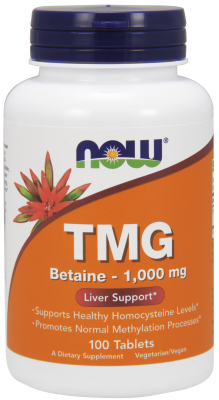
- TMG (Trimethylglycine/Betaine): This acts as a methyl donor shortcut. It can convert homocysteine back into methionine (the precursor to SAMe, your universal methyl donor) via the BHMT pathway, bypassing the folate cycle entirely.
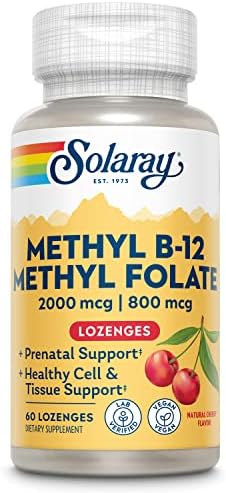
- Methyl-B12 & Methyl-folate: These support the primary “long way” methylation cycle. They ensure that the folate cycle is spinning efficiently to keep SAMe levels high.
The Result: With a larger pool of SAMe, the GAMT enzyme can churn out creatine without “starving” your neurotransmitters or DNA repair mechanisms.
3. The “Creatine Sparing” Strategy (The Twist)
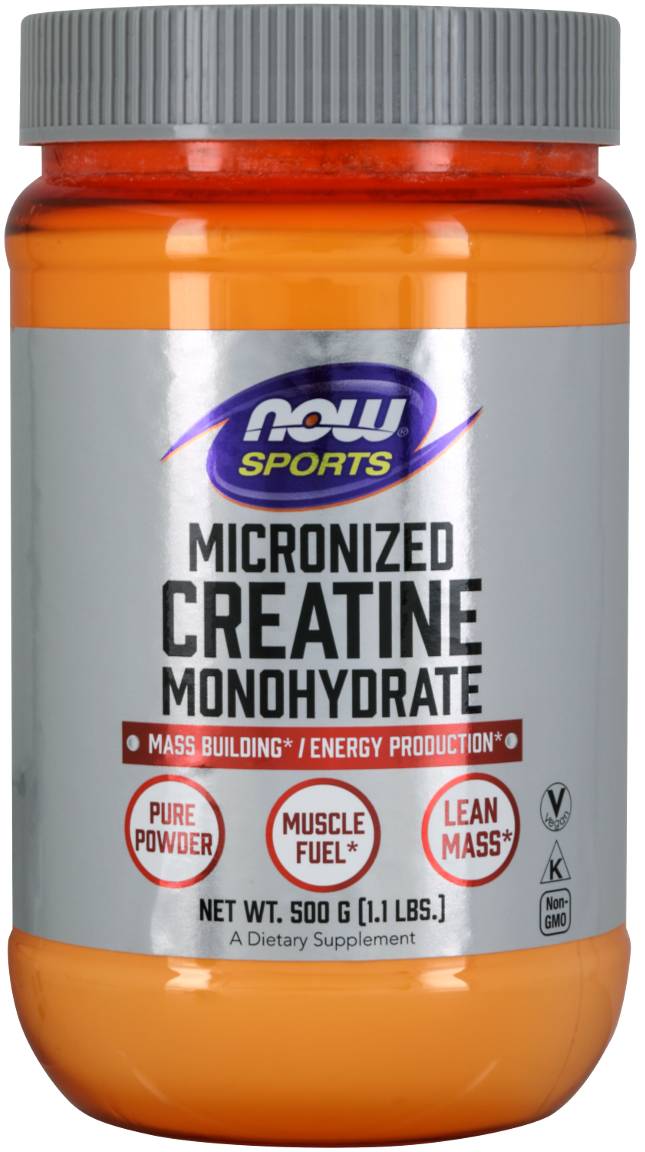
While taking methyl donors helps you make creatine, many functional medicine practitioners suggest the opposite approach is more efficient: Taking actual Creatine Monohydrate.
The Logic: If you supplement with 3–5g of creatine directly, you provide the end product your body was going to spend 40% of its methyl groups making. This “spares” those methyl groups, allowing them to be used for other vital tasks like clearing histamine or making dopamine.
In many ways, taking creatine is one of the most effective ways to “treat” under-methylation because it drastically reduces the demand on the system.
4. Key Considerations for Implementation
If you decide to use TMG and B-vitamins to boost this process, keep these “candid” tips in mind:
- The “Over-Methylation” Crash: If you take too many methyl donors (especially TMG and Methyl-folate) too quickly, you can swing the needle too far. This often manifests as anxiety, irritability, or insomnia. Start low and go slow.
- Hydration: Endogenous creatine production and muscle recovery require significant cellular hydration. If you’re amping up this cycle, increase your electrolyte intake (magnesium, potassium, sodium).
Summary Table
| Supplement | Primary Function in this Context |
| TMG | Fast-track methyl donor; lowers homocysteine quickly. |
| Methyl-B12 | Essential cofactor for the methionine synthase (MTR) enzyme. |
| Methyl-folate | Drives the folate cycle to provide the raw materials for SAMe. |
| Creatine (Direct) | The “Sparing Effect” – reduces the need for methylation by ~40%. |
Summary of Methylation and Creatine Synthesis
The human methylation cycle operates like a high-stakes metabolic budget, where the liver’s demand for creatine synthesis acts as a “methyl hog,” consuming roughly 40% to 50% of the body’s total methyl groups. In individuals who are under-methylators, the body is forced into a survival-based trade-off: it prioritizes the production of creatine to maintain baseline cellular energy (ATP) recycling, but does so by draining the methyl pool needed for DNA repair, detoxification, and neurotransmitter balance. This leads to a “hidden” deficit in muscular power and physical recovery, as the system lacks the metabolic overhead to support both peak performance and basic physiological maintenance simultaneously.
Supplementing with TMG, Methyl-B12, and Methyl-folate serves to “refill the tank,” providing the raw materials necessary to keep the universal methyl donor, SAMe, at functional levels. However, the true metabolic “cheat code” is often the creatine sparing effect: by taking exogenous creatine monohydrate directly, you provide the finished product the liver would otherwise spend a fortune to manufacture. This drastically reduces the systemic demand for methylation, freeing up those valuable methyl groups for other essential tasks like dopamine production and histamine clearance. Ultimately, this dual approach – resupplying methyl donors while reducing their demand – can resolve chronic fatigue and restore the body’s capacity for rapid muscular recovery.
Leave a Reply