

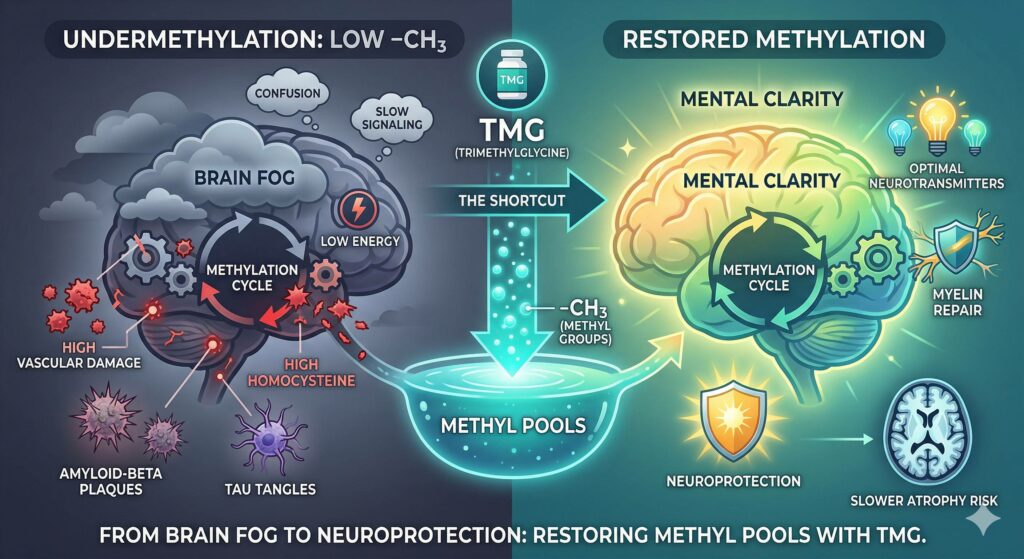
Can Under-Methylation Cause Brain Fog and Dementia?
Restoring “methyl pools” is a bit like making sure your car has enough oil; without it, the engine (your brain) starts to run hot, sluggish, and eventually risks breaking down.
In clinical terms, “undermethylation” usually refers to a state where your body has a shortage of methyl groups (CH3), often marked by high levels of homocysteine. Here is the breakdown of how this affects your brain and what the science says about TMG and Alzheimer’s.
Does Undermethylation Cause Brain Fog?
Yes, there is a strong biochemical link. Methylation is the “on/off” switch for several critical brain functions. When you are “undermethylated,” the following processes slow down:
- Neurotransmitter Synthesis: You need methyl groups to create and recycle serotonin, dopamine, and norepinephrine. A shortage can lead to “brain fog,” low motivation, and mood dips.
- Myelin Repair: Methylation helps maintain the protective coating (myelin) on your nerves. If this is sluggish, signal speed in the brain drops, leading to that “cloudy” feeling.
- Creatine Production: About 40% of your body’s methyl groups go toward making creatine. Since creatine is vital for brain energy (ATP), a methyl shortage can literally “drain the battery” of your neurons.
How TMG (Trimethylglycine) Helps
TMG, also known as Betaine, acts as a high-powered methyl donor. It is essentially a “shortcut” for the body.
While most people focus on the MTHFR pathway (which uses folate and B12), TMG uses a different pathway (the BHMT enzyme) to convert toxic homocysteine back into the beneficial amino acid methionine. By “donating” its methyl groups, TMG:
- Lowers Homocysteine: Reducing a known neurotoxin that causes inflammation.
- Restores SAMe: Increases the availability of S-adenosylmethionine (SAMe), the body’s primary “master” methyl donor.
Undermethylation, Alzheimer’s, and Dementia
High homocysteine (the primary marker of low methylation) is considered one of the most significant, modifiable risk factors for Alzheimer’s.
| Feature | The Link to Undermethylation |
| Brain Atrophy | Elevated homocysteine is directly correlated with faster “shrinkage” of the brain, particularly in the memory-rich hippocampus. |
| Plaques & Tangles | Low methylation capacity is linked to the increased production of Amyloid-beta and Tau proteins, the hallmarks of Alzheimer’s. |
| Vascular Damage | High homocysteine damages the lining of blood vessels (endothelium), reducing blood flow to the brain (Vascular Dementia). |
The Evidence: Key Studies
There is robust evidence that restoring methyl groups can protect the brain, though most human clinical trials use B-Vitamins (B6, B12, and Folate) rather than TMG alone.
- The VITACOG Study (Oxford University): This is the “gold standard” study. Researchers found that high-dose B-vitamins (which support methylation) slowed brain atrophy by up to 50% in elderly people with high homocysteine and mild cognitive impairment.
- TMG and Neuroprotection (Animal Models): Multiple studies (2024-2025) have shown that TMG supplementation in rats reduced “amyloid-beta” accumulation and improved memory performance in Alzheimer’s models by reducing oxidative stress and neuroinflammation.
- Consensus: An international consensus of experts has stated that homocysteine levels above 11 umol/L significantly increase the risk of dementia, and lowering them via methylation support is a primary preventative strategy.
A Quick “Heads Up”: While TMG is great for the brain, in rare cases, high doses can significantly raise LDL cholesterol in some people. It’s always a good idea to monitor your lipids if you’re using it long-term.
Undermethylation is essentially a “cellular brownout” for your brain, where a shortage of methyl groups (CH3) slows down the production of key neurotransmitters and drains your mental energy. This state is marked by elevated homocysteine, a toxic byproduct that acts like “sandpaper” on your brain’s blood vessels and is a major driver of Alzheimer’s and dementia. By supplementing with TMG (Trimethylglycine), you provide a high-powered shortcut to restore these methyl pools, effectively clearing “brain fog” and lowering the risk of cognitive decline. The science – most notably the VITACOG study – suggests that maintaining these methyl levels can slow brain atrophy by up to 50%, making methylation support a critical pillar for both immediate mental performance and long-term brain health.
Leave a Reply