

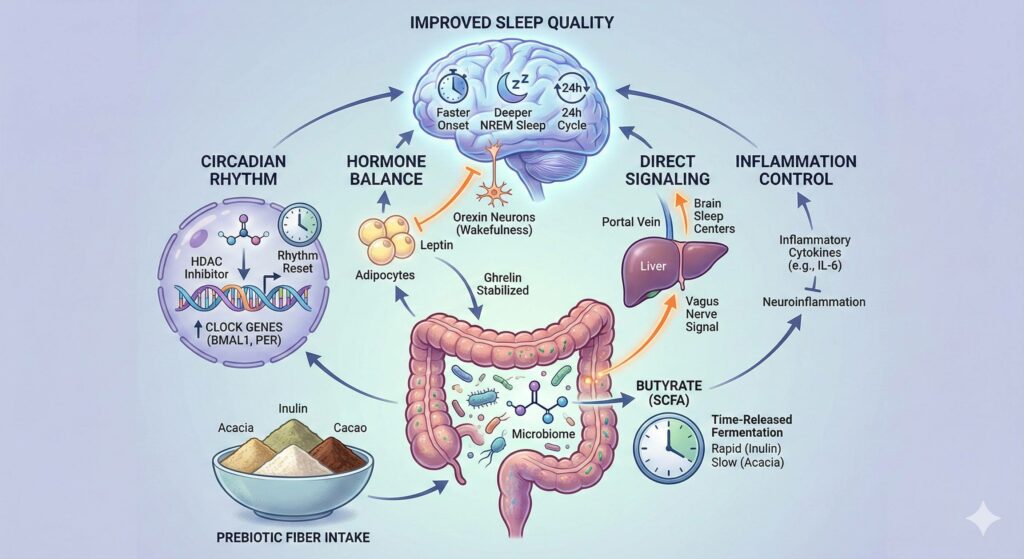
The relationship between the Short-Chain Fatty Acid (SCFA) butyrate and sleep is a fascinating look at the “gut-sleep axis.” When you consume prebiotic fibers that your gut bacteria ferment into butyrate, you aren’t just feeding your colon; you are sending biochemical signals that help reset your internal clock and balance the hormones that govern wakefulness.
Here is how these mechanisms work together to combat insomnia:
1. Regulating the “Core Clock” Genes
Your body’s circadian rhythm is controlled by a set of “clock genes” – primarily BMAL1, CLOCK, PER1, and PER2.1 While the brain has a master clock, every cell in your body has its own peripheral clock.2
- Epigenetic Tuning: Butyrate acts as a Histone Deacetylase (HDAC) inhibitor.3 By inhibiting these enzymes, butyrate allows your DNA to “uncoil” in specific ways that promote the expression of these clock genes.4
- Synchronization: For someone with insomnia, these peripheral clocks are often “out of sync” with the brain’s clock. Butyrate helps re-synchronize them, making the transition into sleep more predictable and robust.
- Upregulation: Studies have shown that butyrate supplementation significantly increases the expression of PER1 and BMAL1, which are critical for maintaining a steady 24-hour cycle.5
2. Balancing Leptin and Ghrelin (The Hunger-Sleep Connection)
Leptin (the “fullness” hormone) and Ghrelin (the “hunger” hormone) do more than just manage weight; they are powerful modulators of arousal.
- Leptin vs. Orexin: Leptin has a direct inhibitory effect on orexin neurons in the hypothalamus.6 Orexin is the chemical that keeps you alert and awake.7 By stimulating leptin production, butyrate helps “turn down the volume” on these wake-promoting neurons, making it easier to fall asleep.
- The Sleep-Deprivation Trap: When you have insomnia, your leptin levels typically drop and ghrelin rises.8 This makes you feel “wired and tired” – hungry, alert, and unable to settle. Butyrate helps break this cycle by boosting leptin expression in your fat cells (adipocytes) through specialized receptors called FFAR2 and FFAR3.
- Ghrelin Stabilization: By improving gut health and metabolic signaling, butyrate helps prevent the nighttime spikes in ghrelin that can lead to “midnight hunger” or early morning awakenings.
3. Direct Sleep Induction (The Portal Vein Signal)
Recent research suggests that butyrate doesn’t even need to reach the brain to help you sleep.
- Hepatoportal Sensors: When butyrate is produced in the gut, it enters the portal vein on its way to the liver.9 There are sensory mechanisms in the portal vein wall and the liver that detect butyrate and send a signal via the vagus nerve to the brain’s sleep centers.10
- Increasing NREMS: In animal studies, direct administration of butyrate led to a significant increase (up to 70%) in Non-Rapid Eye Movement Sleep (NREMS), which is the restorative, deep sleep phase that many insomniacs lack.
Summary Table: Butyrate’s Impact on Sleep
| Mechanism | Action | Result for Insomnia |
| HDAC Inhibition | Upregulates BMAL1 & PER genes | Stronger, more stable circadian rhythm |
| Leptin Boost | Inhibits Orexin neurons | Decreased nighttime alertness/arousal |
| Vagus Nerve Signaling | Activates hepatoportal sensors | Faster sleep onset (reduced latency) |
| Inflammation Control | Lowers cytokines like IL-6 | Reduces “neuroinflammation” that disrupts sleep |
Specific Prebiotic Foods That Can Increase Butyrate Production for Better Sleep
Using a “triple-threat” combination of Acacia fiber, Inulin, and Pure Cacao powder is a highly effective way to nourish the specific bacteria—such as Faecalibacterium prausnitzii and Roseburia—responsible for producing butyrate.
Combining these three creates a “timed-release” effect in the gut, ensuring butyrate production occurs throughout the entire length of the colon, which is key for sustained circadian signaling.
1. Acacia Fiber (The Gentle Stabilizer)
Acacia is a complex, highly branched polysaccharide. Because of its complex structure, it ferments slowly in the gut.
- Gradual Fermentation: Unlike other fibers that ferment quickly in the beginning of the colon, Acacia reaches the distal (end) part of the colon. This provides a steady supply of butyrate throughout the night.
- High Tolerance: Because it ferments slowly, it produces much less gas and bloating than other prebiotics, making it ideal if you have a sensitive stomach.
- Impact: It specifically boosts Bifidobacteria and Lactobacilli, which create the acidic environment necessary for butyrate-producers to thrive.
2. Inulin (The Selective Accelerator)
Inulin is a shorter-chain fructan that ferments more rapidly than Acacia.
- The “Kickstarter”: It provides an immediate fuel source for bacteria in the upper part of the large intestine.
- Bifidogenic Effect: Inulin is one of the most well-researched prebiotics for increasing Bifidobacterium populations.
- Synergy: When combined with Acacia, it creates a “bimodal” fermentation profile – Inulin starts the process, and Acacia finishes it.
3. Pure Cacao Powder (The Polyphenol Powerhouse)
Pure cacao is rich in flavanols and theobromine, which act as “prebiotic-like” compounds.
- Polyphenol-Microbiome Loop: About 95% of cacao polyphenols reach the colon intact. Butyrate-producing bacteria like Roseburia break these down into smaller, anti-inflammatory molecules.
- Improving Diversity: Research shows that cacao significantly increases the abundance of butyrate-producing taxa while reducing “bad” bacteria like Clostridium histolyticum.
- Theobromine & Sleep: While cacao contains trace caffeine, it is high in theobromine, which has a much longer half-life and a more “gentle” effect on the central nervous system. In some studies, theobromine itself has been shown to increase butyrate production independently.
How to Combine Them for Sleep Support
To maximize the “Gut-Sleep Axis” benefits, consistency is more important than a single high dose.
| Ingredient | Suggested Daily Amount | Why it helps sleep |
| Acacia Fiber | 5g – 10g | Sustained butyrate production for deep NREM sleep. |
| Inulin | 3g – 5g | Rapidly resets circadian “clock genes” in the gut. |
| Pure Cacao | 1 – 2 tbsp | Provides polyphenols that lower neuroinflammation. |
Pro-Tip: Try mixing these into a “Gut-Sleep Latte” in the late afternoon or early evening. Use warm (not boiling) water or nut milk. The magnesium naturally found in cacao will add an extra layer of relaxation for your muscles and nervous system.
Summary:
The short-chain fatty acid butyrate acts as a powerful bridge in the gut-sleep axis by regulating circadian “clock genes” like BMAL1 and balancing the metabolic hormones leptin and ghrelin. By stimulating leptin production, butyrate helps suppress wake-promoting orexin neurons in the brain, while its fermentation in the gut sends direct sleep-inducing signals via the vagus nerve to promote deeper non-rapid eye movement sleep (NREMS). To maximize these benefits, a synergistic combination of acacia fiber, inulin, and pure cacao powder provides a “time-released” fermentation profile; the rapid fermentation of inulin and the slower, distal fermentation of acacia ensure consistent butyrate production throughout the night, while cacao’s polyphenols reduce the neuroinflammation that often disrupts sleep cycles.
Leave a Reply