

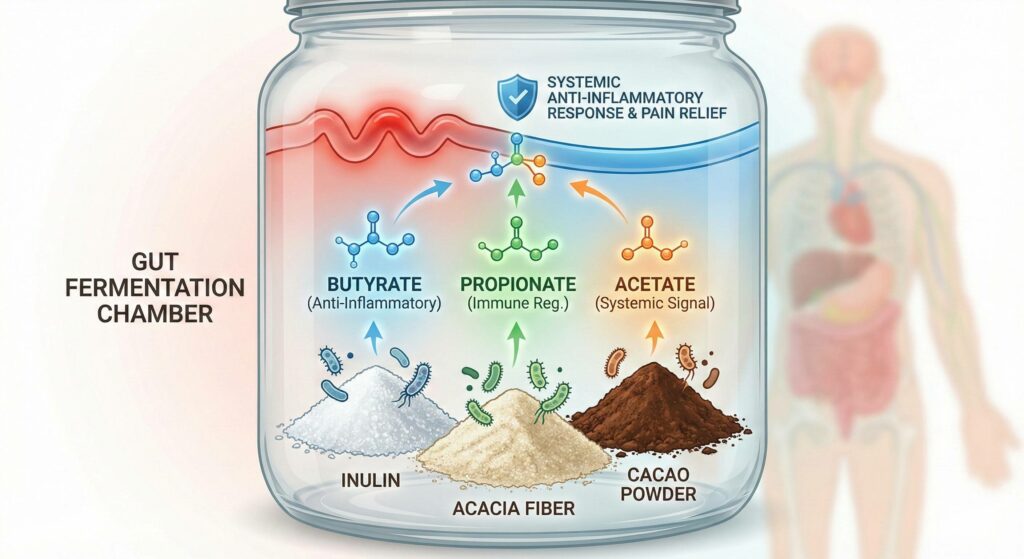
Short-chain fatty acids (SCFAs) – primarily acetate, propionate, and butyrate – are the metabolic byproducts of dietary fiber fermentation by gut bacteria. While they are best known for fueling colonocytes, they are actually potent systemic signaling molecules that play a massive role in regulating pain and inflammation.
Here is a detailed look at the mechanisms by which SCFAs modulate these responses.
1. Inhibition of Pro-Inflammatory Cytokines
The most direct way SCFAs manage inflammation is by acting as Histone Deacetylase (HDAC) inhibitors.
By inhibiting HDACs, SCFAs (particularly butyrate and propionate) prevent the activation of Nuclear Factor-kappa B (NF-κB). NF-κB is the “master switch” for inflammation; when it’s turned off, the production of pro-inflammatory cytokines like TNF-α, IL-1β, and IL-6 is significantly reduced. This reduction helps lower the overall “inflammatory tone” of the body.
2. Regulation of T-Cells and Immune Tolerance
SCFAs are essential for the production and training of Regulatory T-cells (Tregs).
- The Mechanism: SCFAs bind to specific G-protein coupled receptors (like GPR43 and GPR109A) on immune cells.
- The Result: This signaling promotes the differentiation of naive T-cells into anti-inflammatory Tregs. These cells act as the “peacekeepers” of the immune system, preventing the overactive immune responses that lead to chronic inflammatory pain.
3. Strengthening the Gut Barrier (“Leaky Gut”)
Systemic inflammation is often driven by LPS (Lipopolysaccharides) – endotoxins from the cell walls of “bad” bacteria that leak into the bloodstream.
- SCFAs strengthen the tight junction proteins (like occludin and zonulin) that keep the intestinal lining intact.
- By preventing “leaky gut,” SCFAs stop these triggers from entering the system, thereby preventing the systemic inflammatory cascade before it even begins.
4. Modulation of Microglia (Neuroinflammation)
Recent research into the gut-brain axis shows that SCFAs can cross the blood-brain barrier or signal through the vagus nerve to influence microglia—the resident immune cells of the brain and spinal cord.
- Overactive microglia are a primary driver of central sensitization, a state where the nervous system stays in a high-reactivity mode, making pain feel more intense or persistent.
- SCFAs help keep microglia in an “M2” (anti-inflammatory) state rather than an “M1” (pro-inflammatory) state, potentially reducing the perception of chronic pain.
5. Direct Interaction with Nociceptors
There is emerging evidence that SCFAs may interact directly with nociceptors (pain-sensing neurons). By binding to GPR43 receptors on peripheral nerves, SCFAs may modulate the threshold at which these nerves fire, effectively “turning down the volume” on pain signals sent to the brain.
Comparison of Primary SCFAs in Inflammation
| SCFA | Primary Role in Inflammation | Key Mechanism |
| Butyrate | Potent anti-inflammatory | Strongest HDAC inhibitor; fuels the gut barrier. |
| Propionate | Immune regulation | Influences T-cell differentiation and liver glucose metabolism. |
| Acetate | Systemic signaling | Most abundant; reaches peripheral tissues to modulate immune cells. |
Summary
In short, SCFAs help manage pain and inflammation by suppressing inflammatory master-switches, fortifying the gut barrier, and calming the nervous system’s immune response.
Did you know: Fibers like Inulin, Acacia Fiber and Cacao powder can feed good bacteria and increase SCFAs
Each of these ingredients has a unique “fermentation personality.” While they all support the production of Short-Chain Fatty Acids (SCFAs), they do so at different speeds and via different bacterial pathways.
If you are looking to manage systemic inflammation, the choice often depends on digestive tolerance and the specific SCFA you want to prioritize (specifically butyrate for its anti-inflammatory punch).
1. Inulin: The “High-Output” Fast Fermenter
Inulin is a type of fructan (a prebiotic fiber) found in chicory root, agave, and Jerusalem artichoke.
- Fermentation Speed: Rapid. It is fermented quickly in the upper part of the colon.
- SCFA Profile: Excellent for butyrate production. It is highly “bifidogenic,” meaning it selectively feeds Bifidobacteria, which then produce acetate that other bacteria (like Faecalibacterium prausnitzii) convert into butyrate.
- The Trade-off: Because it ferments so fast, it can produce significant gas (hydrogen and CO₂) as a byproduct. For people with sensitive guts or SIBO, this can cause bloating and “fizzing” sensations.
- Best For: Maximizing SCFA volume quickly, provided the digestive system can handle the rapid gas production.
2. Acacia Fiber: The “Slow and Gentle” Fermenter
Also known as Gum Arabic, this is a complex polysaccharide derived from the sap of the Acacia tree.
- Fermentation Speed: Slow. Unlike inulin, acacia has a high molecular weight and a branched structure, meaning bacteria have to “work harder” and take longer to break it down.
- SCFA Profile: It promotes a steady, sustained release of SCFAs throughout the entire length of the colon, rather than just the beginning. It is particularly effective at increasing the population of Faecalibacterium prausnitzii, one of the body’s most important anti-inflammatory butyrate producers.
- The Benefit: It is much better tolerated than inulin. It produces very little gas because the fermentation is so gradual.
- Best For: Individuals with sensitive digestion or those looking for a “slow-drip” of anti-inflammatory SCFAs across the whole colon.
3. Cacao Powder: The “Polyphenol” Powerhouse
Cacao is unique because it provides both fiber (mostly insoluble, but some soluble) and a high concentration of polyphenols (flavanols like epicatechin).
- The Mechanism: About 90% of cacao polyphenols reach the colon intact. Here, they act like “prebiotic-like” compounds. They inhibit “bad” bacteria (like Clostridia) and encourage the growth of Lactobacillus and Bifidobacterium.
- SCFA Profile: Research indicates that roasted cacao powder specifically favors the production of butyrate. Interestingly, raw cacao may favor acetate and propionate more, but the roasting process seems to modify the fiber in a way that shifts the microbial output toward butyrate.
- The Synergy: Cacao polyphenols themselves are anti-inflammatory. When combined with the SCFAs produced by its fiber, you get a dual-action effect on the gut-brain axis.
- Best For: Combining antioxidant benefits with gut health; specifically useful for mood and cardiovascular-related inflammation.
Comparison Matrix
| Feature | Inulin | Acacia Fiber | Cacao Powder |
| Primary SCFA | Butyrate / Acetate | Butyrate / Propionate | Butyrate (if roasted) |
| Fermentation Rate | Fast (High gas) | Slow (Low gas) | Moderate |
| Digestive Comfort | Moderate to Low | High (Very gentle) | High |
| Key Bacteria Fed | Bifidobacteria | F. prausnitzii | Lactobacillus / Bifido |
| Additional Benefit | Mineral absorption | Blood sugar stability | Polyphenol antioxidants |
Strategic Application
Many health-focused formulations use a combination approach:
- Acacia provides the “gentle” base.
- Inulin (in smaller doses) provides the “fuel.”
- Cacao provides the flavor and the secondary “polyphenol” anti-inflammatory pathway.
Short-chain fatty acids (SCFAs), particularly butyrate, serve as powerful systemic anti-inflammatories by inhibiting HDAC enzymes, suppressing pro-inflammatory cytokines, and fortifying the gut barrier to prevent endotoxin-driven systemic stress. While all prebiotic fibers support this process, they offer distinct functional profiles: inulin acts as a rapid fermenter for high-volume butyrate production but may cause bloating; acacia fiber provides a slow, gentle fermentation that supports the entire length of the colon with high digestive tolerance; and cacao powder contributes a unique synergistic effect through its polyphenols, which modulate gut bacteria to favor anti-inflammatory pathways. Together, these fibers provide a multi-faceted approach to calming the nervous system and managing chronic pain through the gut-brain axis.
Leave a Reply