

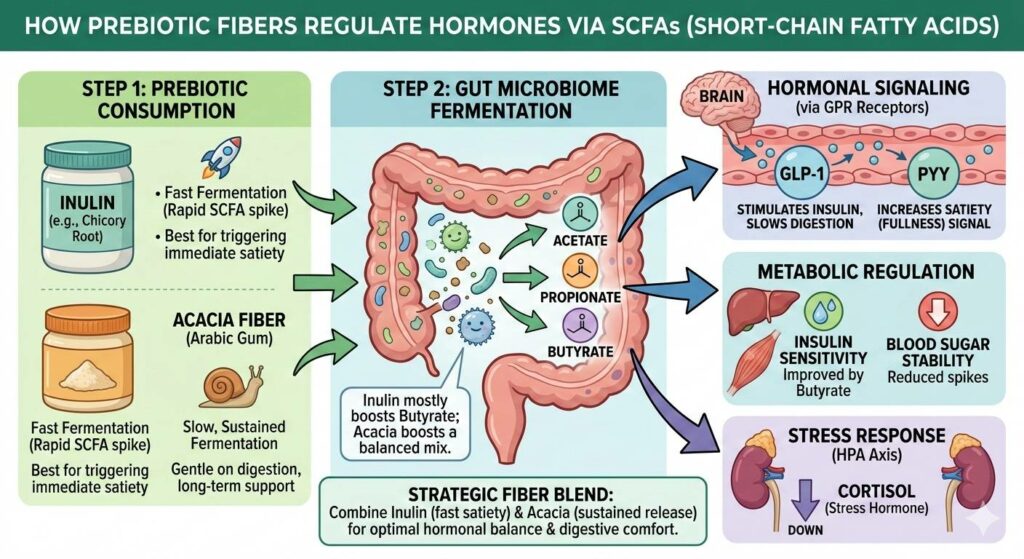
Short-chain fatty acids (SCFAs) – primarily acetate, propionate, and butyrate – are the byproducts of your gut bacteria fermenting dietary fiber. While they are famous for gut health, they actually act as powerful signaling molecules that travel through the blood to talk to your endocrine system.
Yes, SCFAs play a critical role in hormone regulation, particularly those related to metabolism, hunger, and stress.
1. Metabolic & Hunger Hormones
SCFAs are major players in signaling “fullness” to the brain. They bind to specific receptors (GPR41 and GPR43) in the gut lining, triggering the release of:
- GLP-1 (Glucagon-like peptide-1): This hormone stimulates insulin secretion and slows down gastric emptying. It’s the same pathway targeted by modern metabolic medications.
- PYY (Peptide YY): This acts as a primary “satiety” signal, telling your brain you’ve had enough to eat.
2. Insulin and Blood Sugar Control
By stimulating GLP-1, SCFAs indirectly manage insulin levels. Furthermore, butyrate has been shown to improve insulin sensitivity by affecting the way cells use energy. This helps prevent the “hormonal roller coaster” of blood sugar spikes and crashes.
3. The Stress Connection (Cortisol)
There is emerging evidence that SCFAs can modulate the Hypothalamic-Pituitary-Adrenal (HPA) axis, which controls your body’s response to stress.
- High levels of SCFAs are associated with lower levels of cortisol (the stress hormone).
- They help maintain the integrity of the blood-brain barrier, preventing systemic inflammation that can trigger a chronic stress response.
4. Adiponectin and Leptin
SCFAs influence how fat tissue (adipose) behaves. They can increase the production of adiponectin, a hormone that protects against inflammation and heart disease, and help regulate leptin, which manages long-term energy storage and hunger.
Summary Table: Hormonal Impact of SCFAs
| Hormone | Primary Effect of SCFAs | Result |
| GLP-1 | Stimulates release | Better insulin response |
| PYY | Stimulates release | Increased fullness (satiety) |
| Cortisol | Downregulates HPA axis | Reduced stress response |
| Insulin | Improves sensitivity | Stable blood sugar |
A Note on Logic: While the connection is strong, it’s worth noting that SCFAs aren’t “hormone pills.” They are the messengers. To get the benefit, the focus remains on the “factory” – your gut microbiome – which needs a steady supply of prebiotic fibers to keep production lines running.
Sustain production of SCFAs with Inulin and Acaia Fiber!
Choosing between Inulin and Acacia fiber is a great move for SCFA production, but they “behave” differently in your gut. They aren’t interchangeable; they actually target different sections of your microbiome and produce different hormonal benefits.
1. Inulin: The “High-Speed” Fermenter
Inulin is a fructan (a chain of fructose molecules). Because its structure is relatively simple, your gut bacteria can break it down very quickly.
- Primary SCFA Produced: High levels of Butyrate.
- Hormonal Impact: Excellent for stimulating GLP-1 and PYY because it ferments rapidly in the upper part of the large intestine where many L-cells (which secrete these hormones) are located.
- The Caveat: Because it ferments so fast, it can cause gas and bloating if you start with a high dose. It “feeds” the bacteria so aggressively that they produce gas faster than your body can sometimes handle.
2. Acacia Fiber: The “Slow-Release” Specialist
Acacia is a complex polysaccharide. It has a highly branched, “tangled” structure that takes bacteria much longer to disassemble.
- Primary SCFA Produced: A more balanced mix, with a significant boost to Propionate and Butyrate.
- Hormonal Impact: Because it ferments slowly, it provides a “sustained release” of SCFAs all the way through to the end of the colon. This is excellent for long-term insulin sensitivity and lowering systemic inflammation.
- The Benefit: It is much gentler on the stomach. It is often labeled “low-FODMAP” friendly because it doesn’t cause the rapid gas expansion that Inulin does.
Comparison at a Glance
| Feature | Inulin | Acacia Fiber |
| Fermentation Speed | Fast | Slow/Gradual |
| Target Bacteria | Bifidobacteria (mainly) | Diversity of species |
| Digestive Comfort | Can cause bloating | Highly tolerable |
| Best For… | Immediate satiety signals | Long-term gut barrier & stability |
Strategic Suggestion: The “Hybrid” Approach
If you want to maximize hormone regulation while keeping your digestion happy, consider a 70/30 or 50/50 blend:
- Acacia as the Base: Use it to provide a steady, slow-burning source of fuel for your microbiome.
- Inulin as the Booster: Add a smaller amount of Inulin to specifically trigger those GLP-1 “fullness” hormones.
Pro Tip: Always start with a very low dose (e.g., 2-3 grams total) and increase every few days. Your “microbiome machinery” needs time to scale up production to handle the new workload.
Short-chain fatty acids (SCFAs), specifically acetate, propionate, and butyrate, serve as critical chemical messengers that bridge the gap between gut fermentation and the endocrine system to regulate metabolic health. By binding to specialized receptors in the digestive tract, these metabolites trigger the release of satiety hormones like GLP-1 and PYY, which manage hunger and insulin secretion, while also modulating the HPA axis to lower systemic cortisol levels. To effectively sustain this hormonal regulation, a strategic combination of prebiotic fibers is ideal: Inulin provides a rapid fermentable source that specifically targets immediate fullness signals, while Acacia fiber offers a slower, more tolerable fermentation process that supports long-term insulin sensitivity and gut barrier integrity.
Leave a Reply