

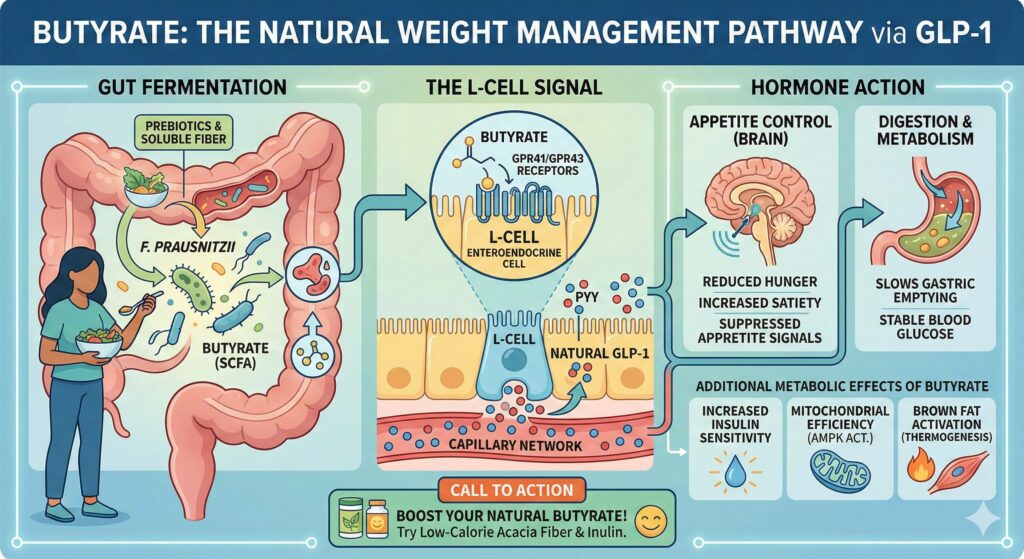
Short-chain fatty acids (SCFAs) like butyrate are essentially the “magic sub-products” of a healthy gut. While most people focus on fiber, it’s the fermentation of that fiber into butyrate that actually does the heavy lifting for metabolic health.
Here is how butyrate acts as a natural trigger for the body’s weight-management systems.
The Butyrate-GLP-1 Connection
The primary way butyrate influences weight is by stimulating L-cells in the lining of the colon and distal small intestine. These cells are responsible for secreting Glucagon-like peptide-1 (GLP-1), the same hormone that popular weight-loss medications mimic.
1. Activation of G-Protein Coupled Receptors
Butyrate acts as a signaling molecule. When it reaches the lower gut, it binds to specific receptors on the L-cells, primarily GPR41 and GPR43 (also known as Free Fatty Acid Receptors 2 and 3).
- The Result: This binding signals the L-cell to release a pulse of endogenous (natural) GLP-1 into the bloodstream.
2. Slowing Gastric Emptying
Once GLP-1 is released via butyrate stimulation, it acts on the digestive tract to slow down gastric emptying.
- The Benefit: Food stays in your stomach longer, leading to a prolonged feeling of fullness (satiety) and preventing the rapid glucose spikes that lead to fat storage.
3. The Brain-Gut Axis
Butyrate-induced GLP-1 travels to the brain – pecifically the hypothalamus – where it suppresses appetite signals. It shifts the body from “seeking energy” (hunger) to “utilizing energy” (satiety).
Beyond GLP-1: Additional Weight Benefits
While GLP-1 is the star of the show, butyrate helps manage weight through two other critical pathways:
- PYY Secretion: Along with GLP-1, butyrate triggers the release of Peptide YY (PYY). This hormone further reduces appetite and increases the efficiency of nutrient absorption.
- Thermogenesis: Butyrate has been shown to activate “brown fat” and increase mitochondrial activity. This means the body becomes more efficient at burning calories as heat rather than storing them as white adipose tissue (fat).
- Insulin Sensitivity: By reducing systemic inflammation, butyrate helps the body’s natural insulin work better. When insulin is stable, the body is less likely to store excess blood sugar as fat.
How to Increase Natural Butyrate Production
Since butyrate is a byproduct of fermentation, you can’t just “eat” it (most butyrate foods, like butter, are absorbed in the upper GI tract before reaching the L-cells). You have to “grow” it.
| Strategy | Source |
| Resistant Starch | Cooked and cooled potatoes, green bananas, legumes. |
| Soluble Fiber | Oats, chia seeds, Brussels sprouts, and apples. |
| Inulin | Acacia Fiber, Garlic, onions, leeks, and Jerusalem artichokes. |
| Polyphenols | Dark berries, green tea, and dark chocolate (these feed butyrate-producing bacteria like F. prausnitzii). |
Quick Note: While butyrate is powerful, it works best as part of a high-fiber ecosystem. Think of fiber as the “fuel” and butyrate as the “exhaust” that actually cleans up your metabolism.
Turning up your Metabolic Thermostat!
Butyrate doesn’t just “burn fat” in a vacuum; it acts more like a metabolic thermostat, recalibrating how your body handles energy intake and storage. To understand its role in weight loss beyond the GLP-1 connection, it helps to look at how it physically changes your fat cells and your liver.
1. Mitochondrial Efficiency (The “Burn” Factor)
Butyrate is a primary energy source for your colonocytes (gut lining cells), but its influence travels much further. It has been shown to activate AMPK (Adenosine Monophosphate-activated Protein Kinase), often called the body’s “master metabolic switch.”
- What this does: When AMPK is activated, it tells the body to stop storing fat and start burning it for energy.
- The “Brown Fat” Effect: Butyrate helps in the “browning” of white adipose tissue. White fat stores energy (weight gain), while brown fat burns energy to produce heat (weight loss).
2. Strengthening the “Leaky Gut” Barrier
Chronic inflammation is a silent driver of weight gain. When the gut barrier is weak, toxins like LPS (Lipopolysaccharides) leak into the bloodstream, causing systemic inflammation that leads to insulin resistance.
- The Butyrate Fix: Butyrate is the primary “fuel” that repairs the gut lining. By sealing the gut, it lowers systemic inflammation, making it significantly easier for your body to respond to its own weight-regulating hormones.
3. Liver Health and Fat Storage
The liver is the central hub for fat metabolism. Butyrate influences the liver by inhibiting an enzyme called HMG-CoA reductase, which is involved in cholesterol synthesis.
- It also helps prevent De Novo Lipogenesis (the process of turning dietary carbs into stored fat) by downregulating the genes responsible for fat production in the liver.
Comparing Butyrate Strategies
While you can take supplements, their effectiveness depends heavily on where they are absorbed.
| Method | Effectiveness for Weight Loss | Why? |
| Dietary Fiber | High | Fermentation happens in the colon, exactly where the L-cells (GLP-1 triggers) live. |
| Sodium Butyrate (Capsule) | Low to Medium | Often absorbed in the stomach or small intestine before reaching the target area. |
| Tributyrin (Supplement) | High | A “pro-drug” form of butyrate that survives the upper GI tract to reach the colon. |
The “Starch” Secret: Resistant Starch
If you want to maximize butyrate for weight loss, Resistant Starch (RS) is the most potent fuel. Unlike regular starch, RS resists digestion in the small intestine and arrives intact in the colon to be turned into butyrate.
- Pro Tip: Cooked and then cooled starches (like potatoes or rice) undergo “retrogradation,” which significantly increases their resistant starch content. Eating a potato salad made with cooled potatoes provides more butyrate potential than a hot baked potato.
Note: While it’s tempting to look at butyrate as a “shortcut,” it works best when it’s part of a diverse “postbiotic” ecosystem. It doesn’t just manage weight; it manages the environment that allows weight loss to happen.
Butyrate acts as a powerful metabolic signaling molecule that mimics the effects of modern weight-loss medications by naturally stimulating the release of GLP-1 and PYY from the gut lining. By binding to specific receptors in the colon, this short-chain fatty acid slows digestion, suppresses appetite via the brain-gut axis, and flips the “metabolic switch” (AMPK) to favor fat burning over storage. Beyond appetite control, butyrate repairs the gut barrier to reduce weight-driving inflammation and enhances mitochondrial function, effectively recalibrating the body’s energy balance. To easily boost your body’s natural production of this “weight-loss fatty acid,” consider incorporating acacia fiber and inulin into your daily routine; these low-calorie, highly soluble fibers provide the ideal fuel for your gut bacteria to generate the butyrate necessary for sustainable metabolic health.
Leave a Reply