

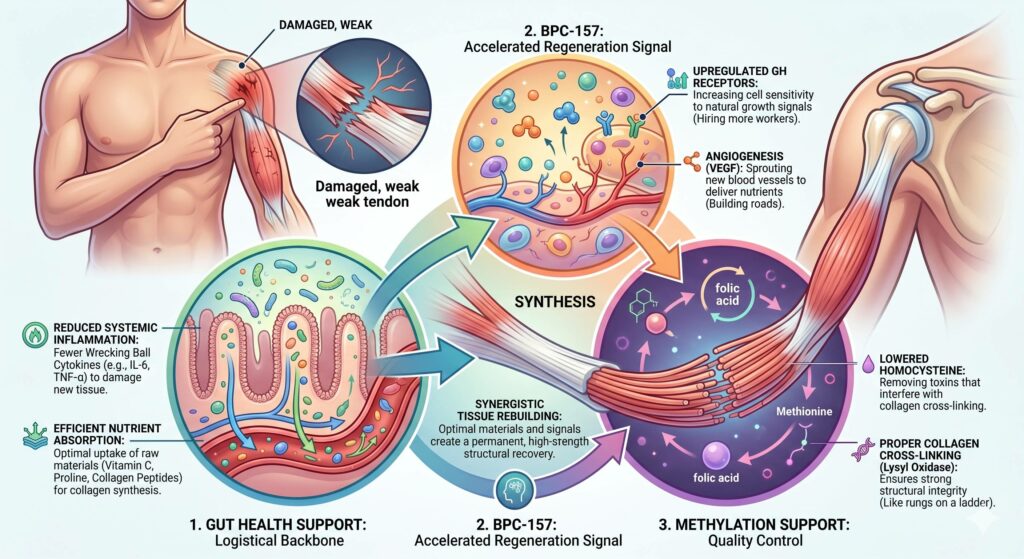
Why is it important to have good Gut Health and support Proper Methylation when on BPC-157 Peptide?
This is a complex question that touches on multiple intersecting biological systems. The short answer is yes, managing methylation and gut health can absolutely support collagen and tendon health, but they do so through entirely different mechanisms than BPC-157.
Does this also up-regulate GHRs?
Most alternative approaches, including methylation and gut support, do not up-regulate GH receptors (GHRs) in the direct, localized manner that BPC-157 does.
Here is a breakdown of how these alternatives work to support connective tissue and why their mechanism differs from BPC-157.
Part 1: Under-Methylation and Tendon/Collagen Health
Can supporting methylation improve tendon health? Yes, significantly.
Methylation is a fundamental biochemical process (adding a “methyl group” to molecules) that controls DNA expression, neurotransmitter production, and protein synthesis. The link to collagen is indirect but powerful.
The Homocysteine-Collagen Connection
When a person is an “under-methylator” (often due to genetic factors like the MTHFR mutation or nutrient deficiencies), their bodies cannot effectively process a compound called homocysteine. This leads to elevated homocysteine levels in the blood.
High homocysteine is toxic to connective tissue. It directly interferes with lysyl oxidase, the enzyme responsible for cross-linking collagen and elastin fibers. Think of collagen cross-links like the rungs on a ladder; without them, the collagen is structurally weak and fragile, making tendons and ligaments highly susceptible to injury.
How Methylation Support Helps:
By providing the “building blocks” for methylation (like active Folate (B9), B12, and B6), you can lower homocysteine. This removes the inhibition on lysyl oxidase, allowing your body to build stronger, more resilient collagen structures.
Does it Up-Regulate GH Receptors?
No. Supporting methylation optimizes the quality of the collagen building blocks and structures. It does not signal the tissue to become more sensitive to growth hormone.
Part 2: Gut Health and Tendon/Collagen Health
Can gut health support tendon health? Yes, through the “Gut-Tendon Axis.”
The gut is the primary site of nutrient absorption and the central regulator of systemic inflammation.
The Inflammatory Link
Chronic gut issues (like dysbiosis or “leaky gut”) cause a persistent, low-grade release of inflammatory markers (such as LPS and cytokines like IL-6 and TNF-alpha) into the bloodstream. These markers don’t just stay in the gut; they travel systemically.
Tendons and joints have poor blood supply and can become “sinks” for this systemic inflammation. Persistent inflammation inhibits fibroblast activity (the cells that repair collagen) and activates matrix metalloproteinases (MMPs), which actually break down existing collagen.
How Gut Support Helps:
- Reducing Inflammation: By optimizing the microbiome (probiotics/prebiotics) and repairing the gut lining (glutamine, collagen peptides), you reduce the systemic inflammatory load. This stops the “attack” on connective tissue, allowing repair to occur naturally.
- Improving Nutrient Absorption: A healthy gut efficiently absorbs the critical nutrients needed for collagen synthesis (Vitamin C, glycine, proline, copper, zinc).
Does it Up-Regulate GH Receptors?
No. Gut health support works by removing roadblocks (inflammation) and ensuring raw materials are available. It does not up-regulate GH receptors.
Comparison of Mechanisms: BPC-157 vs. Alternatives
As established previously, BPC-157’s primary “superpower” for tendons is localized angiogenesis (new blood flow) and local up-regulation of GHRs to sensitize damaged tissue to repair signals.
Here is how common alternatives compare:
| Approach | Primary Mechanism for Tendon/Collagen Health | Does it Up-Regulate GH Receptors? |
| BPC-157 | Locally increases GH receptor density & stimulates angiogenesis (VEGF). | Yes. |
| Mechanical Loading (PT) | Controlled stress signals the tissue to adapt and grow. | Yes. (This is the primary natural method to increase local GHR density) |
| Methylation Support | Lowers homocysteine to improve collagen cross-linking/quality. | No. |
| Gut Health Support | Reduces systemic inflammation that degrades tissue; optimizes nutrient absorption. | No. |
| Collagen + Vitamin C | Provides the raw materials and co-factors for collagen synthesis. | No. |
Summary
BPC-157 is unique because it provides a direct, localized, regenerative signal to the damaged tissue by making it hypersensitive to repair hormones (GHR up-regulation).
Methylation and gut health support are foundational approaches. They improve the overall systemic environment. A useful analogy would be repairing a broken bridge:
- Under-Methylation/Gut Support: Works like fixing the supply lines, reducing the workload on existing workers (reducing inflammation), and ensuring the materials are high quality (improving cross-linking).
- BPC-157: Works like hiring hundreds of extra workers specifically at the bridge location and equipping them with amplified communication tools (receptors) so they work faster and more efficiently.
The Synergy of Foundational Repair
While BPC-157 acts as a high-efficiency “site manager” by increasing Growth Hormone receptor density and stimulating angiogenesis (new blood flow), it ultimately requires a stable environment and high-quality materials to be successful. Supporting methylation provides the essential “quality control” for this process; by managing homocysteine levels, it allows for proper collagen cross-linking, ensuring the new tissue is structurally sound rather than brittle. Simultaneously, gut health serves as the logistical backbone, suppressing systemic inflammation that would otherwise degrade new repairs and ensuring the efficient absorption of the micronutrients required for cellular reconstruction.
Boosting these foundational systems is critical because they prevent BPC-157’s regenerative signals from being bottlenecked by poor material quality or a hostile internal environment. If methylation is compromised, BPC-157 may signal the body to build new tissue, but that tissue will lack the structural integrity to withstand mechanical stress. Likewise, a “leaky” or inflamed gut creates a constant stream of pro-inflammatory cytokines that act like a “wrecking ball” to the very repairs the peptide is trying to facilitate. By optimizing these pathways, you ensure the body has both the raw materials and the stable work site needed to turn BPC-157’s temporary signal into a permanent, high-strength structural recovery.
Leave a Reply