

Can Anti-Histamines Hinder Muscle Growth?
The relationship between antihistamines and muscle growth is a topic of increasing interest in exercise science. Research suggests that while taking an occasional antihistamine likely won’t destroy your progress, chronic or high-dose usage can indeed interfere with the biological signals required for muscle hypertrophy.
Here is a breakdown of how these medications interact with the muscle-building process.
The Role of Histamine in Exercise
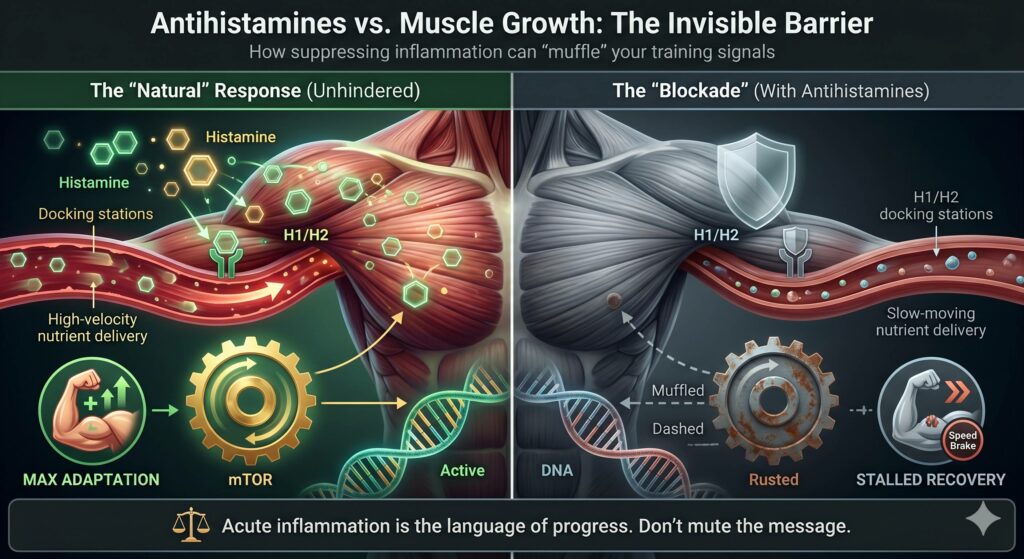
While usually associated with allergies, histamine is also a signaling molecule produced by the body in response to the “stress” of a workout. It acts as a local vasodilator, increasing blood flow to the worked muscles, which aids in the delivery of nutrients and the removal of waste products.
Furthermore, histamine plays a key role in the inflammatory cascade that triggers muscle repair and remodeling.
Potential Interference with Muscle Growth
- Blunting Gene Expression: Studies have shown that when both H1 receptors (targeted by drugs like Claritin or Allegra) and H2 receptors (targeted by drugs like Pepcid) are blocked, the expression of hundreds of genes associated with muscle recovery is significantly reduced. This includes genes responsible for glucose uptake and the restructuring of muscle tissue.
- Reduced Vasodilation: By blocking the histamine-induced “pump” or exercise-induced hyperemia, antihistamines can reduce the amount of blood flow to the muscles after a session. This may lead to a slower recovery rate and less efficient nutrient delivery during the critical “anabolic window.”
- mTOR and Protein Synthesis: While antihistamines may not directly “shut off” mTOR, they can dampen the overall inflammatory environment that the body uses as a signal to activate protein synthesis. By suppressing the natural inflammatory response to resistance training, the stimulus for the body to build back bigger and stronger is partially muffled.
Summary of Impact
| Aspect | Impact of Antihistamines |
| Muscle Remodeling | Decreased. Blunts the expression of genes needed for tissue repair. |
| Post-Workout Blood Flow | Reduced. Prevents optimal vasodilation after exercise. |
| Hypertrophy Signaling | Dampened. Suppresses the “good” inflammation required for growth signals. |
| Acute vs. Chronic | Varies. Occasional use has a negligible effect; chronic use may hinder long-term gains. |
Practical Considerations
If the goal is maximizing muscle mass, the following nuances are important:
- H1 vs. H2 Blockers: Most “muscle blunting” effects observed in research occurred when both H1 and H2 receptors were blocked simultaneously. Standard allergy medication (H1) alone has a smaller effect than a combination of allergy and acid reflux medication (H2).
- Timing: Taking an antihistamine several hours away from the workout window may minimize the interference with the acute inflammatory response.
- Alternative Recovery: Since antihistamines suppress inflammation, they can be thought of similarly to NSAIDs (like Ibuprofen). Relying on them for recovery might reduce the “training effect” because the body isn’t forced to adapt to the stress of the workout as robustly.
In short, for the average person, an occasional allergy pill won’t halt progress. However, for those looking to optimize every possible percentage of muscle growth, chronic usage – especially around the training window – may act as a “speed brake” on hypertrophy.
Histamine acts as a vital signaling molecule that regulates the body’s adaptive response to the stress of resistance training. It facilitates exercise-induced hyperemia, increasing blood flow to deliver nutrients and remove metabolites, while also triggering the inflammatory cascade necessary for muscle remodeling. By blocking these signals, antihistamines can dampen the acute biological “alarm” that tells the body to begin the repair process, potentially reducing the efficiency of the post-workout recovery window.
Chronic or high-dose usage of antihistamines, particularly when both H1 and H2 receptors are inhibited, can significantly blunt the expression of genes associated with muscle growth and glucose uptake. While occasional use likely has a negligible effect on overall progress, frequent administration may muffle the inflammatory cues that stimulate mTOR and other anabolic pathways. This interference essentially acts as a physiological “speed brake,” slowing down the protein synthesis and structural adaptations required for long-term hypertrophy.
Leave a Reply