

Does deep allergy relief happen?
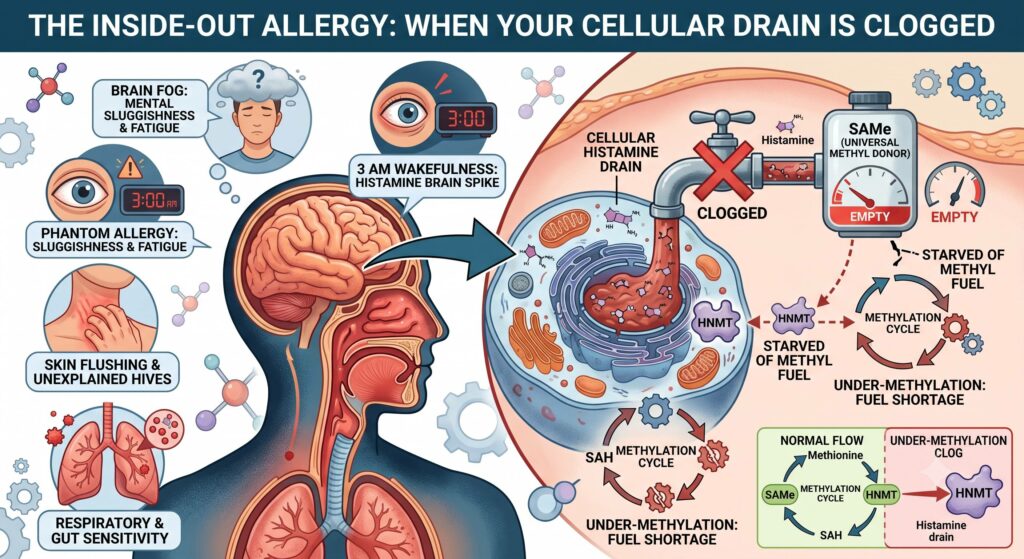
True, deep allergy relief doesn’t just happen in your sinuses – it happens inside your cells through a biochemical process called methylation.
If you suffer from chronic, frustrating “allergies” that never seem to clear up with standard over-the-counter antihistamines, the root cause might not be pollen, dander, or dust at all. Instead, you might be dealing with a fundamental cellular fuel shortage. When your body is under-methylating, you are essentially living with a clogged cellular drain, leaving you chronically flooded by your own natural histamine loads.
To understand why this happens, it helps to see exactly how your body is wired to handle histamine.
The Inside-Out Allergy: HNMT vs. DAO
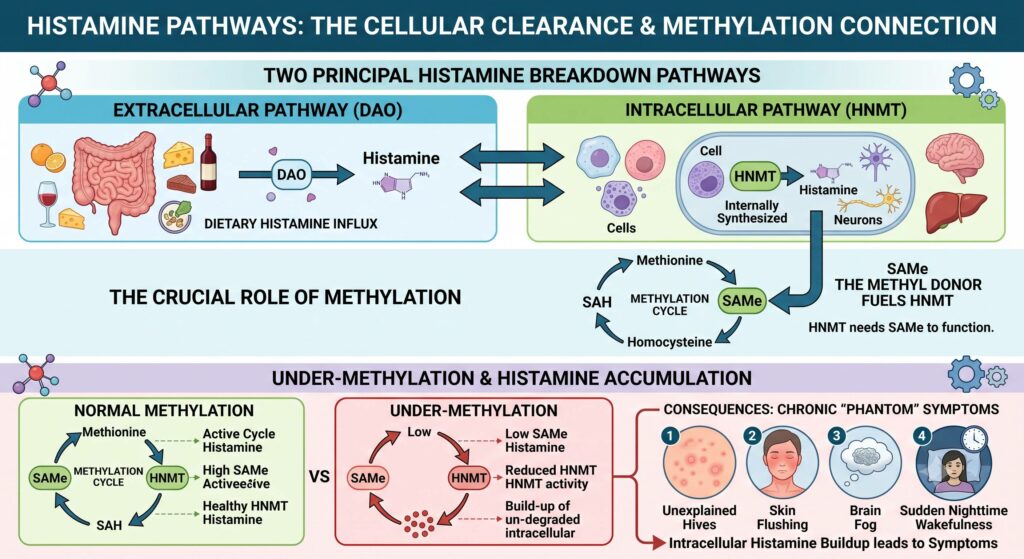
As shown in the pathway layout above, your body relies on two completely distinct systems to break down histamine:
- DAO (Diamine Oxidase): This enzyme patrols your gut and bloodstream. It acts like a security guard, breaking down the external histamine you swallow from foods like aged cheese, wine, or leftovers.
- HNMT (Histamine N-Methyltransferase): This enzyme operates inside your cells, with a massive presence in your liver, lungs, and central nervous system. It is responsible for clearing out internal, cellular histamine.
Here is the catch: as you can see right next to the HNMT node in the diagram, this enzyme is strictly dependent on SAMe (S-adenosylmethionine). SAMe is the primary universal “methyl donor” created by a healthy, functioning methylation cycle.
If you are an under-methylator, your biochemical machinery struggles to generate enough of these vital methyl groups. Starved of its SAMe fuel, your intracellular HNMT enzyme slows to a crawl. Even normal, daily levels of internal histamine have nowhere to go, backing up like a clogged sink.
Anatomy of a “Phantom” Allergy
Because this histamine accumulation is happening inside your cells and brain rather than just on your mucous membranes, it doesn’t always present as a typical runny nose or itchy eyes. Instead, under-methylators often walk around with a distinct cluster of low-grade, vague symptoms:
| Symptom | The Intracellular Methylation Mechanism |
| Sudden 3 AM Wakefulness | Histamine is a powerful, wakefulness-promoting neurotransmitter. When cellular HNMT fails to degrade it overnight, a microscopic spike in brain histamine snaps you wide awake, often accompanied by a racing mind. |
| Brain Fog & Fatigue | Constant intracellular histamine overload creates low-grade neuroinflammation, leaving you feeling mentally sluggish, unfocused, and chronically drained. |
| Unexplained Hives & Flushing | Minor triggers – like a warm shower, a mild emotional stressor, or minor friction on the skin – can cause sudden red flushing on the neck and chest or random, shifting hives because the baseline histamine bucket is already full. |
| Exercise Intolerance | Working out naturally releases histamine to dilate blood vessels. For an under-methylator, this normal release can trigger immediate over-heating, extreme itchiness, or a post-workout crash. |
The Antihistamine Trap: Standard allergy pills (H1 blockers) only blindfold your cells by blocking histamine receptors. They do absolutely nothing to help your body actually clear the physical volume of histamine out of your tissues. For an under-methylator, true relief only comes from turning the biochemical faucet back on.
How to Refuel the System
If this dynamic resonates with you, the goal is to gently optimize your methylation cycle so your HNMT enzyme has the chemical fuel it needs to process histamine cleanly.
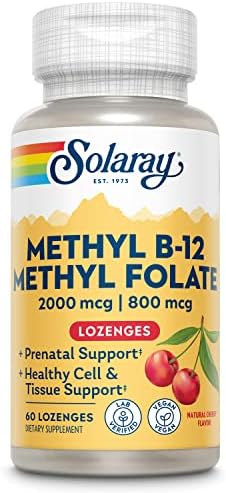
- Focus on Methyl Donors: Supporting the cycle with bioavailable cofactors like Methylfolate (L-5-MTHF) and Methylcobalamin (B12) helps the body generate SAMe naturally.
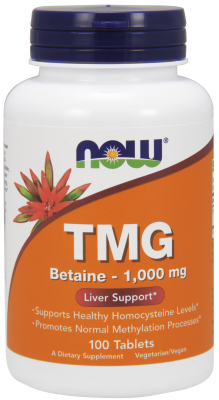
- Incorporate Phosphatidylcholine or TMG: Trimethylglycine (TMG) and choline-rich foods (like egg yolks) provide an alternative pathway (the BHMT pathway) to recycle homocysteine into SAMe, freeing up precious methyl groups for your overworked HNMT enzyme.
- Manage Histamine Influx: While you work on fixing the intracellular drain, it helps to temporarily lower the external load by avoiding massive dietary histamine bombs (fermented foods, alcohol, and aged meats).
The provided text explores the critical link between the biochemical process of methylation and intracellular allergy relief, specifically for individuals known as “under-methylators.” While common allergy symptoms are often managed externally, chronic “phantom” issues – such as unexplained hives, skin flushing, brain fog, and sudden nighttime wakefulness – may actually result from a fundamental cellular fuel shortage. The body employs two primary distinct systems to degrade histamine: the extracellular DAO enzyme, which clears dietary histamine from the gut, and the intracellular HNMT enzyme, which clears internally synthesized histamine in areas like the brain and liver. Critically, the HNMT enzyme is strictly dependent on SAMe (the primary methyl donor); when an individual is under-methylating and starved of this “methyl fuel,” HNMT slows down, causing internal histamine to back up like a clogged drain.
Because this histamine accumulation is internalized and sometimes neuroinflammatory, it manifests as vague, low-grade systemic symptoms that standard antihistamines, which only block receptors, cannot effectively resolve. This includes sudden 3 AM wakefulness, as cellular histamine spike promotes arousal, or intense flushing and exercise intolerance due to an already overloaded internal “histamine bucket.” The article emphasizes that true relief for under-methylators only occurs by supporting the biochemical faucet rather than just wearing a receptor blindfold. Effective strategies for refueling the system include utilizing bioavailable methylation cofactors like methylfolate and methylcobalamin (B12), incorporating trimethylglycine (TMG) or phosphatidylcholine to support alternative pathways, and temporarily reducing the incoming dietary histamine load while the cellular cleanup mechanism is restored.
Leave a Reply