
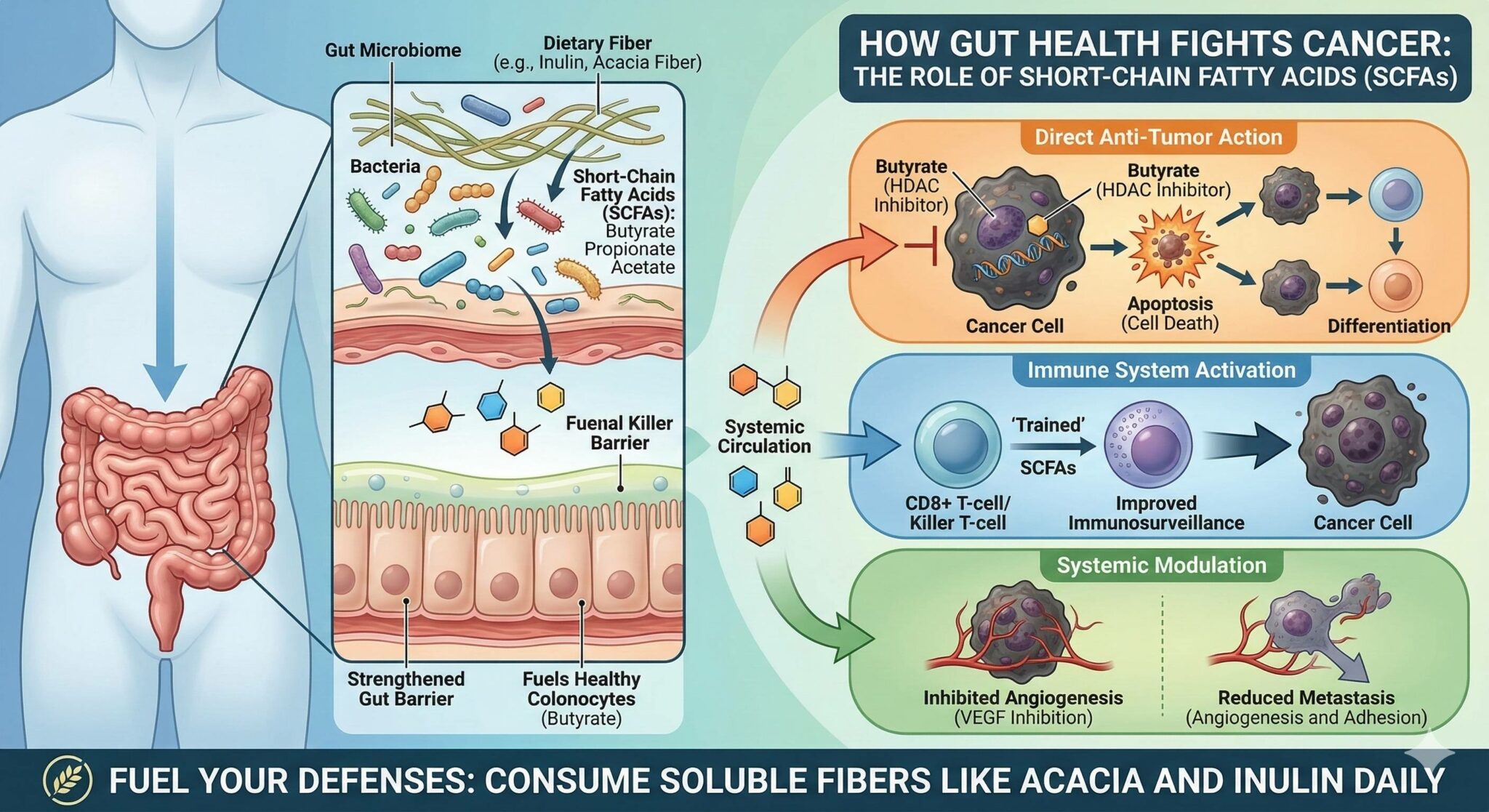
Short-chain fatty acids (SCFAs) – primarily acetate, propionate, and butyrate – are the metabolic byproducts produced when your gut bacteria ferment dietary fiber. While they are best known for fueling the lining of the colon, research increasingly shows they play a sophisticated role in systemic cancer defense.
Here is how these tiny molecules help your body’s “internal security” manage and fight cancer cells.
1. Direct Anti-Tumor Effects (The War on Growth)
SCFAs, particularly butyrate, act as histone deacetylase (HDAC) inhibitors. In the world of epigenetics, this is a big deal:
- Gene Reactivation: They can “turn back on” genes that suppress tumors, which cancer cells often silence to grow uncontrollably.
- Cell Cycle Arrest: SCFAs can force cancer cells to stop dividing. Instead of multiplying, the cells enter a state of “programmed cell death” known as apoptosis.
- Differentiation: They can encourage “undifferentiated” cancer cells (which act like aggressive stem cells) to mature into normal, functional cells that are less dangerous.
2. Strengthening the “Wall” (The Barrier Effect)
A “leaky gut” allows toxins and bacteria to enter the bloodstream, triggering chronic inflammation – a known driver of cancer.
- Mucus Production: SCFAs stimulate the production of protective mucus and strengthen the “tight junctions” between cells in the gut lining.
- Fueling the Guard: Butyrate provides up to 70% of the energy needed by colon cells (colonocytes). A well-fueled gut lining is much more effective at preventing the DNA damage that leads to colorectal cancer.
3. Training the Immune System
Your gut houses roughly 70-80% of your immune system. SCFAs act as signaling molecules that “train” these immune cells:
- T-Reg Cell Activation: They promote the production of Regulatory T-cells, which prevent the “over-inflammation” that can lead to tumor development.
- Enhanced Surveillance: SCFAs can boost the activity of Natural Killer (NK) cells and Cytotoxic T-lymphocytes, the “soldiers” specifically tasked with hunting down and destroying mutated or cancerous cells.
4. Reducing Systemic Inflammation
Chronic inflammation creates a “pro-cancer” environment where mutated cells can thrive. By binding to specific receptors (like GPR41 and GPR43), SCFAs send signals throughout the body to lower inflammatory markers. This makes the overall “soil” of the body less hospitable for a “seed” of cancer to take root.
How to Support SCFA Production
To maximize these benefits, your gut bacteria need the right raw materials. This process is often called “Prebiotic Priming.”
| Source Type | Examples |
| Resistant Starch | Cooked and cooled potatoes, green bananas, legumes. |
| Soluble Fiber | Oats, apples (pectin), chia seeds, berries. |
| Inulin-Rich Foods | Garlic, onions, leeks, Jerusalem artichokes. |
| Cruciferous Veggies | Broccoli, cauliflower, Brussels sprouts. |
Note: While SCFAs are a powerful tool in prevention and adjunctive care, they are part of a complex ecosystem. Always consult with an oncologist or a specialized dietitian when integrating gut-health strategies into a formal cancer treatment plan.
More on SCFAs and Cancer
Beyond the structural and direct cell-killing effects, SCFAs act as systemic “molecular messengers” that influence how the rest of your body – and your medical treatments – respond to cancer.
Here are the other critical ways SCFAs help the body fight cancer:
1. Improving Treatment Efficacy (Synergy)
Recent studies show that SCFAs aren’t just preventive; they can make standard cancer treatments work better.
- Immunotherapy Boost: SCFAs (especially butyrate) can improve the response to Checkpoint Inhibitors (like PD-1/PD-L1 therapies). They help “prime” the T-cells so the immune system can better recognize and attack the tumor.
- Chemo-sensitization: SCFAs can make cancer cells more sensitive to chemotherapy drugs like 5-Fluorouracil (5-FU) and Oxaliplatin. By weakening the cancer cell’s internal defenses, SCFAs make it easier for these drugs to do their job.
- Radiation Support: There is evidence that butyrate can enhance the efficiency of radiotherapy, particularly in colorectal cancer, by altering the cancer cell’s ability to repair its own DNA after it has been hit by radiation.
2. Starving the Tumor (Metabolic Reprogramming)
Cancer cells have a “sweet tooth” – they typically rely on glucose (sugar) for rapid growth, a process called the Warburg Effect.
- The “Butyrate Paradox”: While healthy gut cells use butyrate for fuel, many cancer cells cannot process it efficiently. When cancer cells are forced to take up butyrate, it disrupts their ability to use glucose, effectively “starving” their primary energy source.
- Blocking Fat Synthesis: SCFAs can interfere with lipogenesis (the creation of new fats), which cancer cells need to build their outer membranes as they multiply.
3. Cutting Off the Supply Line (Anti-Angiogenesis)
For a tumor to grow larger than a pinhead, it must grow its own blood vessels to get nutrients—a process called angiogenesis.
- Inhibiting VEGF: SCFAs have been shown to downregulate Vascular Endothelial Growth Factor (VEGF). By lowering the levels of this “growth signal,” SCFAs help prevent the tumor from building the plumbing it needs to expand and metastasize.
4. Preventing Metastasis (The “Stickiness” Factor)
Cancer is most dangerous when it spreads. SCFAs help keep cancer cells “anchored” or prevent them from surviving in the bloodstream.
- Reducing Invasiveness: SCFAs can downregulate enzymes (like Matrix Metalloproteinases) that cancer cells use to “dissolve” surrounding tissue to move through the body.
- Restoring Cell-to-Cell Communication: They help maintain the “stickiness” (adhesion) between cells, making it harder for individual cancer cells to break away from a primary tumor.
Summary of SCFAs by Function
| SCFA | Primary “Specialty” in Cancer Defense |
| Butyrate | DNA regulation (HDAC inhibition), fueling healthy gut lining, inducing apoptosis. |
| Propionate | Anti-inflammatory signaling and regulating liver/systemic glucose metabolism. |
| Acetate | Acts as a signaling molecule for immune cell recruitment to the tumor site. |
A Note on Variety: Because different types of fiber (pectin from apples vs. beta-glucan from oats) produce different ratios of these SCFAs, a diverse plant-based diet is usually more effective than a single fiber supplement.
Short-chain fatty acids (SCFAs), such as butyrate, act as potent metabolic allies in the body’s defense against cancer by regulating gene expression, starving tumors of glucose, and cutting off the blood supply needed for malignancy to spread. By serving as histone deacetylase (HDAC) inhibitors, these microbial byproducts can effectively “turn on” tumor-suppressor genes and trigger programmed cell death in mutated cells while simultaneously priming the immune system to better recognize and attack systemic threats. To harness these biological benefits and optimize your internal defenses, prioritize your gut health today by incorporating high-quality soluble fibers like acacia fiber and inulin into your daily routine to fuel the specific beneficial bacteria responsible for SCFA production.
Leave a Reply