

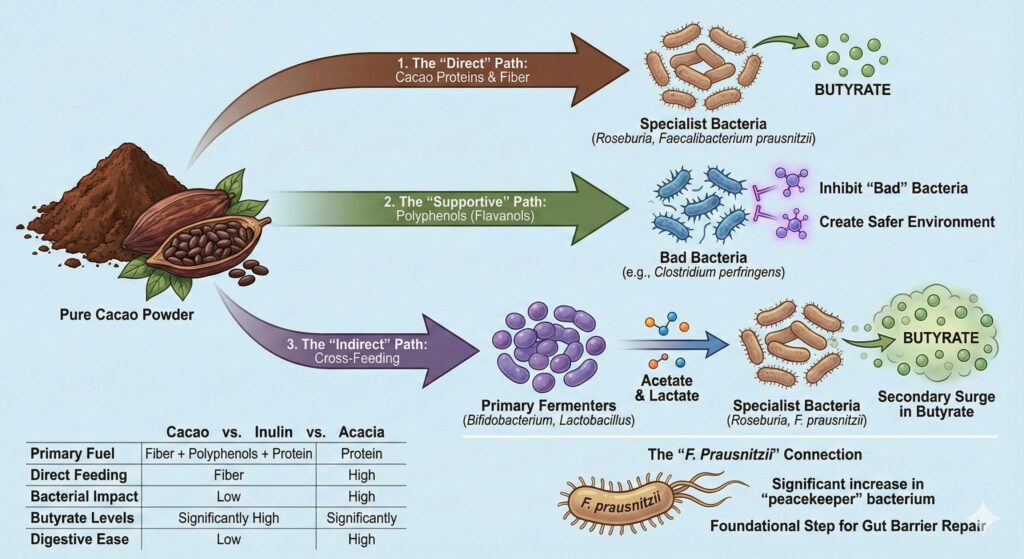
Pure cacao powder is a powerhouse for butyrate production, but like inulin and acacia fiber, it uses a combination of direct feeding and the “cross-feeding” partnership.
However, cacao is unique because it provides three different “fuels” for your gut, whereas inulin and acacia only provide one (fiber).
How Cacao Directly Feeds Butyrate Producers
Cacao powder doesn’t just contain fiber; it contains polyphenols and indigestible proteins, which change the math on how butyrate is produced.1
1. The “Direct” Path: Cacao Proteins and Fiber
Unlike many other supplements, cacao contains indigestible proteins that survive all the way to the large intestine.2
- Direct Action: Recent research (notably studies in 2025) suggests that these specific cacao proteins and insoluble fibers can be fermented directly by “specialist” bacteria like Roseburia and Faecalibacterium prausnitzii.
- These bacteria are the “gold standard” for butyrate production. Unlike Bifidobacteria, they have the machinery to break down these more complex structures directly into butyrate.
2. The “Supportive” Path: Polyphenols (Flavanols)
Cacao is famous for its high concentration of polyphenols (epicatechins and procyanidins).3
- Creating the Environment: These polyphenols act like “security guards.” They inhibit “bad” bacteria (like Clostridium perfringens) that compete for space.4
- By clearing out the “bad” guys, the polyphenols create a safer, high-antioxidant environment where butyrate-producing bacteria can thrive and multiply.
3. The “Indirect” Path: Cross-Feeding
Cacao is also highly bifidogenic.
- Just like inulin, cacao boosts Bifidobacterium and Lactobacillus.5
- These “primary fermenters” eat the soluble portions of the cacao and produce acetate and lactate.
- The butyrate-producers then “scoop up” that acetate and lactate to finish the job, creating a massive secondary surge in butyrate.
Cacao vs. Inulin vs. Acacia
| Feature | Pure Cacao Powder | Inulin | Acacia Fiber |
| Primary Fuel | Fiber + Polyphenols + Protein | Soluble Fiber | Soluble Fiber |
| Direct Feeding | Yes (to specialists like Roseburia) | Low (mostly indirect) | Moderate |
| Bacterial Impact | Multi-layer (Diverse) | High (Bifidobacteria) | Moderate (Gentle) |
| Butyrate Levels | Significantly High | High | Moderate-High |
| Digestive Ease | Generally High | Low (Gas/Bloat) | High |
The “F. Prausnitzii” Connection
If your goal is specifically to increase Faecalibacterium prausnitzii– often called the “peacekeeper” bacterium – cacao is one of the best tools available.6 It has been shown in human trials to significantly increase this specific strain, which is the body’s #1 producer of butyrate and is often missing in people with gut inflammation.
Cacao powder provides a multi-layered approach by delivering fiber, polyphenols, and proteins that both directly and indirectly support the growth of Faecalibacterium prausnitzii. Because this “peacekeeper” bacterium is significantly depleted in individuals with UC, strategically “farming” its population through these prebiotics and “cross-feeding” (where Bifidobacteria create the acetate that F. prausnitzii consumes) is a key foundational step in repairing the gut barrier and maintaining long-term remission.
Leave a Reply