

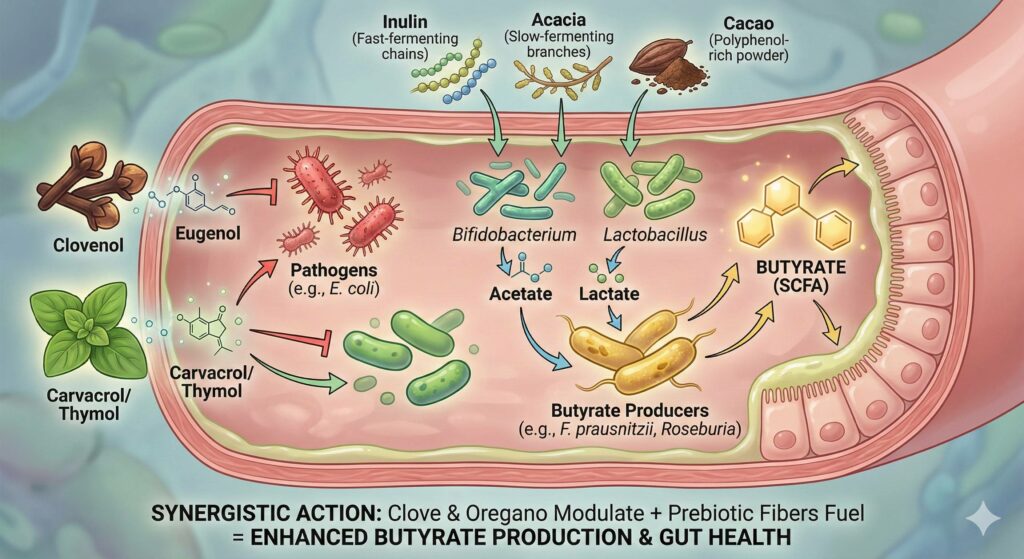
While both clove and oregano possess powerful antimicrobial properties, research suggests they often act more as “modulators” of the gut microbiome rather than blunt instruments like synthetic antibiotics. In many cases, they can actually support the growth of friendly bacteria and increase the production of Short-Chain Fatty Acids (SCFAs) when used in appropriate amounts.
Clove (Eugenol)
Clove’s primary active compound is eugenol.1 It is known for its selective activity, meaning it often targets pathogens while leaving beneficial strains relatively undisturbed.
- Friendly Bacteria: Studies (primarily in animal models and in vitro) show that eugenol can inhibit common pathogens like E. coli and Salmonella without significantly harming beneficial Lactobacillus species. Some research indicates it may even increase microbial diversity.
- SCFA Production: Research into clove-containing essential oil blends has shown a significant increase in the production of total SCFAs, specifically butyrate and propionate. This is likely because by reducing the “pathogenic load,” beneficial fermenting bacteria have less competition for nutrients and can thrive.
- Gut Barrier: Eugenol has also been shown to stimulate the production of the inner mucus layer in the colon, which provides a better environment for beneficial bacteria to colonize.2
Oregano (Carvacrol & Thymol)
Oregano is often called “nature’s antibiotic” because of its high concentration of carvacrol and thymol.3 Because it is so potent, its effect on the gut depends heavily on the dose and duration.
- Friendly Bacteria: While carvacrol can kill beneficial bacteria at high concentrations in a lab setting, dietary or supplemental doses often show a “eubiotic” effect. In several animal trials, oregano oil supplementation actually increased the abundance of Bifidobacterium and Lactobacillus.4 However, because it is broad-spectrum, very high or prolonged doses could potentially lead to a temporary reduction in some friendly strains.
- SCFA Production: Evidence suggests oregano oil can boost SCFA levels. A study published in PLOS One found that oregano powder significantly increased the concentrations of acetic and butyric acid in microbial cultures.5
- Pathogen Suppression: It is particularly effective at reducing Streptococcus and other opportunistic bacteria, which “clears the way” for more beneficial, SCFA-producing species to flourish.
Summary of Effects
| Feature | Clove (Eugenol) | Oregano (Carvacrol/Thymol) |
| Pathogen Effect | Strong inhibition (E. coli, Candida) | Broad-spectrum inhibition |
| Friendly Bacteria | Generally spared at low/moderate doses | Can be affected at high doses, but often boosted at low doses |
| SCFA Impact | Shown to increase total SCFAs | Specifically shown to increase butyrate and acetate |
| Gut Lining | Strengthens mucus barrier | Improves intestinal morphology (villi height) |
Key Considerations
- Dosage is Crucial: Most “harm” to friendly bacteria occurs at concentrations far higher than what is typically consumed in food or standard supplementation.
- Duration: To be safe, many practitioners recommend “pulsing” potent antimicrobials like oregano oil (e.g., 2 weeks on, 2 weeks off) to ensure the microbiome has time to maintain its natural balance.
- Whole Herb vs. Oil: Using the whole dried herb (clove buds or oregano leaf) is much gentler than using concentrated essential oils, which are extremely potent and should be used with caution.
Does Clove and Oregano Interact With SCFAs and Friendly Bacteria?
The interaction between clove and oregano and Short-Chain Fatty Acids (SCFAs) like butyrate is primarily ecological. Instead of directly “creating” butyrate, these herbs change the environment of the gut to favor the bacteria that do.
Research shows that both Eugenol (from clove) and Carvacrol/Thymol (from oregano) can significantly increase butyrate levels through three main pathways:
1. The “Pathogen Clearance” Effect
By suppressing “resource-hogging” pathogens like E. coli or Salmonella, clove and oregano reduce the competition for dietary fibers. This allows specialized butyrate-producing bacteria to thrive.
- Action: Oregano oil has been shown to reduce Proteobacteria (often inflammatory) while increasing the abundance of Clostridiaceae, a family that contains many potent butyrate producers.
- Result: Higher levels of butyrate in the colon, which fuels the cells lining your gut (colonocytes).
2. Promoting Cross-Feeding (The Bifidogenic Effect)
One of the most interesting findings in animal and in vitro studies is that moderate doses of oregano oil can increase the abundance of Bifidobacterium.
- The Mechanism: Bifidobacteria do not produce butyrate themselves; they produce acetate and lactate.
- The Interaction: Other beneficial bacteria (like Eubacterium rectale) take that acetate and lactate and convert it into butyrate. This is known as cross-feeding. By boosting the “starter” bacteria, these herbs indirectly drive up the final butyrate production.
3. Strengthening the Habitat (Mucin Production)
Butyrate-producing bacteria need a healthy “home” to live in. Both clove and oregano have been shown to:
- Increase Goblet Cell density: These cells produce the mucus layer that coats the gut.
- Upregulate Mucin (MUC2) genes: Clove (eugenol) specifically stimulates the production of this protective slime.
- Why this matters for Butyrate: Many top-tier butyrate producers, such as Faecalibacterium prausnitzii, live near or within this mucus layer. A thicker, healthier mucus barrier provides a more stable environment for these “friendly” colonies.
The Important Catch: The F. prausnitzii Sensitivity
While these herbs generally help, there is a nuance you should be aware of:
Some laboratory studies have found that Faecalibacterium prausnitzii – perhaps the most important butyrate producer in the human gut – can be sensitive to high concentrations of essential oils, sometimes even more sensitive than the pathogens themselves.
The Takeaway: To maximize butyrate and protect your friendly bacteria, dosage and form matter.
- Culinary doses (dried herbs in food) or standardized capsules are generally “eubiotic” (promote balance).
- Concentrated essential oils used long-term without breaks might “overshoot” and temporarily suppress sensitive butyrate producers.
Comparison Table: Interaction with Butyrate
| Interaction Type | Clove (Eugenol) | Oregano (Carvacrol) |
| Direct SCFA Impact | Increases Butyrate & Propionate | Increases Butyrate & Acetate |
| Primary Mechanism | Mucus layer stimulation | Pathogen suppression & Cross-feeding |
| Key Bacterial Ally | Lactobacillus support | Bifidobacterium support |
| Potential Risk | High doses may inhibit F. prausnitzii | High doses may inhibit F. prausnitzii |
What Specific Fibers can boost Butyrate production in the gut?
Inulin, Acacia and Cacao Powder, all three of these prebiotics are effective at raising Short-Chain Fatty Acids (SCFAs), but they do so through different “specialties.” While Inulin is often cited as the most potent for sheer butyrate volume, Acacia and Cacao offer unique advantages in terms of gut tolerance and microbial diversity.
1. Inulin: The High-Octane Butyrate Producer
Inulin is widely considered the gold standard for boosting butyrate because it is a “fast-fermenting” fiber.
- Direct Support: It is one of the preferred food sources for Faecalibacterium prausnitzii, the most prolific butyrate producer in the human gut.1
- Cross-Feeding: Inulin strongly stimulates Bifidobacteria.2 These bacteria produce acetate and lactate, which other butyrate-producing species (like Roseburia) then convert into butyrate.
- The Catch: Because it ferments quickly, it can cause gas and bloating in people with sensitive guts or SIBO.3
2. Acacia Fiber: The “Gentle” Stabilizer4
Acacia (Gum Arabic) is a complex, branched polysaccharide that ferments much more slowly than inulin.
- High Tolerance: Because it ferments slowly along the entire length of the colon, it rarely causes the “gas spike” associated with inulin.5
- Bifidogenic Power: Studies show acacia is highly effective at increasing Bifidobacterium and Lactobacillus.6 While it might produce slightly less butyrate than inulin in the short term, it creates a very stable environment for butyrate-producing colonies to grow.
- Distal Colon Support: Because it takes longer to break down, it can reach the descending colon (the end of the line), where butyrate is often most needed for colon health.
3. Cacao: The Polyphenol Synergy
Cacao is unique because it combines fiber with high concentrations of polyphenols (flavanols).
- Microbial Diversity: Cacao has been shown to increase the abundance of both Faecalibacterium and Roseburia (key butyrate producers) while simultaneously inhibiting “bad” bacteria like Clostridium perfringens.7
- Polyphenol Power: The polyphenols in cacao act like prebiotics themselves.8 They must be broken down by gut bacteria, and this process creates metabolites that further support the gut barrier and reduce inflammation.
Comparison Table: Which is “Best”?
| Feature | Inulin | Acacia | Cacao |
| Butyrate Potency | Highest | Moderate | Moderate/High |
| Fermentation Speed | Fast (High gas potential) | Slow (Very gentle) | Moderate |
| Primary Target | F. prausnitzii, Bifidobacterium | Bifidobacterium, Lactobacillus | Roseburia, Faecalibacterium |
| Best Used For | Rapidly increasing SCFA levels | Long-term gut maintenance/IBD | Increasing diversity & antioxidant status |
Strategic Recommendation
To maximize butyrate production without the side effects of gas, a combination approach is often more effective than choosing just one:
- Acacia + Inulin: Using a blend allows the fast-acting inulin to trigger early fermentation while the acacia ensures beneficial effects reach the very end of the colon.
- The “Butyrate Trio”: Adding cacao to your fiber regimen provides the polyphenols that help protect the gut lining while the fibers fuel the bacteria.
Note on “Rebuilding”: If you are using antimicrobial herbs like oregano or clove, these prebiotic fibers are the “seeds” you plant afterward to ensure the empty space is filled by butyrate-producers rather than opportunistic pathogens.
Clove and oregano act as selective antimicrobial modulators that suppress harmful pathogens while fostering an environment where beneficial, butyrate-producing bacteria can thrive. When these herbs are combined with prebiotic fibers, they create a synergistic effect: Inulin provides high-octane fuel for rapid butyrate production, Acacia offers a gentle, slow-fermenting fiber that reaches the distal colon, and Cacao contributes polyphenols that increase microbial diversity and strengthen the gut barrier. This combination facilitates cross-feeding, a process where “starter” bacteria like Bifidobacterium produce acetate and lactate that are ultimately converted into butyrate by specialized strains, resulting in a more resilient microbiome and enhanced systemic health.
Leave a Reply