Vitamins and Their Uses

  • Home
  • Features
  • Commentary
  • Shop For Vitamins 1-800-877-8702
  • Facebook
  • Google+
  • LinkedIn
  • Twitter
  • Cookie Policy (UK)
Home » Features » Does Alcohol Cause Gut Disbiosis And Reduce SCFA Production?

Does Alcohol Cause Gut Disbiosis And Reduce SCFA Production?

December 13, 2025 By Darrell Miller

Alcohol causes Gut Dysbiosis and reduces SCFAs

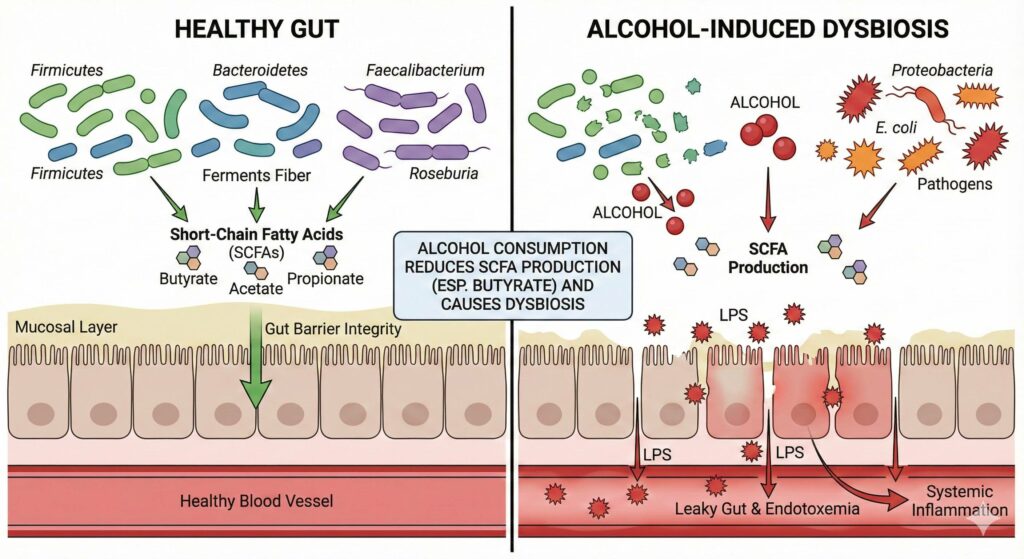
Yes, alcohol consumption is a well-established cause of gut dysbiosis and directly leads to a reduction in Short-Chain Fatty Acid (SCFA) production, particularly butyrate.

Research indicates that ethanol acts as a solvent and a toxin that disrupts the intestinal ecosystem, favoring pro-inflammatory pathogens over the commensal bacteria responsible for fermentation.

1. Mechanism of Alcohol-Induced Dysbiosis

Alcohol does not just “kill” bacteria indiscriminately; it creates a selective pressure that alters the composition of the microbiome.

  • Reduction of Beneficial Families: Chronic alcohol consumption consistently suppresses members of the phyla Firmicutes (specifically the class Clostridia), which are the primary producers of butyrate. Specific genera often depleted include Faecalibacterium, Roseburia, and Lachnospiraceae.
  • Overgrowth of Pathogens: It facilitates the overgrowth of Proteobacteria (such as Escherichia coli) and Bacteroidetes. These gram-negative bacteria contain Lipopolysaccharide (LPS) in their cell walls, which is a potent endotoxin.

2. Impact on SCFA Production

The reduction in SCFA levels is both a direct result of microbial shifts and a contributor to further damage.

  • Butyrate Depletion: This is the most critical loss. Butyrate serves as the primary fuel source for colonocytes (colon cells). When alcohol reduces the population of butyrate-producing bacteria, the intestinal lining becomes “starved,” leading to weakened tight junctions.
  • Acetate and Propionate: While alcohol metabolism in the liver actually produces acetate (leading to elevated systemic acetate levels), the gut-derived acetate and propionate produced by fiber fermentation are often disrupted due to the overall loss of bacterial diversity.

3. The “Leaky Gut” Cycle

The relationship between alcohol, dysbiosis, and SCFAs creates a self-reinforcing cycle of damage, often described via the Gut-Liver Axis:

  1. Lower SCFA availability: Without sufficient butyrate to fuel epithelial repair, the gut barrier weakens.
  2. Permeability: Alcohol directly damages epithelial cells and reduces the expression of tight junction proteins (like Zonula Occludens-1), causing “leaky gut.”
  3. Endotoxemia: The overgrowth of gram-negative bacteria increases the load of LPS (endotoxin). Because the gut barrier is leaky, this LPS translocates into the bloodstream.
  4. Systemic Inflammation: The liver receives this toxic, bacteria-laden blood via the portal vein, triggering inflammation (alcoholic liver disease) and affecting the brain (neuroinflammation).

Summary Table: Alcohol’s Effect on the Microbiome

Component Effect of Alcohol Consequence
Diversity Decreases Reduced resilience against pathogens.
Lachnospiraceae Decreases Significant drop in butyrate production.
Proteobacteria Increases Higher production of toxic LPS (endotoxin).
Gut Permeability Increases Bacteria leak into the bloodstream (translocation).

Recovery Note: The microbiome is resilient. Studies suggest that cessation of alcohol can allow SCFA-producing populations to rebound, often leading to a restoration of gut barrier integrity within “a few weeks of abstinence”.

Chronic alcohol consumption drives gut dysbiosis by significantly altering the microbiome’s composition, specifically suppressing beneficial, butyrate-producing bacteria (such as Firmicutes) while facilitating the overgrowth of inflammatory pathogens like Proteobacteria. This microbial shift leads to a critical reduction in Short-Chain Fatty Acids (SCFAs) – particularly butyrate – which starves colon cells and weakens the intestinal barrier. Consequently, this loss of integrity creates a “leaky gut” that allows bacterial toxins (endotoxins like LPS) to translocate into the bloodstream, triggering systemic inflammation and liver damage via the gut-liver axis, a cycle that requires cessation of alcohol to reverse.

Share this post: on Twitter on Facebook

Related posts:

  1. What are the benefits of Short-Chain Fatty Acids and Butyrate that is produced by friendly bacteria?
  2. Can Sugar Cause Gut Dysbiosis and Slow SCFAs Production by Friendly Bacteria
  3. Interesting Fact: SCFAs act as an “Epigenetic Switches”
  4. Can SCFAs Help The Body Eliminate Visceral Fat, The Fat Around Organs?
  5. Does SCFAs Thyroid Function and Help Slow Down Hashimoto Disease?
  6. Can SCFAs Help The Body Fight Macular Degeneration And Cataracts?
  7. Can SCFAs Help Build A Healthy Stomach Lining?
  8. Can prebiotics help probiotics in the gut produce SCFA which in turn supports the bodies production of GLP-1?

Filed Under: Features Leave a Comment

Leave a Reply Cancel reply

Your email address will not be published. Required fields are marked *


  1. Boost SCFAs with Prebiotic Fiber!

Want To Learn More About Vitamins, Nutrition And More? Subscribe!

*  Your Email Address:
*  Preferred Format:
    First Name:
*  Enter the security code shown:

Email marketing by Interspire

Categories

POPULAR READS

300px-Rumex_acetosella_38427.jpg

Health Benefits of Ojibwa Comparable to Essiac Tea

320px-Rheumatoid_Arthritis.jpg

What Are The Health Benefits Of Curamed?

All You Need To Know About Serrapaptase

Why Is Solaray A Great Vitamin And Herb Company?

Archives

  • December 2025
  • November 2025
  • September 2025
  • August 2025
  • July 2025
  • May 2025
  • January 2025
  • September 2024
  • August 2024
  • July 2024
  • June 2024
  • May 2024
  • March 2024
  • January 2024
  • November 2023
  • October 2023
  • July 2023
  • June 2023
  • May 2023
  • April 2023
  • March 2023
  • February 2023
  • January 2023
  • December 2022
  • November 2022
  • October 2022
  • September 2022
  • August 2022
  • July 2022
  • June 2022
  • May 2022
  • April 2022
  • March 2022
  • February 2022
  • January 2022
  • December 2021
  • October 2021
  • September 2021
  • August 2021
  • July 2021
  • June 2021
  • May 2021
  • April 2021
  • March 2021
  • February 2021
  • January 2021
  • December 2020
  • November 2020
  • October 2020
  • September 2020
  • August 2020
  • July 2020
  • June 2020
  • May 2020
  • April 2020
  • March 2020
  • February 2020
  • January 2020
  • December 2019
  • November 2019
  • October 2019
  • September 2019
  • August 2019
  • July 2019
  • June 2019
  • May 2019
  • April 2019
  • March 2019
  • February 2019
  • January 2019
  • December 2018
  • November 2018
  • October 2018
  • September 2018
  • August 2018
  • July 2018
  • June 2018
  • May 2018
  • April 2018
  • March 2018
  • February 2018
  • January 2018
  • December 2017
  • November 2017
  • October 2017
  • September 2017
  • August 2017
  • July 2017
  • June 2017
  • May 2017
  • April 2017
  • March 2017
  • February 2017
  • January 2017
  • December 2016
  • November 2016
  • October 2016
  • September 2016
  • August 2016
  • July 2016
  • June 2016
  • May 2016
  • April 2016
  • March 2016
  • February 2016
  • January 2016
  • December 2015
  • November 2015
  • October 2015
  • September 2015
  • August 2015
  • July 2015
  • June 2015
  • May 2015
  • April 2015
  • February 2015
  • January 2015
  • December 2014
  • November 2014
  • October 2014
  • September 2014
  • August 2014
  • July 2014
  • June 2014
  • May 2014
  • April 2014
  • March 2014
  • February 2014
  • January 2014
  • December 2013
  • November 2013
  • October 2013
  • September 2013
  • August 2013
  • July 2013
  • June 2013
  • May 2013
  • March 2013
  • January 2013
  • December 2012
  • November 2012
  • October 2012
  • September 2012
  • August 2012
  • July 2012
  • June 2012
  • May 2012
  • April 2012
  • March 2012
  • December 2011
  • November 2011
  • October 2011
  • September 2011
  • August 2011
  • July 2011
  • June 2011
  • May 2011
  • April 2011
  • March 2011
  • February 2011
  • January 2011
  • December 2010
About Us · Contact Us · Shop Now
Copyright © 2025 · VitanetOnline.com