

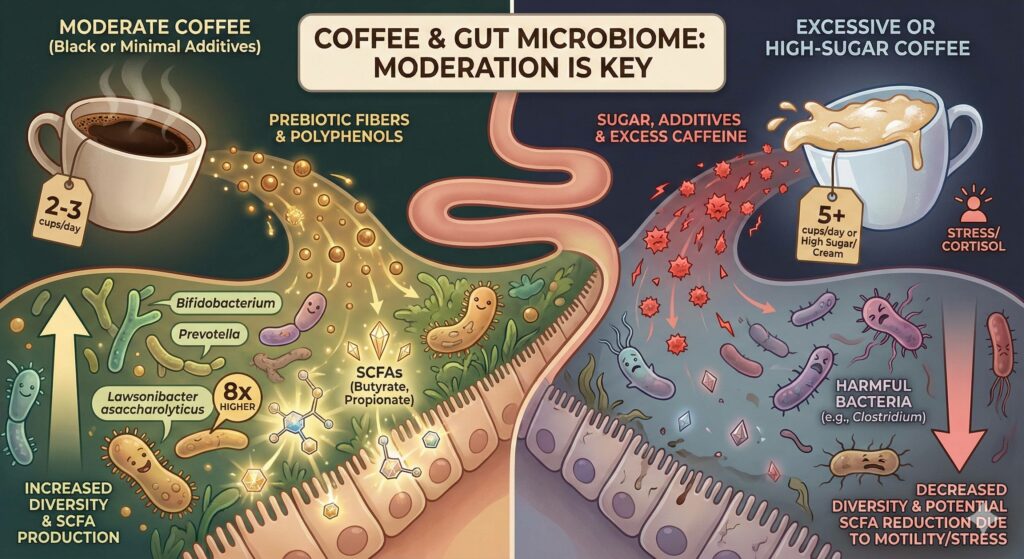
Research indicates that for most people, moderate coffee consumption increases gut microbiome diversity and promotes the production of short-chain fatty acids (SCFAs), rather than reducing them.
However, the premise about “reducing” SCFAs might stem from confusion with the effects of excessive caffeine intake or specific digestive conditions (like IBS) where coffee can trigger motility issues that disrupt fermentation.
The following breakdown details how coffee interacts with your gut bacteria and SCFAs.
1. Does Coffee Reduce SCFAs?
Generally, No. In fact, coffee acts as a “prebiotic” that fuels SCFA production.
- The Mechanism: Coffee beans contain soluble fibers (like galactomannans and arabinogalactans) and polyphenols (like chlorogenic acid). These compounds pass through the stomach undigested and reach the colon.
- The Result: Your gut bacteria ferment these compounds. This fermentation process produces SCFAs, specifically butyrate and propionate, which are crucial for colon health and inflammation control.
- Recent Findings: A notable 2024 study published in Nature Microbiology found that coffee drinkers have significantly higher levels of a specific bacterium called Lawsonibacter asaccharolyticus, which is a known butyrate producer.
2. Does Coffee Affect Gut Diversity?
Yes, largely in a positive way.
Regular, moderate coffee drinkers tend to have a more diverse microbiome than non-drinkers. Higher diversity is generally a marker of better gut health.
- Beneficial Bacteria Increased:
- Bifidobacterium: A major group of “good” bacteria often found in probiotics; coffee has been shown to boost their numbers.
- Prevotella: Often associated with plant-rich diets and better glucose metabolism.
- Lawsonibacter asaccharolyticus: As mentioned above, this species is up to 8x higher in regular coffee drinkers.
- Harmful Bacteria Decreased: Some studies suggest coffee may inhibit the growth of certain potentially harmful bacteria, such as specific strains of Clostridium and E. coli.
3. The “Reduction” Nuance: When Coffee Might Be Harmful
If you have heard that coffee reduces SCFAs, it may refer to these specific contexts:
| Context | Why it might negatively affect SCFAs |
| Excessive Consumption | Drinking very high amounts (5+ cups/day) can overstimulate gut motility (the speed at which food moves). If food moves too fast (diarrhea), bacteria don’t have time to ferment fiber, potentially lowering SCFA absorption/production. |
| Stress Response | High caffeine intake can spike cortisol. Chronic stress is known to lower gut diversity and SCFA production. |
| Sugar & Cream | If your coffee is loaded with artificial sweeteners, sugar, or highly processed creamers, these additives can harm diversity and reduce SCFA production, even if the coffee itself is beneficial. |
Summary Recommendation
To maximize the gut benefits (SCFA production) of coffee:
- Stick to Moderate Intake: 2-3 cups per day is generally the “sweet spot” in studies.
- Watch the Additives: Black coffee or coffee with minimal, natural additives is best for the microbiome.
- Filter It: Some studies suggest filtered coffee is better for metabolic markers than unfiltered (like French press), though both feed gut bacteria.
Research indicates that moderate coffee consumption generally acts as a prebiotic that boosts gut health rather than harming it. The soluble fibers and polyphenols in coffee beans are fermented by gut bacteria, leading to increased microbial diversity and the production of beneficial Short-Chain Fatty Acids (SCFAs) like butyrate and propionate. Specifically, regular coffee drinkers often show higher levels of helpful bacteria such as Bifidobacterium and Lawsonibacter asaccharolyticus. However, the benefits can be negated by excessive consumption, which may disrupt digestion speed, or by adding high amounts of sugar and processed creamers that can harm the microbiome.
Leave a Reply