

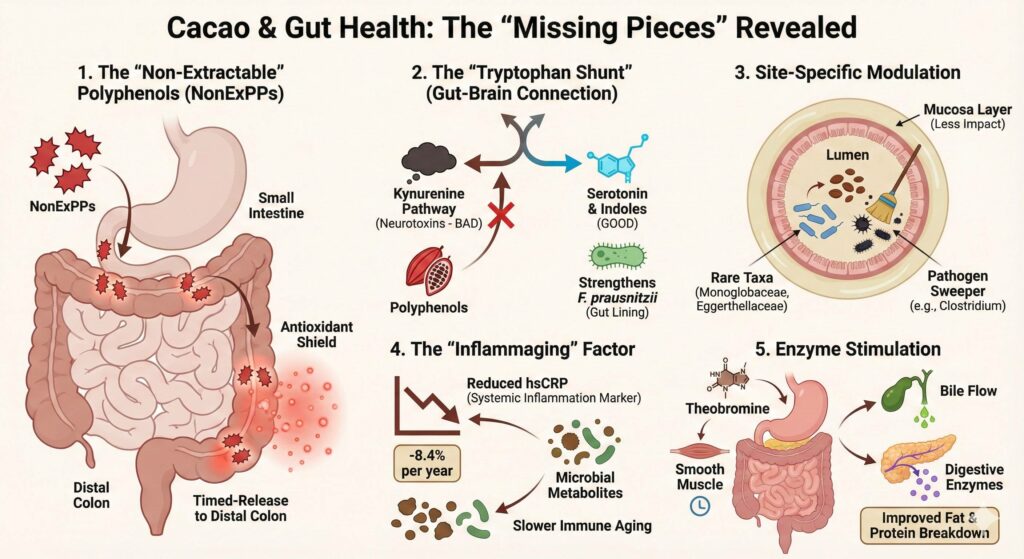
Recent research from late 2025 and early 2026 has introduced a few “missing pieces” that explain exactly why it is so much more effective than standard fiber supplements.
Here are the specific details that haven’t been mentioned:
1. The “Non-Extractable” Polyphenols (NonExPPs)
While most people focus on soluble polyphenols, cacao contains High-Molecular Weight Proanthocyanidins (HmwPaCs) and Non-Extractable Polyphenols.
- The Secret: These are too large to be absorbed in the small intestine.1 They act as “timed-release” antioxidants that travel all the way to the distal colon (the very end of your gut).
- The Benefit: Most antioxidants are absorbed early on, leaving the lower colon vulnerable. Cacao is one of the few foods that delivers a “shield” of antioxidants specifically to the area where the most fermentation (and potential inflammation) occurs.
2. The “Tryptophan Shunt” (Gut-Brain Connection)
Cacao is unique because it doesn’t just feed bacteria; it manages how your gut uses L-tryptophan.
- The Problem: When the gut is inflamed, the body “shunts” tryptophan into the Kynurenine pathway, which produces neurotoxins linked to depression and brain fog.2
- The Cacao Fix: Recent 2025 studies show that cacao polyphenols inhibit this shunt. Instead, they encourage the gut to turn tryptophan into Serotonin (95% of which is made in the gut) and Indoles. Indoles are specialized signaling molecules that tell the “peacekeeper” bacteria (F. prausnitzii) to strengthen the gut lining.
3. Site-Specific Modulation
New “mapping” of the microbiome (from late 2025 research) shows that cacao doesn’t affect the whole gut equally:
- Rare Taxa Support: Cacao has been found to specifically boost rare but critical “helper” families like Monoglobaceae and Eggerthellaceae.3 These bacteria are specialized in breaking down the complex cell walls of the cacao bean that other bacteria can’t touch.
- Lumen vs. Mucosa: Cacao is highly effective at cleaning the gut lumen (the “flow” of the gut) but is less impactful on the bacteria living directly in the mucus layer. This makes it an excellent “sweeper” for clearing out pathogens like Clostridium perfringens in the open space of the intestine.
4. The “Inflammaging” Factor
Large-scale trials (the COSMOS trial updates in late 2025) found that daily cacao consumption reduces hsCRP (a key marker of systemic inflammation) by about 8.4% per year in older adults.4
- The Gut Connection: This reduction isn’t just from the cacao itself, but from the metabolites produced when your gut bacteria eat the cacao. This suggests that “farming” your gut with cacao is a primary strategy for slowing down the aging of the immune system.
5. Enzyme Stimulation
Cacao contains theobromine, which acts differently than the caffeine in coffee.5 While caffeine can sometimes over-stimulate the gut, theobromine has a “mild relaxant” effect on the smooth muscles of the digestive tract. This can help improve bile flow and the release of digestive enzymes, making it easier to break down fats and proteins from your actual meals.
Comparison Summary (Updated)
| Feature | The “Missing” Detail |
| Antioxidant Delivery | Reaches the Distal Colon (where most fibers fail). |
| Brain Health | Diverts Tryptophan toward Serotonin instead of toxins. |
| Aging | Reduces hsCRP by 8.4% via microbial metabolites. |
| Motility | Theobromine relaxes gut muscles for smoother digestion. |
Beyond its role as a prebiotic, pure cacao powder serves as a multi-functional “gut-optimizer” by delivering non-extractable polyphenols that provide a timed-release antioxidant shield for the lower colon. It significantly influences the gut-brain axis by diverting tryptophan away from neurotoxic pathways and toward the production of serotonin and indoles, which strengthen the gut barrier. Additionally, cacao supports rare “helper” bacteria, acts as a mechanical “sweeper” to clear pathogens from the gut lumen, and generates metabolites that clinically reduce systemic inflammation markers like hsCRP. Combined with the muscle-relaxing effects of theobromine that enhance bile flow and enzyme release, cacao offers a sophisticated, site-specific approach to digestive health and long-term “inflammaging” prevention.
Leave a Reply