

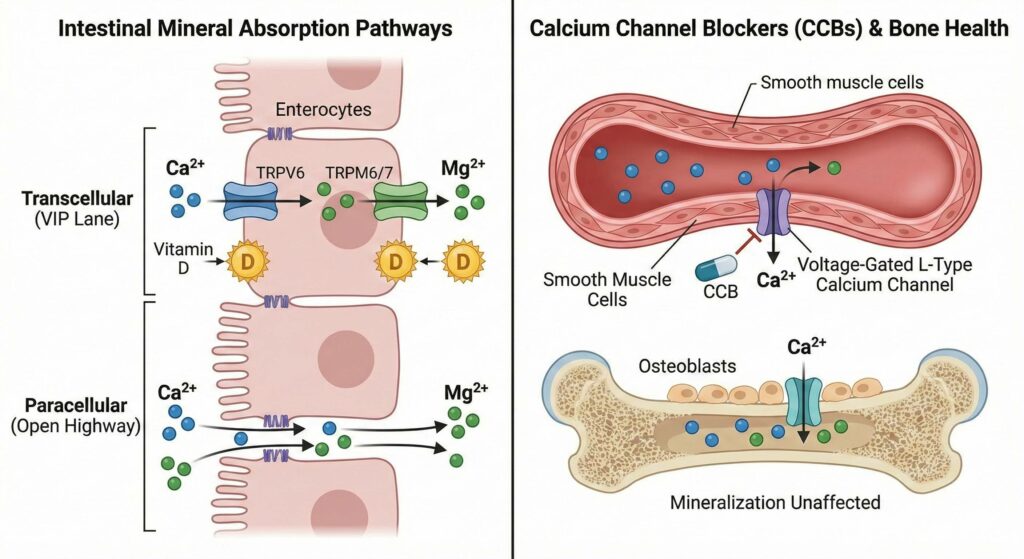
The intestinal tract uses two distinct “highways” to move minerals like calcium and magnesium from your food into your bloodstream. Understanding these explains why they sometimes get in each other’s way.
The Two Main Transport Pathways
1. The Transcellular Pathway (The “VIP Lane”)
This is an active, energy-dependent process where the minerals move through the intestinal cells (enterocytes).
- Specific “Gates”: This pathway uses dedicated protein channels.
- Calcium primarily uses a gate called TRPV6 (mostly in the upper small intestine).
- Magnesium uses gates called TRPM6 and TRPM7 (mostly in the lower small intestine and colon).
- The Escort: Once inside the cell, calcium is carried across by a shuttle protein called Calbindin-D9k.
- Regulation: This lane is highly regulated by hormones like Vitamin D. If your body has enough calcium, it “closes” these gates to prevent overload.
2. The Paracellular Pathway (The “Open Highway”)
This is a passive process where minerals slip between the junctions of the intestinal cells.
- No Gates: There are no specific protein transporters here; it’s driven purely by concentration. If you have a high concentration of minerals in your gut (like after taking a supplement), they “leak” through the gaps into your blood.
- Non-Saturable: Unlike the VIP lane, this highway doesn’t “fill up,” but it is where most competition happens because the minerals are all crowded into the same narrow spaces at once.
Why Do They Compete?
While they have their own specific “gates” in the transcellular pathway, competition occurs for two main reasons:
- Shared Crowd Space: In the paracellular pathway, a massive influx of one mineral (like a 1,000mg calcium pill) can physically crowd out the other.
- Chemical “Clumping”: In the gut, calcium and magnesium can sometimes bind with phosphates or phytates to form insoluble complexes. If they “clump” together, they become too large to fit through any pathway and are simply flushed out of the body.
Should You Break Up the Consumption?
For the absolute best results (maximum absorption of every milligram), the answer depends on your dose:
| Dose Size | Recommendation | Why? |
| Low Doses (<250mg combined) | Together is fine. | The “VIP lanes” can handle the small volume without a traffic jam. |
| High Doses (>500mg Calcium) | Separate them. | High doses saturate the pathways and increase the chance of competition. |
| Combined Formulas (2:1 Ratio) | Usually fine. | Many “Cal-Mag” supplements use a 2:1 ratio (e.g., 500mg Ca to 250mg Mg) which is physiologically balanced for most people. |
The “Best Results” Strategy
- Space them by 2 hours: If you are taking high-dose individual supplements, take your Calcium with breakfast and your Magnesium with dinner (Magnesium also helps with evening relaxation).
- Watch the Vitamin D: Since Vitamin D “opens the gates” for calcium, ensure your D levels are adequate, or your calcium will just sit in the “highway” and block the magnesium.
What are these transport pathways in the intestinal tract?
The intestinal tract uses two distinct “highways” to move minerals like calcium and magnesium from your food into your bloodstream. Understanding these explains why they sometimes get in each other’s way.
The Two Main Transport Pathways
1. The Transcellular Pathway (The “VIP Lane”)
This is an active, energy-dependent process where the minerals move through the intestinal cells (enterocytes).
- Specific “Gates”: This pathway uses dedicated protein channels.
- Calcium primarily uses a gate called TRPV6 (mostly in the upper small intestine).
- Magnesium uses gates called TRPM6 and TRPM7 (mostly in the lower small intestine and colon).
- The Escort: Once inside the cell, calcium is carried across by a shuttle protein called Calbindin-D9k.
- Regulation: This lane is highly regulated by hormones like Vitamin D. If your body has enough calcium, it “closes” these gates to prevent overload.
2. The Paracellular Pathway (The “Open Highway”)
This is a passive process where minerals slip between the junctions of the intestinal cells.
- No Gates: There are no specific protein transporters here; it’s driven purely by concentration. If you have a high concentration of minerals in your gut (like after taking a supplement), they “leak” through the gaps into your blood.
- Non-Saturable: Unlike the VIP lane, this highway doesn’t “fill up,” but it is where most competition happens because the minerals are all crowded into the same narrow spaces at once.
Why Do They Compete?
While they have their own specific “gates” in the transcellular pathway, competition occurs for two main reasons:
- Shared Crowd Space: In the paracellular pathway, a massive influx of one mineral (like a 1,000mg calcium pill) can physically crowd out the other.
- Chemical “Clumping”: In the gut, calcium and magnesium can sometimes bind with phosphates or phytates to form insoluble complexes. If they “clump” together, they become too large to fit through any pathway and are simply flushed out of the body.
Should You Break Up the Consumption?
For the absolute best results (maximum absorption of every milligram), the answer depends on your dose:
| Dose Size | Recommendation | Why? |
| Low Doses (<250mg combined) | Together is fine. | The “VIP lanes” can handle the small volume without a traffic jam. |
| High Doses (>500mg Calcium) | Separate them. | High doses saturate the pathways and increase the chance of competition. |
| Combined Formulas (2:1 Ratio) | Usually fine. | Many “Cal-Mag” supplements use a 2:1 ratio (e.g., 500mg Ca to 250mg Mg) which is physiologically balanced for most people. |
The “Best Results” Strategy
- Space them by 2 hours: If you are taking high-dose individual supplements, take your Calcium with breakfast and your Magnesium with dinner (Magnesium also helps with evening relaxation).
- Watch the Vitamin D: Since Vitamin D “opens the gates” for calcium, ensure your D levels are adequate, or your calcium will just sit in the “highway” and block the magnesium.
Summary:
Calcium and magnesium interact through a complex balance of competition and cooperation within the intestinal tract’s transcellular (active) and paracellular (passive) pathways. While high supplemental doses can compete for absorption “highway” space, magnesium remains essential for activating the Vitamin D required for calcium uptake. Similarly, medications like calcium channel blockers do not interfere with bone density or mineralization because they specifically target voltage-gated L-type channels in cardiovascular tissue rather than the distinct mechanisms used by the bone matrix. For optimal absorption, spacing high-dose individual supplements by at least two hours ensures these minerals do not crowd intestinal transport gates, maintaining a healthy equilibrium between systemic regulation and structural bone health.
Leave a Reply