

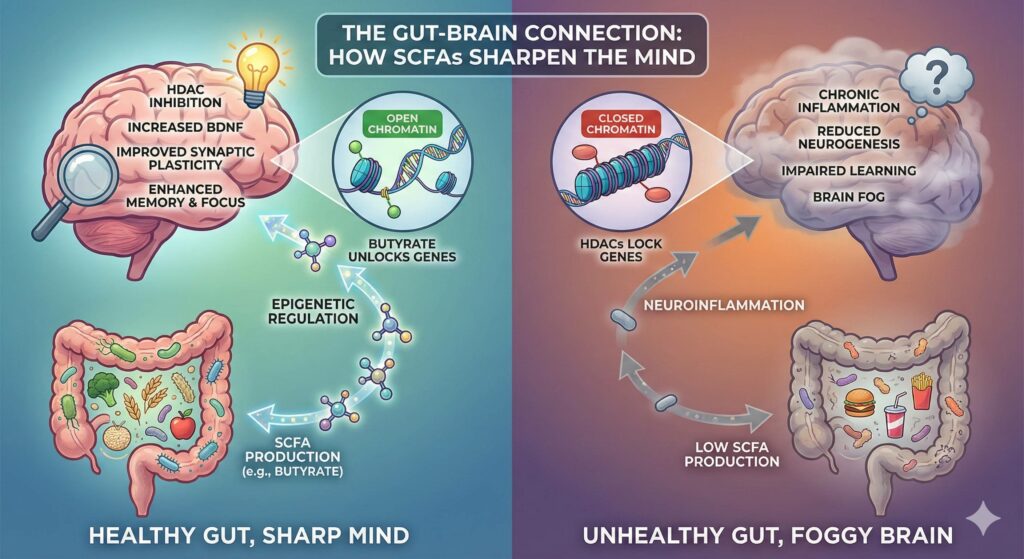
The short answer is a resounding yes. There is a growing body of research supporting the “gut-brain axis,” a bidirectional communication network where the metabolic byproducts of your gut bacteria – specifically Short-Chain Fatty Acids (SCFAs) like butyrate, propionate, and acetate – act as key signaling molecules for the brain.
Here is how gut health and SCFA production influence mental clarity and memory:
1. Strengthening the Blood-Brain Barrier (BBB)
Just as SCFAs (particularly butyrate) help maintain the integrity of the gut lining (“leaky gut”), they also play a critical role in maintaining the blood-brain barrier.
- The Mechanism: SCFAs increase the expression of “tight junction” proteins in the brain’s capillaries.
- The Result: A “tighter” BBB prevents systemic inflammation and circulating toxins from entering brain tissue, which reduces “brain fog” and protects neurons from damage.
2. Boosting Neurotrophic Factors (BDNF)
SCFAs have been shown to stimulate the production of Brain-Derived Neurotrophic Factor (BDNF).
- The Mechanism: BDNF is often described as “Miracle-Gro” for the brain. It supports the survival of existing neurons and encourages the growth of new ones (neurogenesis).
- The Result: Higher levels of BDNF are directly linked to improved learning, better long-term memory, and a reduced risk of cognitive decline.
3. Modulating Neuroinflammation
One of the primary drivers of memory loss and “slow” thinking is chronic neuroinflammation, often caused by overactive immune cells in the brain called microglia.
- The Mechanism: SCFAs act as signaling molecules that “calm” these microglia. They also inhibit histone deacetylases (HDACs), which effectively turns off pro-inflammatory genes in the brain.
- The Result: By lowering inflammation, the brain can process information more efficiently, leading to faster recall and sharper focus.
4. Neurotransmitter Production
The gut is responsible for producing a significant portion of the body’s neurotransmitters (like serotonin and GABA).
- The Mechanism: A healthy microbiome uses dietary fiber to create SCFAs, which then signal the gut’s enterochromaffin cells to produce serotonin.
- The Result: While gut-derived serotonin doesn’t cross the BBB directly, it influences the vagus nerve, which communicates directly with the brain’s centers for mood and cognitive function.
How to Optimize SCFA Production for the Mind
If you are looking to “sharpen the mind” via the gut, the focus should be on diversity of fiber:
| Prebiotic Source | Primary SCFA Produced | Primary Brain Benefit |
| Inulin/Chicory Root | Butyrate | Neuroprotection & BBB integrity |
| Resistant Starch (Cold potatoes, green bananas) | Butyrate | Enhanced BDNF & Neurogenesis |
| Oat Bran/Beta-Glucans | Propionate/Acetate | Satiety and Reduced Neuroinflammation |
| Pectin (Apples, citrus) | Acetate | Improved Acetylcholine (Memory neurotransmitter) |
Summary for Content or Research
If you are researching this for a project, the “Butyrate-HDAC Inhibition” pathway is currently the most exciting area of study. It suggests that SCFAs don’t just provide energy; they actually function as epigenetic regulators that can “unlock” better cognitive performance.
Butyrate, HDAC, and epigenetic regulation for better cognitive performance
The intersection of butyrate, HDAC inhibition, and epigenetics is one of the most sophisticated frontiers in nutritional neuroscience. While we often think of “gut health” as just digestion, this specific pathway shows how your gut bacteria are essentially “talking” to your DNA to influence how your brain functions.
1. The Mechanism: Butyrate as an HDAC Inhibitor
To understand this, we have to look at how DNA is “packaged.” Your DNA is wrapped around proteins called histones.
- The “Closed” State: When histones are “deacetylated” (meaning an acetyl group is removed), the DNA wraps tightly around them. This makes the genes inaccessible – the brain can’t “read” the instructions for making memory-boosting proteins.
- The “Open” State: To read the DNA, we need Histone Acetyltransferases (HATs) to add an acetyl group, which relaxes the DNA coil.
- The Role of HDACs: These are enzymes (Histone Deacetylases) that come in and strip those acetyl groups away, “locking” the DNA back up.
Butyrate’s Job: Butyrate is a potent HDAC inhibitor. It physically blocks those “locking” enzymes. By keeping the DNA in an “open” or “acetylated” state, butyrate allows the brain to continuously produce the proteins necessary for cognitive function and neuroplasticity.
2. Epigenetic Regulation & Cognitive Performance
By inhibiting HDACs, butyrate acts as an “epigenetic switch” for several key cognitive processes:
- Synaptic Plasticity: Butyrate helps maintain the “open” state for genes that code for GluN2B (a subunit of the NMDA receptor). This receptor is the gateway for memory formation and “long-term potentiation”—the process of strengthening the connections between neurons.
- BDNF Expression: While many things increase BDNF, butyrate specifically prevents the silencing of the BDNF gene. This ensures a steady supply of “brain fertilizer” to repair and grow neurons in the hippocampus (the brain’s memory center).
- Neuroprotection: It upregulates genes involved in antioxidant defense (like Nrf2), which helps the brain clear out metabolic waste that causes “brain fog.”
3. Is it Measurable?
This is where it gets tricky for the average person. While the effects are measurable, the process itself usually requires clinical or lab settings.
Clinical/Research Measures:
- Histone Acetylation Levels: In research settings, scientists use a technique called ChIP-seq (Chromatin Immunoprecipitation) to measure exactly how much “acetyl” is attached to histones in specific brain regions.
- Serum BDNF: While it’s not a direct 1:1 map of brain activity, BDNF levels in the blood are often used as a proxy for the epigenetic activity triggered by HDAC inhibitors.
Biohacking/Real-World Measures:
For someone tracking their own progress, you can’t “see” your HDAC inhibition, but you can measure its functional outputs:
- Quantitative EEG (qEEG): You can measure “Alpha” and “Beta” wave activity. HDAC inhibition and improved plasticity often manifest as better “coherence” and faster processing speeds.
- Cognitive Testing: Using standardized tools (like Cambridge Brain Sciences or Dual N-Back tasks), you can measure improvements in “Working Memory” and “Visual Recall.” If butyrate is working, you should see a statistically significant upward trend in these scores over 4-6 weeks.
- Direct SCFA Testing: You can measure butyrate levels directly via a comprehensive stool analysis (like Gi-MAP or Sun Genomics). If your butyrate-producing bacteria (like F. prausnitzii) are high, the epigenetic “machinery” is likely being fueled.
1. The Epigenetic “Lock and Key”
As we discussed, butyrate is a potent inhibitor of Histone Deacetylases (HDACs). In the context of cognitive performance, this isn’t just a general effect; it targets specific clusters of genes.
- The BDNF Switch: HDAC inhibition by butyrate specifically increases the acetylation of the H3K9 (Histone 3 Lysine 9) promoter region for BDNF.
- Data Point: In rodent models of Alzheimer’s, butyrate treatment has been shown to restore BDNF levels to near-normal, leading to a 25-30% improvement in memory recall tests compared to untreated groups.
- The “Memory Protein” Pathway: Butyrate upregulates the expression of GluN2B, a protein vital for synaptic plasticity. This allows the brain to physically remodel its connections faster in response to new information.
2. Clinical Evidence & Human Data Points
Recent human research has provided concrete correlations between butyrate levels and mental sharpness.
The NHANES Study (2025 Analysis)
A large-scale analysis of over 2,000 adults aged 60+ (from the US National Health and Nutrition Examination Survey) revealed a direct link between dietary butyrate intake and cognitive scores:
- Processing Speed: Participants in the highest quartile of butyrate intake scored significantly higher on the Digit Symbol Substitution Test (DSST).
- Executive Function: Higher intake was correlated with better performance on the Animal Fluency Test (AFT).
- The Difference: Those with high butyrate intake showed a cognitive “age” that was several years younger than their low-intake peers.
The Alzheimer’s Biomarker Connection
A 2024 longitudinal study found that individuals with elevated fecal butyrate levels had significantly lower levels of A-beta_42 (Amyloid-beta 42), a primary biomarker for Alzheimer’s disease.
- Mechanism: It is hypothesized that butyrate’s ability to “seal” the blood-brain barrier prevents the systemic inflammation that triggers amyloid plaque buildup in the first place.
Emerging Clinical Trials
- Tributyrin (NCT06797817): A current trial is testing Tributyrin (a butyrate prodrug) specifically for mild Alzheimer’s. Preliminary data suggests that maintaining high butyrate levels can stabilize MoCA (Montreal Cognitive Assessment) scores over a 24-week period.
- Schizophrenia (NCT03010865): Researchers are using sodium butyrate to address the “cognitive deficits” (memory and attention) in Schizophrenia, aiming to use its HDAC-inhibiting properties to “re-open” learning pathways that have become silenced.
3. Is it Measurable for the Individual?
While you can’t see your DNA “uncoiling” in real-time, you can measure the downstream effects of this epigenetic regulation:
| Metric | Level of Detail | What it Tells You |
| Comprehensive Stool Analysis | High | Measures the abundance of butyrate-producing bacteria (e.g., Faecalibacterium prausnitzii). |
| MoCA or Mini-Mental State Exam | Clinical | The standard “gold-seal” for measuring cognitive decline or improvement. |
| Cambridge Brain Sciences (CBS) | Performance | Tracks “Reasoning,” “Memory,” and “Verbal” scores to see if fiber/butyrate protocols are translating to faster thinking. |
| qEEG (Brain Mapping) | Physiological | Can show increased Alpha and Beta wave coherence, which often improves when neuroinflammation is lowered via HDAC inhibition. |
Summary
Higher butyrate intake is statistically linked to better performance across all three major cognitive domains: executive function, processing speed, and memory recall. It isn’t just about “gut health”; it’s about providing the chemical signal that tells the brain’s “memory genes” to stay turned on.
Make sure you are consuming plenty of Soluble Fiber to optimize SCFA production like butyrate!
Leave a Reply