

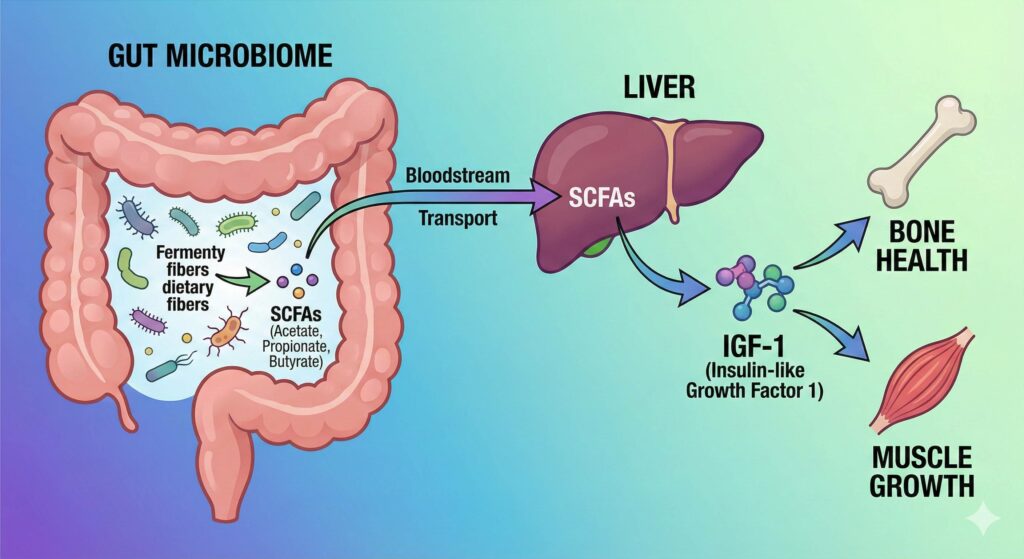
Research indicates a strong connection between gut health and the production of Insulin-like Growth Factor 1 (IGF-1).1 This relationship is primarily mediated by the “gut-liver axis,” where the metabolites produced by a healthy microbiome – specifically Short-Chain Fatty Acids (SCFAs) – act as signaling molecules that trigger the systemic release of this vital growth hormone.2
The Gut-Liver Connection
While the majority of IGF-1 is produced in the liver in response to Growth Hormone (GH), recent studies have shown that the gut microbiota plays a critical role in modulating these levels.3
- The Signaling Pathway: When beneficial bacteria ferment prebiotic fibers, they produce SCFAs (acetate, propionate, and butyrate).4 These SCFAs enter the bloodstream and travel to the liver and adipose (fat) tissue.5
- Inducing Production: Research, including studies on germ-free models, has demonstrated that the presence of SCFAs is “sufficient to induce” host IGF-1 synthesis.6 Essentially, SCFAs signal the liver to increase its output of IGF-1.7
- Bioavailability: Beyond just production, SCFAs like butyrate help regulate IGF-binding proteins (IGFBPs).8 These proteins act as “carriers” that determine how much IGF-1 is actually available for your tissues to use.9
Key Benefits of the SCFA-IGF-1 Link
The interaction between your gut and IGF-1 has broad implications for systemic health:
| Health Area | Impact of SCFA-Induced IGF-1 |
| Bone Health | IGF-1 is a master regulator of bone formation. SCFAs promote bone density and skeletal growth specifically by boosting IGF-1 levels. |
| Muscle Growth | As an anabolic hormone, IGF-1 is essential for muscle repair and protein synthesis, making gut health a factor in maintaining muscle mass. |
| Metabolic Health | IGF-1 helps regulate blood sugar and insulin sensitivity. SCFAs support this by acting on G-protein coupled receptors (like GPR43) to improve metabolic signaling. |
| Gut Integrity | Locally, IGF-1 can promote the repair and regeneration of the intestinal lining, creating a positive feedback loop for gut health. |
Mechanisms of Action
SCFAs influence IGF-1 through two primary biological “switches”:
- HDAC Inhibition: Butyrate acts as a histone deacetylase inhibitor, which can “turn on” certain genes related to growth factors and their binding proteins.10
- GPCR Activation: SCFAs bind to specific receptors (GPR41 and GPR43) on various cells, which can trigger hormonal cascades that eventually boost circulating IGF-1.
Note: Clinical research is increasingly looking at how “microbiota-directed foods” (high-fiber diets) can be used to treat growth-related issues or age-related bone loss by naturally optimizing the body’s IGF-1 production.
A healthy gut microbiome promotes the release of Insulin-like Growth Factor 1 (IGF-1) by fermenting prebiotic fibers into Short-Chain Fatty Acids (SCFAs), which travel through the bloodstream to the liver to stimulate hormone synthesis. This “gut-liver axis” connection relies on SCFAs like butyrate and propionate to act as signaling molecules that not only trigger the production of IGF-1 but also regulate the binding proteins that determine its bioavailability in the body. By optimizing this pathway, the gut effectively influences systemic processes such as bone mineralization, muscle protein synthesis, and metabolic regulation, highlighting the microbiome’s role as a critical endocrine organ.
Leave a Reply