
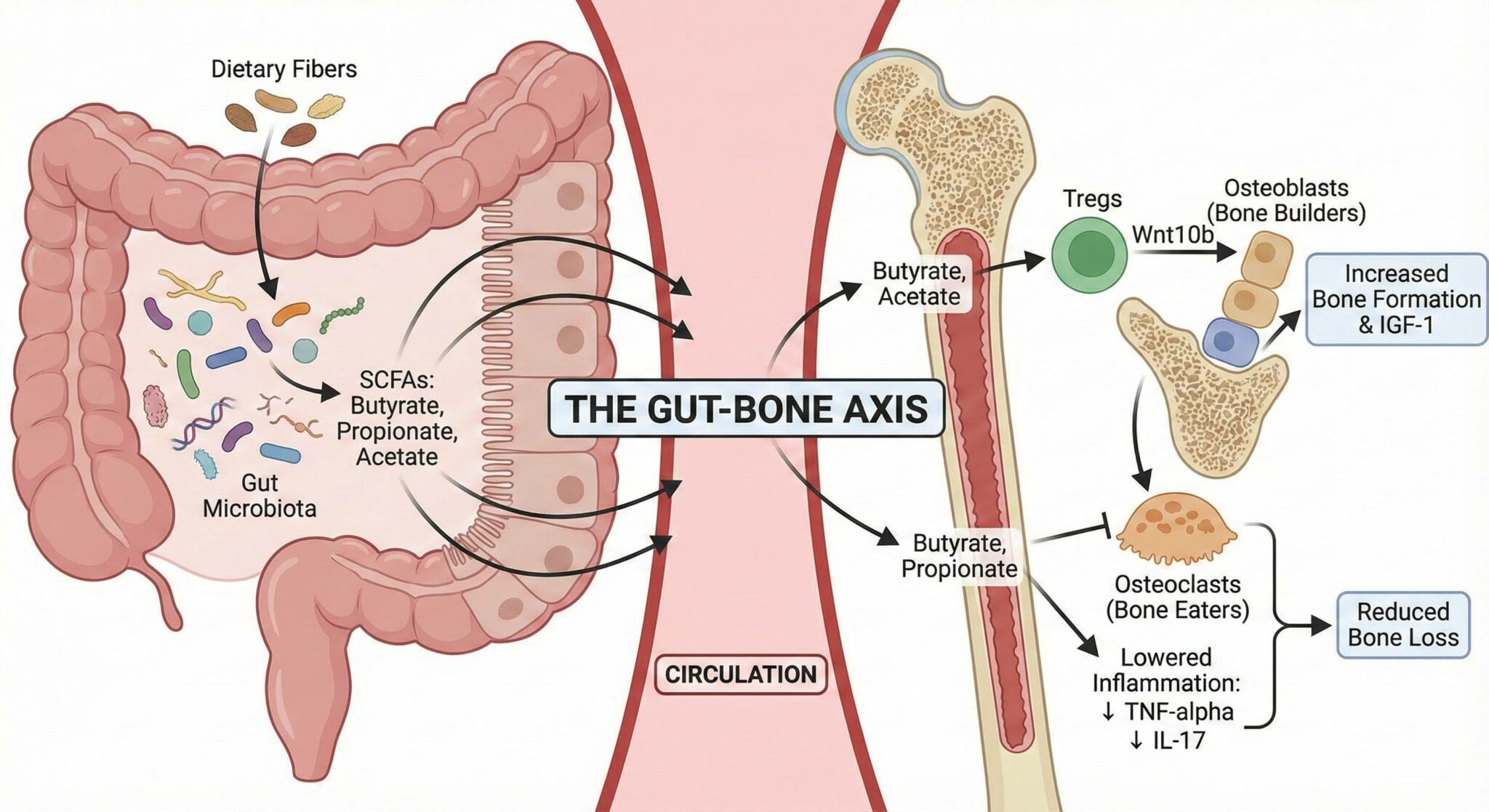
Yes, current research indicates that Short-Chain Fatty Acids (SCFAs) can act as a “double-agent” for bone health: they both stimulate new bone formation and prevent bone loss.
This connection is now widely referred to by scientists as the “Gut-Bone Axis,” a communication highway where the health of your microbiome directly impacts your skeletal strength.
Here is the breakdown of the biological mechanisms for both functions.
1. Can SCFAs help bone formation? (Osteogenesis)
Yes. SCFAs do not just protect existing bone; they actively signal the body to build more.
- Fueling Osteoblasts: Osteoblasts are the cells responsible for laying down new bone. SCFAs, particularly Butyrate, have been shown to directly stimulate the differentiation of these cells, making them more active and efficient at mineralizing bone.
- The Immune Pathway (Treg Cells): This is the most fascinating mechanism. SCFAs increase the number of Regulatory T Cells (Tregs) in your gut. These immune cells then travel to the bone marrow and release signaling proteins (such as Wnt10b). This signal “activates” the bone-building cells (osteoblasts) to start forming new bone tissue.
- Increasing IGF-1: SCFAs have been linked to higher circulating levels of IGF-1 (Insulin-like Growth Factor 1), a critical hormone that promotes the growth and mineralization of skeletal tissue.
2. Can SCFAs assist in preventing bone loss? (Anti-Resorption)
Yes. This is perhaps their strongest effect. Bone loss occurs when “bone-eating” cells (osteoclasts) become too aggressive, often due to inflammation.
- Stopping the “Bone Eaters”: SCFAs (specifically Propionate and Butyrate) can “reprogram” the metabolism of osteoclasts. By shifting how these cells use energy, SCFAs essentially force them to power down, inhibiting their ability to break down bone tissue.
- Lowering Inflammation: Chronic inflammation is a primary driver of osteoporosis and bone loss (often called “inflamm-aging”). SCFAs are potent anti-inflammatories. By lowering systemic inflammation (reducing cytokines like TNF-alpha and IL-17), they remove the signal that typically triggers rapid bone loss.
- Gut Barrier Integrity: A “leaky gut” allows toxins to enter the bloodstream, which triggers inflammation that eats away at bone. SCFAs strengthen the gut lining, preventing this leakage and preserving bone density indirectly.
Summary Table: Specific SCFAs and Bone Health
| SCFA | Primary Bone Benefit | Mechanism |
| Butyrate | Dual Action (Formation & Protection) | Stimulates bone-building cells (osteoblasts) and inhibits bone-eating cells (osteoclasts). |
| Propionate | Protection (Anti-Resorption) | Reduces inflammation and inhibits the differentiation of osteoclasts. |
| Acetate | Support | Primarily acts as a fuel source but supports the overall environment for the other two to work. |
The “Take-Home” on Efficacy
While much of this research comes from advanced animal models (showing that high-fiber diets can actually reverse bone loss in post-menopausal models), the biological pathways are conserved in humans. This suggests that a diet high in fermentable fibers (prebiotics) is a viable strategy for supporting skeletal integrity.
Leave a Reply