
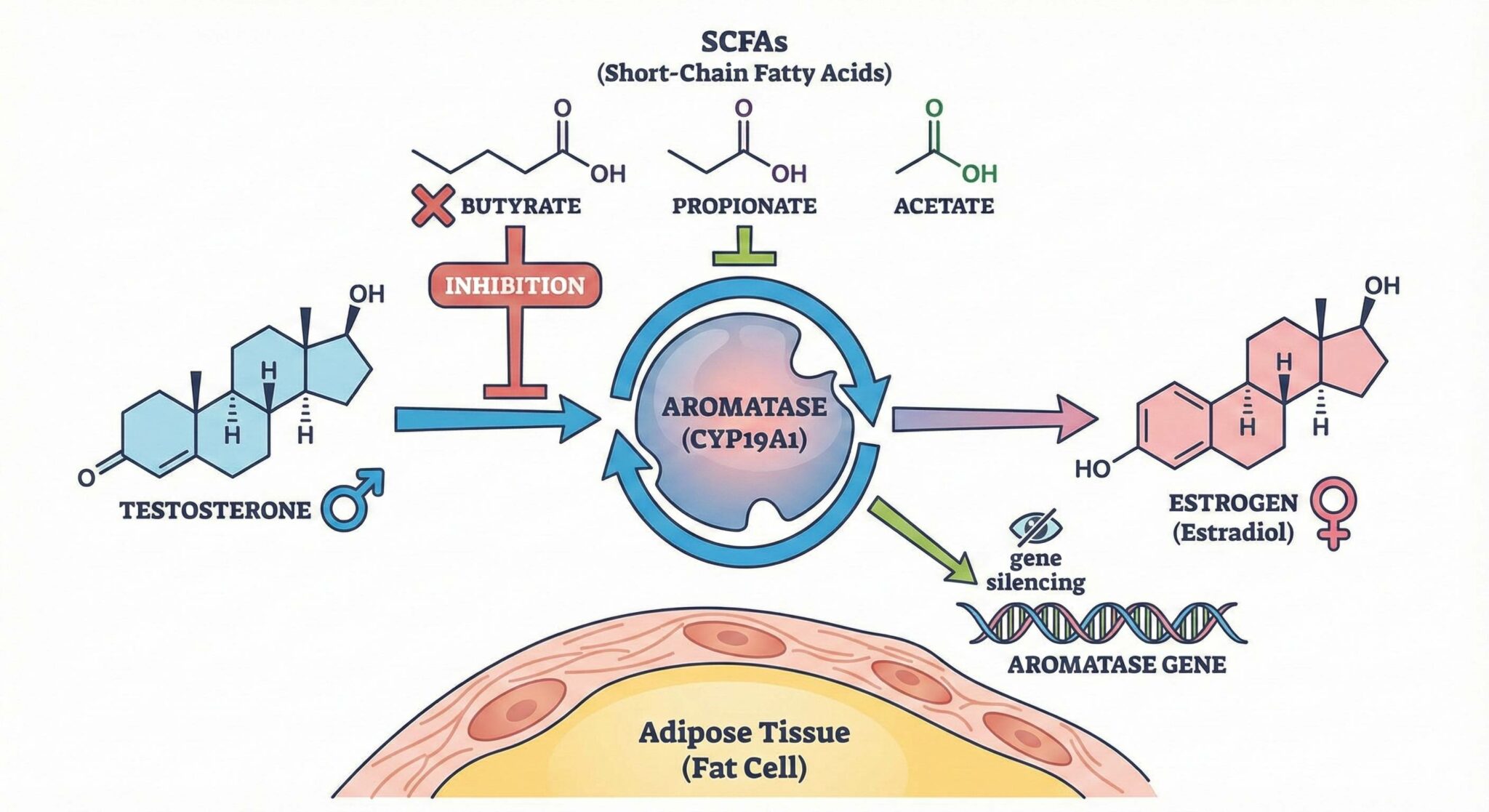
Yes, there is evidence that Short-Chain Fatty Acids (SCFAs) – specifically butyrate – can slow down the conversion of testosterone to estrogen.
They do this through two distinct pathways: a direct mechanism where butyrate suppresses the “conversion enzyme” itself, and an indirect mechanism where SCFAs reduce the body fat that drives this conversion.
Here is the breakdown of how SCFAs affect this hormonal balance.
1. The Direct Mechanism: Stopping the Enzyme (Butyrate)
The conversion of testosterone to estrogen is handled by an enzyme called aromatase. If you have high aromatase activity, more of your free circulating testosterone gets “aromatized” (converted) into estrogen.
- Butyrate inhibits Aromatase: Research indicates that Sodium Butyrate (a form of the SCFA butyrate) can directly inhibit the expression of the aromatase gene.
- How it works: It acts as a Histone Deacetylase (HDAC) inhibitor. In simple terms, it “switches off” specific promoters (promoters I.3 and II) on the gene that tells your cells to create the aromatase enzyme.
- Where it happens: This effect has been specifically observed in adipose (fat) tissue fibroblasts. This is crucial because body fat is the primary site where testosterone is converted into estrogen in men. By silencing the gene in fat cells, butyrate effectively reduces the “machinery” available to convert your testosterone.
2. The Indirect Mechanism: Shrinking the “Factory”
Beyond direct gene silencing, all three major SCFAs (Butyrate, Propionate, and Acetate) help slow this conversion by changing your body composition.
- Fat is the Factory: Visceral body fat (belly fat) is essentially a giant factory for aromatase. The more belly fat you have, the more aromatase you produce, and the more testosterone gets converted to estrogen.
- SCFAs burn the Factory: SCFAs regulate energy metabolism and improve insulin sensitivity. They signal your body to stop storing fat and start burning it.
- The Result: By reducing visceral fat over time, you physically remove the tissue responsible for the majority of testosterone-to-estrogen conversion.
3. Bonus: The “Estrobolome” Factor
While not a direct conversion issue, SCFAs also help manage the estrogen already in your system.
- Estrogen Recycling: Your liver dumps excess estrogen into your gut to be excreted. However, if your gut microbiome is unhealthy (dysbiosis), certain bad bacteria produce an enzyme called beta-glucuronidase. This enzyme “unlocks” the excreted estrogen, allowing it to be re-absorbed back into your bloodstream.
- SCFA Role: A high-fiber diet that produces SCFAs lowers the pH of the colon, which can inhibit these “estrogen-recycling” bacteria. This ensures that once estrogen is removed, it stays removed, rather than re-entering circulation to compete with testosterone.
Summary Table
| Mechanism | SCFA Involved | Action | Effect on T to E Conversion |
| Direct Inhibition | Butyrate | Silences the gene for Aromatase (CYP19A1). | High: Directly prevents the enzyme from being created in fat cells. |
| Metabolic Control | All (Butyrate, Propionate, Acetate) | Improves insulin sensitivity & reduces visceral fat. | Medium/High: Reduces the amount of fat tissue available to perform the conversion. |
| Gut Health | All | Lowers colon pH & suppresses Beta-glucuronidase. | Indirect: Prevents estrogen from being re-absorbed, keeping the T:E ratio healthy. |
Short-Chain Fatty Acids (SCFAs), particularly butyrate, act as a natural brake on the conversion of testosterone into estrogen through both direct and metabolic pathways. Directly, butyrate functions as a gene silencer (HDAC inhibitor) in fat cells, suppressing the production of aromatase, the specific enzyme responsible for transforming testosterone into estrogen. Indirectly, SCFAs improve metabolic health and insulin sensitivity, helping to reduce visceral body fat – the primary “factory” where this hormonal conversion takes place – while also promoting a gut environment that prevents the re-absorption of excess estrogen, thereby preserving higher levels of free circulating testosterone.
Leave a Reply