

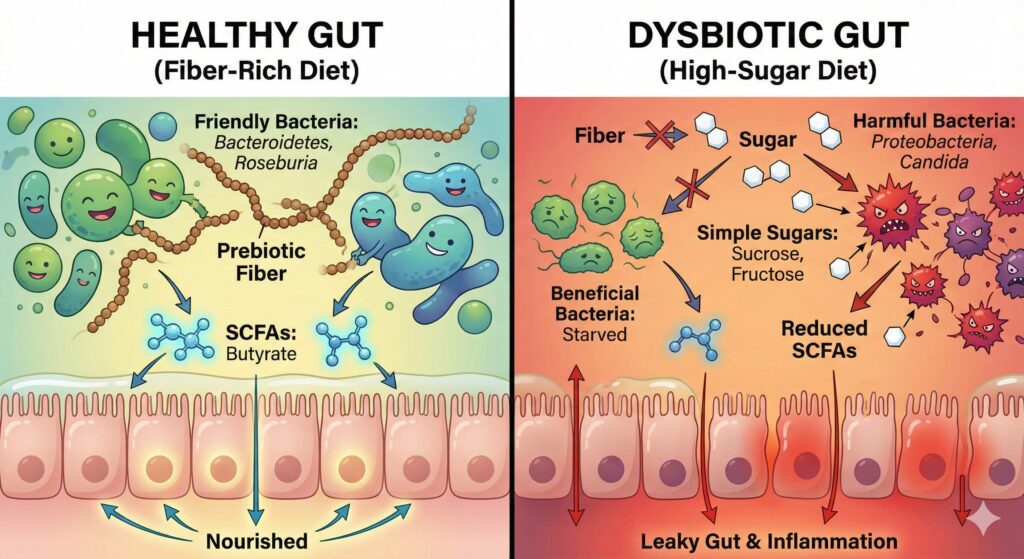
Yes, high sugar intake can cause gut dysbiosis and significantly reduce the production of Short-Chain Fatty Acids (SCFAs).1
In a healthy gut, beneficial bacteria ferment dietary fiber to produce SCFAs (like butyrate), which fuel your gut cells and lower inflammation.2 When you consume excess sugar, you disrupt this ecosystem, effectively “starving” the good bacteria and feeding the harmful ones.3
The following breakdown explains how this process works.
1. Sugar Feeds the “Bad” Bacteria (Dysbiosis)4
Simple sugars (like sucrose and fructose) are rapidly absorbed in the small intestine. However, when you consume them in excess, they can spill over into the colon.5
- The “Sugar Rush” Effect: Harmful bacteria (such as those in the Proteobacteria phylum) and yeasts (like Candida) thrive on simple sugars.6 They feast on this excess sugar and reproduce rapidly.7
- Crowding Out: As these sugar-loving microbes multiply, they aggressively compete for space and resources, crowding out the beneficial bacterial species (like Bacteroidetes) that rely on complex fibers.8
- Loss of Diversity: This shift leads to a drop in microbial diversity.9 A diverse microbiome is resilient; a sugar-dominant microbiome is fragile and prone to infection.
2. How Sugar Slows SCFA Production
Friendly bacteria (such as Faecalibacterium prausnitzii and Roseburia) are the “factories” that produce SCFAs.10 Sugar sabotages their production line in three ways:
- Starvation: SCFA producers require prebiotic fiber (from vegetables, grains, legumes) to function. A high-sugar diet often lacks fiber. Without their primary fuel source, these bacteria cannot produce SCFAs.
- Population Decline: As mentioned above, the sugar-eating bacteria physically displace the fiber-eating bacteria. Fewer fiber-eating bacteria directly results in lower SCFA output.
- Metabolic Shift: Some bacteria are “metabolic switch-hitters.” If given a choice between easy sugar and difficult fiber, they will choose sugar. When they switch to metabolizing sugar, they produce different byproducts (like gases or lactate) instead of the beneficial SCFAs.
3. The Consequence: A Vicious Cycle
The reduction of SCFAs creates a dangerous feedback loop in the gut:
| Component | Normal Function | Effect of Low SCFAs |
| Gut Lining | SCFAs (especially butyrate) fuel the cells lining the colon, keeping them tight and healthy. | Cells become energy-starved and weak, leading to gaps between cells (Leaky Gut). |
| pH Level | SCFAs are acidic; they keep the gut environment slightly acidic, which kills pathogens. | The gut becomes less acidic (higher pH), creating a perfect environment for pathogens like E. coli or Salmonella to thrive. |
| Mucus Layer | SCFAs stimulate the production of a protective mucus layer over the gut wall. | The mucus layer thins, allowing bacteria to come into direct contact with the gut wall, triggering inflammation. |
Summary
By eating excess sugar, you are essentially firing the “workers” (good bacteria) who repair your gut lining and hiring “vandals” (bad bacteria) who damage it.11
High sugar intake significantly damages gut health by causing dysbiosis and reducing the production of essential Short-Chain Fatty Acids (SCFAs). In a healthy ecosystem, beneficial bacteria ferment prebiotic fiber to produce SCFAs like butyrate, which nourish gut cells and maintain a strong barrier. However, excessive consumption of simple sugars feeds harmful bacteria and yeasts, allowing them to proliferate and crowd out beneficial species. This shift not only starves the “good” bacteria of their necessary fiber fuel but also causes some to shift their metabolism away from producing SCFAs. The resulting decline in SCFAs weakens the intestinal lining, thins the protective mucus layer, and raises gut pH, creating a vicious cycle that leads to inflammation and “leaky gut.”
Sources:
blog.mdpi.com
How Sugar Affects Gut Microbiota – MDPI Blog
Accordingly, such an imbalance is known as dysbiosis. Bacteroides produce short-chain fatty acids by breaking down complex carbohydrates, but what do these do? …
pmc.ncbi.nlm.nih.gov
The Interplay of Dietary Fibers and Intestinal Microbiota Affects Type 2 Diabetes by Generating Short-Chain Fatty Acids – PubMed Central
Dietary fiber is resistant to digestive enzymes in the gut, which modulates the anaerobic intestinal microbiota (AIM) and fabricates SCFAs. Acetate, butyrate, …
missiongastrohospital.com
How Sugar Impacts Your Gut Health – Mission Gastro Hospital
Excess sugar feeds harmful bacteria and yeast. When you ingest large quantities of sugar, it fosters a perfect environment for harmful microorganisms to …
news.yale.edu
Sugar targets gut microbe linked to lean and healthy people – Yale News
The gut microbiota plays a key role in human health, and its composition is associated with diet. Until recently, scientists believed that sugar was absorbed …
Chiropractor Spokane Valley WA
www.rccspokanevalley.com
Sweet Poison: How Excessive Sugar Consumption Harms Your Gut Health in Spokane Valley WA
Promotes the Growth of Harmful Pathogens and Cancer Cells: Sugar serves as food for harmful pathogens in the gut, such as Candida yeast and harmful bacteria …
blog.mdpi.com
How Sugar Affects Gut Microbiota – MDPI Blog
A high intake of sugar modifies the ratio between Proteobacteria and Bacteroides. This happens when excess sugar is not absorbed in the small intestine and is …
sydneygastroenterologist.com.au
Sugar And The Gut Microbiome – Dr. Suhirdan Vivekanandarajah
In fact, a study conducted on mice found that a high sucrose/glucose diet affected a beneficial type of bacteria, the Bacteroides thetaiotaomicron. This …
www.researchgate.net
High Intake of Sugar and the Balance between Pro- and Anti-Inflammatory Gut Bacteria
impaired integrity, and the animals developed metabolic endotoxemia and hepatic steatosis, while. remaining normal-weight [6]. The observed microbial changes …
pmc.ncbi.nlm.nih.gov
Gut Microbiota Dysbiosis: Triggers, Consequences, Diagnostic and Therapeutic Options
At the species level, a decrease in SCFA-producing bacteria such as Faecalibacterium prausnitzii and Clostridium clusters IV, XIVa and XVIII [39] and an …
Leave a Reply