

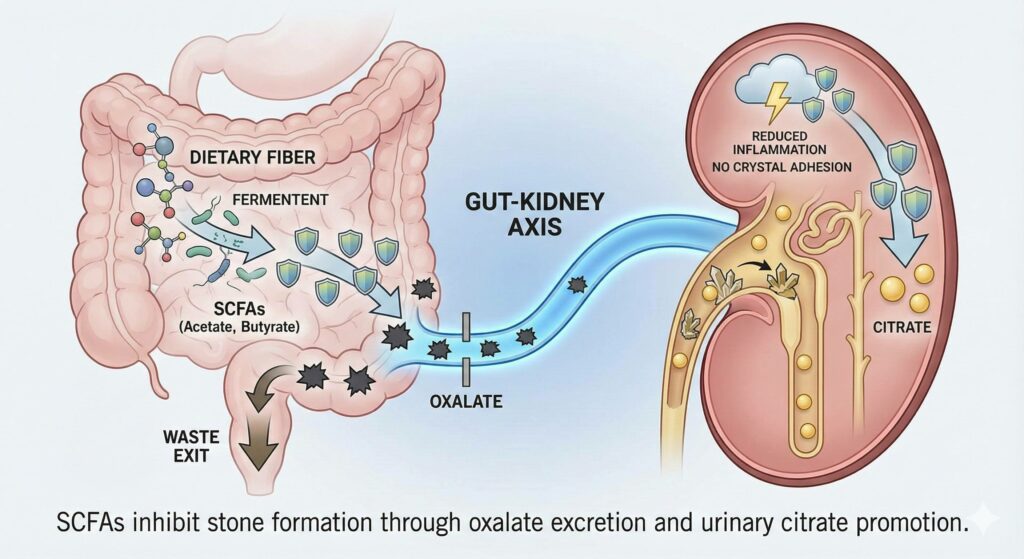
Emerging research suggests that short-chain fatty acids (SCFAs) – primarily acetate, propionate, and butyrate – play a vital role in preventing the formation of kidney stones, particularly the most common type: calcium oxalate (CaOx) stones.1
This connection is part of what scientists call the “gut-kidney axis.” Here is how SCFAs help the kidneys manage and prevent stone formation:
1. Regulation of Oxalate Transport
Oxalate is a primary building block of most kidney stones. SCFAs help control how much oxalate enters your system through the gut:
- Intestinal Transporters: Research shows that SCFAs (especially acetate and propionate) regulate specific proteins in the gut, such as SLC26A6.2
- Increased Excretion: By activating these transporters, SCFAs can promote the secretion of oxalate back into the intestines to be flushed out of the body, rather than letting it be absorbed into the bloodstream and sent to the kidneys.
2. Reducing Kidney Inflammation
Kidney stones aren’t just about minerals; they often involve an inflammatory response to crystals that have already formed.3
- Immune Shield: SCFAs act on receptors (like GPR43) to modulate the immune system.4 They help increase protective immune cells (macrophages) and decrease aggressive ones (neutrophils) that cause tissue damage when crystals are present.
- Preventing Adhesion: By keeping inflammation low, SCFAs make it harder for small “seed” crystals to stick to the walls of the kidney tubules, which prevents them from growing into full-sized stones.
3. Boosting Urinary Citrate
Citrate is one of the body’s most powerful natural defenses against kidney stones because it binds to calcium, preventing it from binding with oxalate.
- A Positive Link: Clinical studies have found that people with higher levels of SCFAs in their blood also tend to have higher levels of urinary citrate, creating a more “stone-resistant” environment in the urine.5
4. The Role of Gut Microbiota
People who suffer from recurrent kidney stones often have a “dysbiosis” (imbalance) in their gut bacteria.6
- Missing Producers: Research indicates that stone-formers typically have fewer SCFA-producing bacteria, such as Faecalibacterium prausnitzii.7
- Fiber Connection: Since SCFAs are produced when your gut bacteria ferment dietary fiber, a low-fiber diet can lead to lower SCFA levels, potentially increasing the risk of stone formation.
Summary Table: How SCFAs Fight Stones
| Mechanism | Impact on Stones |
| Oxalate Transport | Decreases the amount of oxalate that reaches the kidneys. |
| Anti-Inflammatory | Reduces the “stickiness” and damage caused by crystals in the kidney. |
| Citrate Production | Encourages the body to produce citrate, which blocks stone growth. |
| Microbiome Health | Crowds out stone-promoting bacteria and uremic toxins. |
Important Note: While the science is promising, most direct evidence comes from animal models and observational human studies. It is always best to maintain a high-fiber diet and stay well-hydrated as foundational habits for kidney health.
Short-chain fatty acids (SCFAs) like acetate and butyrate serve as a critical defense against kidney stones by modulating the gut-kidney axis to reduce the concentration of stone-forming minerals. They primarily prevent calcium oxalate stones by regulating intestinal transporters that increase oxalate excretion through the gut rather than the kidneys, while simultaneously boosting levels of urinary citrate, a natural stone inhibitor. Furthermore, SCFAs dampen inflammation within the kidney tubules, which prevents small mineral crystals from adhering to tissue and growing into larger, painful stones. Because SCFAs are produced through the fermentation of fiber, maintaining a diverse gut microbiome is essential for providing these systemic protective benefits.
Leave a Reply