

Does DIM prevent testosterone from converting to estrogen, and does it help the liver tag hormones like estrogen for elimination?
The short answer is both, but its primary and most well-documented role is helping the liver “tag” hormones for safer elimination.1
While DIM (Diindolylmethane) is often marketed as an “estrogen blocker,” it is more accurately described as a hormonal balancer. It changes how your body processes the hormones you already have and can influence the rate at which new ones are made.
1. Helping the Liver “Tag” Hormones (The 2:16 Ratio)
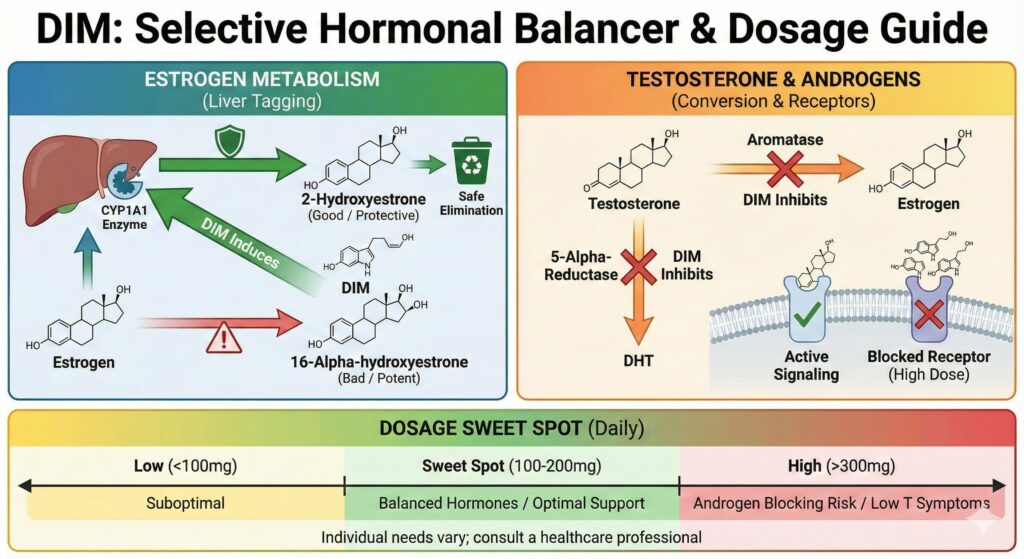
DIM’s most significant role occurs in Phase I liver detoxification.2 Your liver breaks down estrogen into different metabolites, which are often categorized as “good” or “bad”:3
- The “Good” Pathway (2-hydroxyestrone): These metabolites are weak, have protective effects, and are easily eliminated from the body.4
- The “Bad” Pathway (16-alpha-hydroxyestrone): These are more potent, “sticky” estrogens that can lead to symptoms like weight gain, mood swings, and breast tenderness.5
DIM works by inducing specific enzymes (like CYP1A1) that force your liver to “tag” more estrogen for the 2-hydroxy (good) pathway.6 This shift effectively lowers the overall burden of strong estrogens in your system and prepares them for excretion.7
2. Preventing Conversion (Aromatase Inhibition)
DIM also acts as a natural, mild aromatase inhibitor.8 Aromatase is the enzyme responsible for converting testosterone into estrogen.9
- By slowing down this enzyme, DIM can help maintain higher levels of free testosterone because less of it is being “lost” to estrogen conversion.10
- For men, this is often why DIM is used alongside testosterone support – to ensure the extra testosterone doesn’t just turn into extra estrogen.11
Key Nuances to Consider
| Feature | Impact of DIM |
| Testosterone | Helps keep it “free” and active by preventing conversion and slightly lowering SHBG (a protein that binds testosterone). |
| Estrogen | Doesn’t “kill” estrogen; it shifts it from high-potency forms to low-potency, safer forms. |
| Dosage | Crucial: Low to moderate doses (100-200mg) generally support balance. Very high doses (300mg+) can occasionally act as an “anti-androgen,” meaning they might actually block testosterone receptors. |
| Elimination | DIM helps with the first step (tagging). You still need healthy Phase II detoxification (methylation) and gut health (regular bowel movements) to actually get the tagged hormones out of your body. |
Note: If you find that your urine turns a darker, tea-like color when taking DIM, don’t worry – this is usually a sign that the “tagged” estrogen metabolites are being successfully excreted.
Does DIM help the liver tag testosterone and DHT as well or is it selective to estrogen only?
It is a common point of confusion, but the short answer is that DIM is highly selective for estrogen when it comes to the “tagging” (Phase I metabolism) process. It does not “tag” testosterone or DHT for elimination in the same way it does for estrogen.
In fact, for many people, DIM is used specifically to keep testosterone levels healthy by preventing them from being converted into other things.12
1. Estrogen: The “Tagging” Process
As we discussed, DIM’s primary claim to fame is its ability to induce the CYP1A1 enzyme. This enzyme is like a specialist that only works on estrogen. It “tags” estrogen to become 2-hydroxyestrone (the “good” estrogen), which is then easily flushed out.13
2. Testosterone and DHT: A Different Mechanism
DIM affects testosterone and DHT, but not by tagging them for the liver to destroy. Instead, it interacts with them in three different ways:
- Aromatase Inhibition: DIM helps block the enzyme aromatase, which converts testosterone into estrogen.14 This protects your testosterone rather than eliminating it.
- 5-Alpha-Reductase Inhibition: It can mildly inhibit the conversion of testosterone into DHT (the more potent androgen linked to hair loss and prostate issues).15 Again, this is about preventing a conversion, not tagging the hormone for the “trash can.”
- Androgen Receptor Antagonism (At High Doses): This is the “selective” part you should be aware of. At high doses (typically over 300mg), DIM can actually block the receptors where testosterone and DHT sit.16 It doesn’t eliminate the hormones from your blood; it just stops them from “plugging in” to the cells.
Summary Comparison
| Action | Estrogen | Testosterone / DHT |
| Liver Tagging | Yes. Actively shifts it to “safe” pathways for removal. | No. DIM does not typically tag androgens for elimination. |
| Conversion | N/A | Prevents conversion into Estrogen or DHT. |
| Receptor Site | Balances receptor activity. | Can block receptors if the dose is too high. |
Why this matters for you
If your goal is to lower estrogen while keeping your testosterone and DHT high, DIM is generally effective because it clears out the “bad” estrogens while leaving the testosterone alone to do its job.
However, if you take too much DIM, you might inadvertently block your testosterone receptors, which can lead to symptoms of “low T” even if your blood levels look normal.
DIM (Diindolylmethane) acts as a selective hormonal balancer by optimizing the liver’s ability to “tag” estrogen for safe elimination while simultaneously protecting testosterone levels. By inducing the CYP1A1 enzyme, DIM shifts estrogen metabolism toward the protective 2-hydroxy pathway rather than the more potent 16-alpha pathway, effectively clearing out “bad” estrogens. While it also serves as a mild aromatase inhibitor to prevent testosterone from converting into estrogen or DHT, its “sweet spot” for most men typically falls between 100mg and 200mg daily. Exceeding 300mg can be counterproductive, as high doses may inadvertently block androgen receptors, preventing testosterone from working effectively even if blood levels remain high.
Leave a Reply