
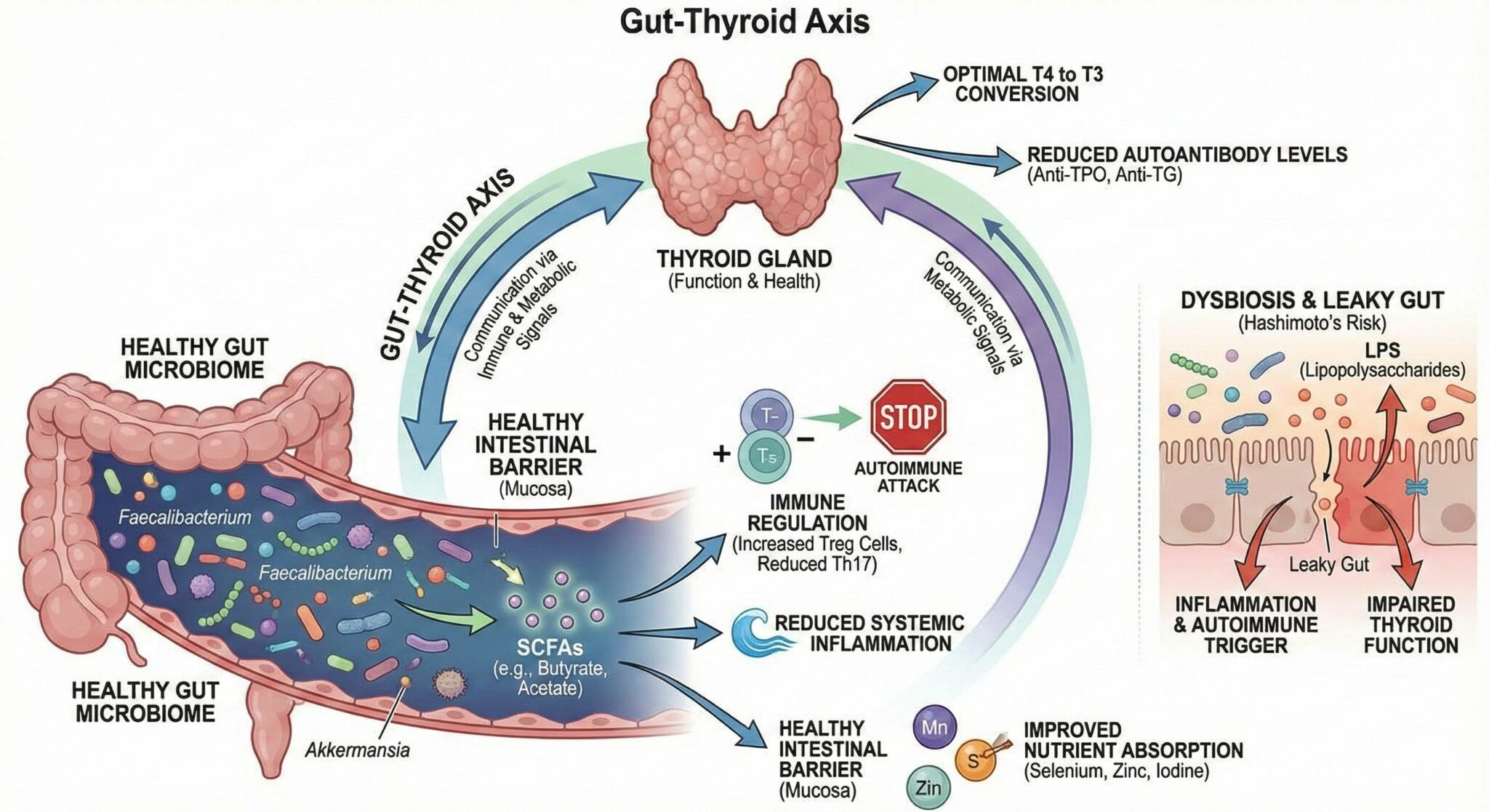
The short answer is yes. Short-Chain Fatty Acids (SCFAs) – particularly butyrate – appear to play a significant protective role in thyroid function and may help slow the progression of Hashimoto’s thyroiditis.
Because Hashimoto’s is primarily an autoimmune condition (where the immune system attacks the thyroid) rather than just a “thyroid issue,” SCFAs are critical because they act as immune regulators.
Here is the breakdown of the biological mechanisms connecting SCFAs to thyroid health and Hashimoto’s disease.
1. Immune Modulation (The “Brake” on Autoimmunity)
This is likely the most important mechanism for Hashimoto’s.
- The Problem: In Hashimoto’s, there is an imbalance in T-cells. You typically have too many Th17 cells (which drive inflammation and tissue destruction) and not enough T-regulatory (Treg) cells (which tell the immune system to calm down and stop attacking “self” tissue).
- The SCFA Solution: SCFAs, specifically butyrate, are potent inducers of Treg cell differentiation. By increasing the population of Treg cells, SCFAs help restore the immune balance, potentially dampening the autoimmune attack on the thyroid gland.
2. Repairing “Leaky Gut” (Intestinal Permeability)
There is a high correlation between Hashimoto’s and increased intestinal permeability (leaky gut).
- The Problem: When the gut lining is compromised, bacterial toxins (like LPS) and undigested food proteins escape into the bloodstream. This triggers systemic inflammation and can lead to molecular mimicry, where the immune system confuses thyroid tissue with these foreign invaders and attacks the thyroid.
- The SCFA Solution: SCFAs are the primary fuel source for colonocytes (gut lining cells). They stimulate the production of mucin and strengthen tight junction proteins (like zonulin and occludin). A stronger barrier prevents the “leak” that often triggers or exacerbates Hashimoto’s flares.
3. Lowering Systemic Inflammation
Chronic inflammation suppresses the conversion of the inactive thyroid hormone (T4) into the active form (T3), which is the form your body actually uses.
- The Mechanism: SCFAs inhibit the NF-κB pathway (a major pro-inflammatory pathway). By lowering systemic inflammation, SCFAs may indirectly support better conversion of T4 to T3, reducing symptoms of hypothyroidism (fatigue, brain fog) even if the gland itself is damaged.
4. Nutrient Absorption
Thyroid function relies heavily on specific minerals, primarily Selenium, Zinc, and Iron.
- The Connection: A gut microbiome capable of producing high levels of SCFAs is generally acidic (a lower colonic pH). This acidic environment improves the solubility and absorption of these critical minerals. Without adequate SCFAs, you may suffer from malabsorption, starving the thyroid of the nutrients it needs to function.
Summary of Benefits for Hashimoto’s
| SCFA Mechanism | Effect on Hashimoto’s |
| Treg Cell Induction | Reduces the autoimmune attack on the thyroid gland. |
| Tight Junction Repair | Closes “leaky gut,” preventing immune triggers (molecular mimicry). |
| NF-κB Inhibition | Lowers inflammation, aiding T4-to-T3 conversion. |
| Gut pH Regulation | Improves absorption of Selenium and Zinc (cofactors for thyroid function). |
Practical Application
Since you are interested in natural remedies and the biological impact of these compounds, increasing SCFAs can be approached two ways:
- Prebiotics (The Natural Route): consuming Resistant Starch (cooled potatoes/rice, green bananas), Inulin, and Acacia fiber to feed the bacteria that create butyrate.
- Direct Supplementation: Using Sodium Butyrate or Tributyrin supplements to bypass fermentation and provide SCFAs directly to the gut lining.
Short-Chain Fatty Acids (SCFAs), particularly butyrate, act as a vital protective mechanism for thyroid health by strengthening the “Gut-Thyroid Axis” and potentially slowing the progression of Hashimoto’s disease. They achieve this primarily by reinforcing the intestinal barrier to heal “leaky gut” – preventing toxins from escaping and triggering autoimmune attacks – while simultaneously regulating the immune system to increase Regulatory T cells (Tregs) that calm the destruction of thyroid tissue. Furthermore, by lowering systemic inflammation and creating an acidic gut environment that enhances the absorption of critical minerals like Selenium and Zinc, SCFAs support the efficient conversion of inactive thyroid hormone (T4) into the active form (T3) needed for metabolic function.
Leave a Reply