

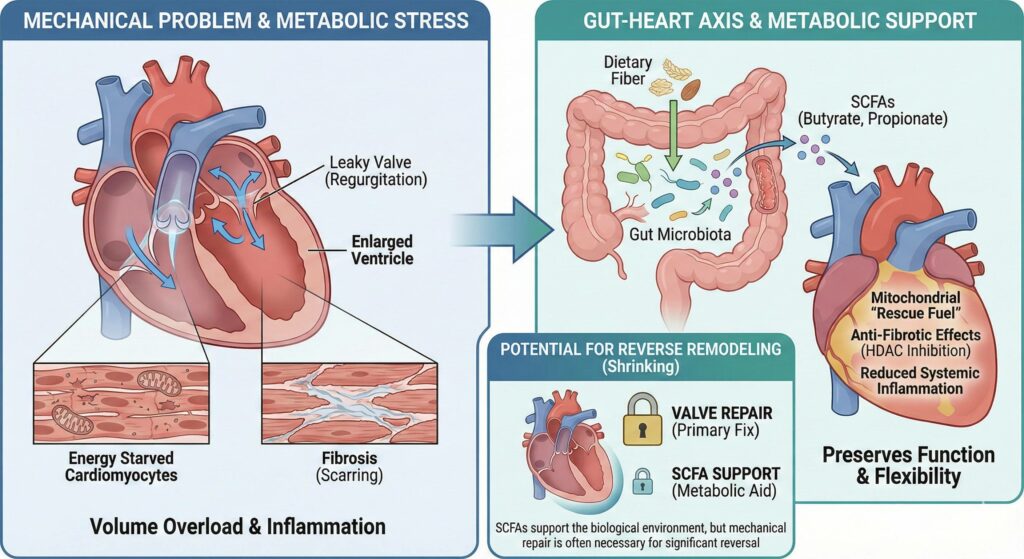
When a person has a leaky heart valve, it causes other health issues like edema. What happens to the heart that causes the valve to start leaking in the first place? Is there cartilage involved or the breakdown of cartilage? Is there a way to naturally repair the valve? Can SCFAs help in the repair or provide the right environment for the body to repair the issue?
Lets answer these question: it is understandable to be concerned about the ripple effects of a leaky heart valve, such as edema (fluid swelling), and to look for root causes and potential natural solutions.
Heart valves are not made of cartilage, though they share similar building blocks. While the body has limited ability to physically “regrow” a damaged valve seal, optimizing your internal environment – specifically through the gut-heart axis and Short-Chain Fatty Acids (SCFAs) – can play a significant role in managing the condition and preventing progression.
Here is a breakdown of the mechanics, the biology, and the potential role of SCFAs.
1. What causes the valve to leak? (The Mechanics)
A “leaky” valve means the valve flaps do not close tightly, allowing blood to flow backward. This forces the heart to pump harder to move the same amount of blood, eventually leading to fluid backup (edema) in the legs or lungs.
Common Causes:
- Calcification: Over time, calcium deposits can build up on the valve flaps, making them stiff and unable to close effectively. This is similar to “hardening of the arteries.”
- Chords Stretching/Breaking: The mitral valve is anchored by tiny tendon-like strings called chordae tendineae. If these stretch or snap (due to high pressure or weakness), the valve flaps flop backward (prolapse).
- Heart Enlargement: If the heart muscle itself enlarges (due to high blood pressure or heart failure), it physically stretches the ring (annulus) that holds the valve. The valve flaps remain the same size, but the doorway they need to cover has gotten too big.
2. Is Cartilage Involved?
No, but it is a similar concept.
Heart valves are not made of cartilage (like your nose or knee meniscus). Instead, they are made of highly organized collagen and elastin fibers.
- Collagen: Provides strength and structure (like the frame of a house).
- Elastin: Allows the valve to stretch and snap back into shape with every beat (like a rubber band).
The Breakdown:
Just like cartilage in a knee can wear down, the collagen and elastin in heart valves can degrade. This is often driven by chronic inflammation and oxidative stress, which damage these proteins and replace flexible tissue with stiff scar tissue or calcium deposits.
3. Can you naturally repair the valve?
The honest truth: Once a heart valve is physically torn, severely calcified, or a chord has snapped, the body generally cannot “regrow” or “reseal” that tissue on its own. There is no supplement that will stitch the valve back together.
However, you can naturally support the heart to:
- Prevent worsening: Stop the inflammation that is degrading the remaining collagen.
- Reduce the leak’s impact: Strengthen the heart muscle so it can compensate for the leak without failing.
- Reverse “Functional” Leaks: If the valve is leaking because the heart is enlarged (stretched), reducing blood pressure and inflammation can sometimes allow the heart to shrink back to a normal size, helping the valve leaflets touch again.
4. The Role of SCFAs (The Gut-Heart Axis)
The biological mechanisms of SCFAs, this is where the most promising “natural” support lies. While SCFAs likely won’t physically repair the valve tissue, they provide the ideal environment to stop the driver of the damage.
Here is the specific mechanism:
- Energy for the Failing Heart
A heart with a leaky valve works overtime and is energy-starved.
- Mechanism: Typically, the heart runs on fatty acids. In a stressed state, it struggles to produce energy.
- SCFA Role: Butyrate and acetate can be used as an efficient, alternative fuel source for cardiomyocytes (heart muscle cells). This helps the heart pump more efficiently despite the mechanical disadvantage of the leak.
- Stopping the “Stiffening” (Fibrosis)
- The Problem: When a valve leaks, the heart muscle undergoes “remodeling”—it gets stiff and fibrous to handle the stress. This stiffness makes the leak worse.
- SCFA Role: Research suggests SCFAs (especially Butyrate) act as HDAC inhibitors (histone deacetylase inhibitors). This is a genetic “switch” that can suppress the pathways that cause heart tissue to become fibrous and stiff. By keeping the heart muscle flexible, you reduce the strain on the valve ring.
- Reducing Blood Pressure (The Afterload)
- The Problem: High blood pressure forces the valve to slam shut harder and resist more pressure.
- SCFA Role: Propionate and butyrate interact with receptors (GPR41 and GPR43) in the blood vessels to induce vasodilation (relaxing of arteries). Lowering blood pressure reduces the “back-pressure” on the leaking valve, significantly decreasing the volume of the leak (regurgitation fraction).
Summary of Action Plan
If you are looking to support this naturally, the goal is to preserve the collagen and reduce the load:
- Support Collagen: Since the valve is collagen-based, nutrients like Vitamin C, Lysine, and Proline are critical for maintaining the integrity of the valve tissue (similar to the Linus Pauling protocol).
- Leverage SCFAs: Focus on Butyrate (via resistant starch/fiber or supplementation like inulin and Acacia gum) to control systemic inflammation and provide fuel for the stressed heart muscle.
- Manage K2: Vitamin K2 (MK-7) is essential to direct calcium into bones and out of soft tissues like heart valves, potentially slowing down calcification.
In summary:
A leaky heart valve is typically caused by calcification, structural tearing, or heart enlargement rather than cartilage breakdown, as valves are composed primarily of collagen and elastin fibers. While the body cannot naturally “regrow” a damaged valve seal, progression can be managed by optimizing the internal environment to reduce strain and inflammation. Short-Chain Fatty Acids (SCFAs) play a vital role in this support system: they provide an efficient alternative fuel source for stressed heart muscle, inhibit the fibrosis that stiffens heart tissue, and help lower blood pressure, which reduces the mechanical load the valve must withstand.
Next:

When a person has heart trouble like a leaking valve, and experiences edema, does the edema come from microcirculation leakage and can SCFAs help prevent edema in those with this kind of heart trouble?
To answer this question directly: Yes, edema occurs at the level of the microcirculation, and while Short-Chain Fatty Acids (SCFAs) cannot fix the mechanical problem of a leaking valve, biological evidence suggests they can help strengthen the blood vessel walls to resist the leakage caused by that pressure.
Here is the breakdown of the mechanism and how SCFAs (specifically Butyrate) fit into the “Gut-Heart” equation.
1. The Mechanism: Is it “Microcirculation Leakage”?
Yes. When a person has a leaking heart valve (regurgitation), the heart cannot pump blood forward efficiently. This causes blood to back up, eventually increasing pressure in your tiniest blood vessels—the capillaries (microcirculation).
You can think of it like a soaker hose in a garden:
- The Valve Issue: If you kink the hose (or the pump fails), pressure builds up behind the kink.
- The Microcirculation: The capillaries are like the porous walls of the soaker hose.
- The Edema: When the pressure inside the hose is too high, water is forced out through the pores faster than the soil can absorb it. In the body, this fluid is pushed out of the capillaries and into the surrounding tissue.
However, in heart conditions, it isn’t just high pressure. The vessel walls often become inflamed and “loose,” making them leakier than they should be. This is where SCFAs come in.
2. How SCFAs Can Help Prevent/Manage Edema
SCFAs (Butyrate, Propionate, Acetate) are famous for sealing a “leaky gut,” but research shows they also help seal “leaky vessels” throughout the body.
Here are the three specific mechanisms by which they may help manage edema:
A. Strengthening the Endothelial Barrier (The “Glue”)
Your blood vessels are lined with endothelial cells. These cells are stitched together by proteins called Tight Junctions (specifically VE-cadherin and Occludin).
- The Problem: Chronic inflammation from heart trouble can degrade these proteins, creating gaps between the cells. Fluid leaks out through these gaps easily.
- The SCFA Fix: Butyrate has been shown to inhibit the breakdown of these tight junctions. It effectively acts as “biological glue,” tightening the seal between endothelial cells so they can hold fluid inside the vessel better, even under pressure.
B. Protecting the Glycocalyx (The “Shield”)
Inside your microcirculation, there is a slippery, gel-like coating called the Endothelial Glycocalyx. This layer acts as a primary filter that prevents fluid and proteins from leaking out.
- The Problem: In heart failure and high venous pressure, this protective gel layer is often stripped away or damaged.
- The SCFA Fix: SCFAs reduce the oxidative stress that strips this layer away. By preserving the glycocalyx, you maintain the “waterproofing” of your microcirculation.
C. The Gut-Heart Axis Loop
Heart trouble often causes swelling in the gut wall (gut edema), which leads to “leaky gut.” This lets bacterial toxins (LPS) enter the bloodstream, causing systemic inflammation that makes all your blood vessels leakier.
- The SCFA Fix: By healing the gut lining first, SCFAs stop this flow of toxins. This lowers total body inflammation, which indirectly protects the blood vessels in your legs and lungs from becoming too permeable.
Summary Table: The Leak vs. The Fix
| Factor | What Happens in Heart Trouble | Potential SCFA Benefit |
| Hydrostatic Pressure | Blood backs up due to valve; pressure pushes fluid out. | None. SCFAs cannot fix the mechanical valve pressure. |
| Vessel Permeability | Inflammation makes capillary walls “loose” and porous. | High. Butyrate tightens cell junctions, keeping fluid in. |
| Glycocalyx | The vessel’s protective lining is stripped away. | Moderate. SCFAs help preserve this lining. |
The Verdict
SCFAs cannot strictly prevent edema if the mechanical back-pressure from the heart is severe enough (physics will win eventually). However, they can raise the threshold for when swelling starts. By making your microcirculation tougher and less permeable, your vessels can handle higher pressures before they start leaking fluid into your tissues.
Edema associated with heart valve trouble is indeed caused by microcirculation leakage, where mechanical back-pressure forces fluid through the tiny pores of capillary walls. While Short-Chain Fatty Acids (SCFAs) cannot repair the physical valve defect, they provide a crucial biological defense by strengthening the integrity of these blood vessels. Specifically, SCFAs like butyrate act as a “biological glue” that reinforces the tight junctions between endothelial cells and preserves the protective glycocalyx lining, essentially waterproofing the vessels so they are more resilient against the high pressure and less prone to leaking fluid into surrounding tissues.
Leave a Reply