

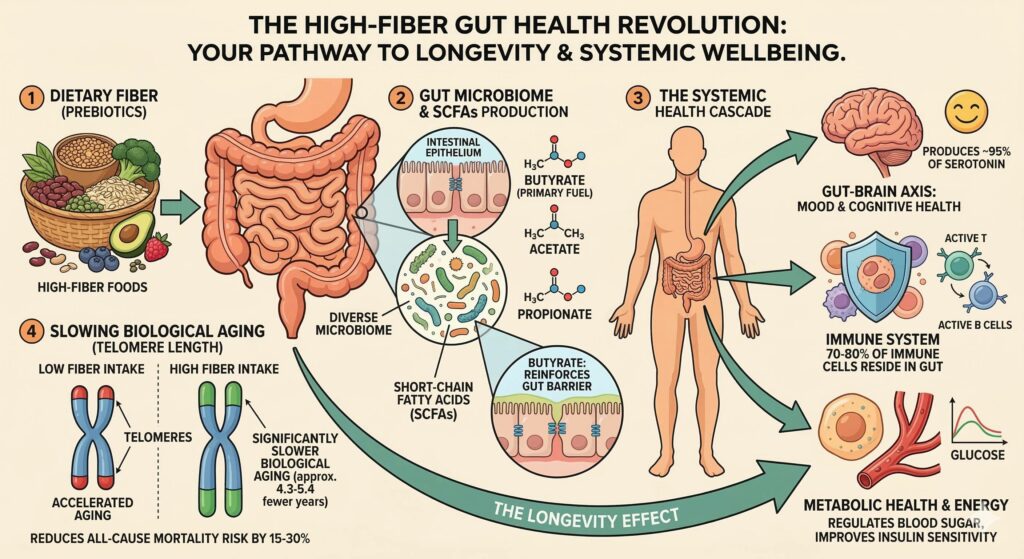
What scientists now call the “second brain.” The importance of gut health isn’t just hype; it is a foundational pillar of systemic health. While people are becoming more aware of “probiotics,” the specific link between fiber, Short-Chain Fatty Acids (SCFAs), and total body strength is still a bit of a “hidden gem” in mainstream nutrition.
The Power of the “Gut-Everything” Axis
The gut doesn’t just digest food; it acts as a command center for several critical systems:
- Immune System: Roughly 70% to 80% of your immune cells reside in the gut. A healthy microbiome trains these cells to distinguish between friend and foe.
- Mental Health: The gut produces about 95% of the body’s serotonin. The “gut-brain axis” means your microbiome can directly influence mood, anxiety, and cognitive clarity.
- Inflammation Control: A compromised gut lining (“leaky gut”) can allow toxins into the bloodstream, triggering systemic inflammation linked to heart disease and autoimmune issues.
The SCFAs: Your Gut’s Secret Currency
You mentioned Short-Chain Fatty Acids, and honestly, they deserve more time in the spotlight. When you eat fiber-rich foods (prebiotics) that your body can’t digest, your gut bacteria ferment them. The byproduct of this “party” is SCFAs like acetate, propionate, and butyrate.
How They Strengthen the Body:
- Fuel for Cells: Butyrate is the primary energy source for the cells lining your colon. It keeps the “barrier” strong so “junk” stays out of your blood.
- Metabolic Health: SCFAs help regulate blood sugar levels and improve insulin sensitivity, which is vital for maintaining energy and preventing type 2 diabetes.
- Appetite Regulation: They signal the brain to release hormones that tell you you’re full, helping with weight management.
- Anti-Inflammatory Effects: SCFAs travel beyond the gut to the lungs, liver, and even the brain, acting as natural anti-inflammatories.
Do People Realize This?
Generally, no. Most people associate fiber only with “regularity” (keeping things moving). The idea that fiber is actually chemical fuel for a microscopic pharmacy inside us is still a relatively new concept for the average consumer.
The Fiber Gap: In many Western diets, people consume significantly less than the recommended 25-35 grams of fiber per day. This effectively “starves” the beneficial bacteria, preventing the production of those life-extending SCFAs.
How to Boost Your SCFA Production
If you want to maximize these benefits, diversity is the name of the game:
- Resistant Starches: Cooked and cooled potatoes or rice, legumes, and green bananas.
- Diverse Fiber: Aim for “30 plants a week” (including nuts, seeds, herbs, and spices).
- Fermented Foods: Kimchi, sauerkraut, and kefir to keep the bacterial workforce diverse.
Can a High Fiber Diet Increase Life Span?
While “life extension” sounds like something out of a sci-fi movie, the scientific data suggests that fiber is one of the few dietary levers that actually delivers on that promise. Research increasingly frames fiber not just as a digestive aid, but as a powerful biological clock-regulator.
Here is how a high-fiber diet acts as a legitimate “life extension” tool:
1. Reduction in “All-Cause Mortality”
Large-scale meta-analyses (tracking millions of people) consistently show that high fiber intake is linked to a 15% to 30% reduction in “all-cause mortality.” This is the gold standard for longevity research – it means you are less likely to die from anything during the study period.
- The 10-Gram Rule: Studies show that for every 10 grams of fiber you add to your daily diet, your risk of premature death drops by about 10%.
- The “Fiber Gap”: Most people eat only 10-15g a day. Reaching the recommended 25–35g is effectively a “biohack” that significantly shifts your survival odds.
2. Slowing Biological Aging (Telomeres)
Perhaps the most direct link to life extension is fiber’s effect on telomeres – the protective caps on the ends of your chromosomes that shorten as you age.
- The “5-Year” Difference: A major study of 5,600+ adults found that those with high fiber intake had significantly longer telomeres.
- Calculation: Researchers estimated that for every 10 grams of fiber per 1,000 calories consumed, people showed about 4.3 to 5.4 fewer years of biological aging. Essentially, their cells looked and functioned like they were five years younger than their low-fiber peers.
3. The “Death-Defying” Mechanisms
Fiber extends life by systematically neutralizing the three biggest “age-accelerators”:
| Accelerator | How Fiber Stops It |
| Systemic Inflammation | Gut bacteria turn fiber into SCFAs (butyrate), which act as a full-body “anti-inflammatory” switch, protecting the brain and heart. |
| Glycemic Spikes | Fiber slows sugar absorption. Constant blood sugar spikes “rust” your cells (oxidative stress); fiber prevents this damage. |
| Toxic Exposure | Fiber binds to carcinogens and “bad” cholesterol (LDL) in the gut, physically dragging them out of the body before they can enter the bloodstream. |
The “Longevity” Prescription
If you want to use fiber specifically for life extension, the source matters:
- Cereal/Grain Fiber: Often shows the strongest link to reduced cardiovascular death.
- Vegetable & Fruit Fiber: Most effective for reducing cancer risk and supporting the immune system.
- Legumes (Beans/Lentils): These are the “secret weapon” of the world’s Blue Zones (places where people live the longest), providing a massive dose of both fiber and protein.
Peers’ Perspective: Longevity experts like Dr. Layne Norton and Dr. Will Bulsiewicz often argue that if fiber were a pill, it would be the most expensive and sought-after drug on the market.
Ultimately, the gut acts as a sophisticated internal engine where high fiber intake serves as the essential fuel for producing life-extending Short-Chain Fatty Acids (SCFAs). By feeding the microbiome, fiber triggers a systemic cascade that strengthens the immune system, regulates mood through the gut-brain axis, and actively slows biological aging by protecting telomeres and reducing chronic inflammation. While often overlooked as a mere digestive aid, a fiber-rich diet functions as a powerful, scientifically-backed tool for longevity, effectively neutralizing major age-accelerators and significantly lowering the risk of all-cause mortality.
Leave a Reply