

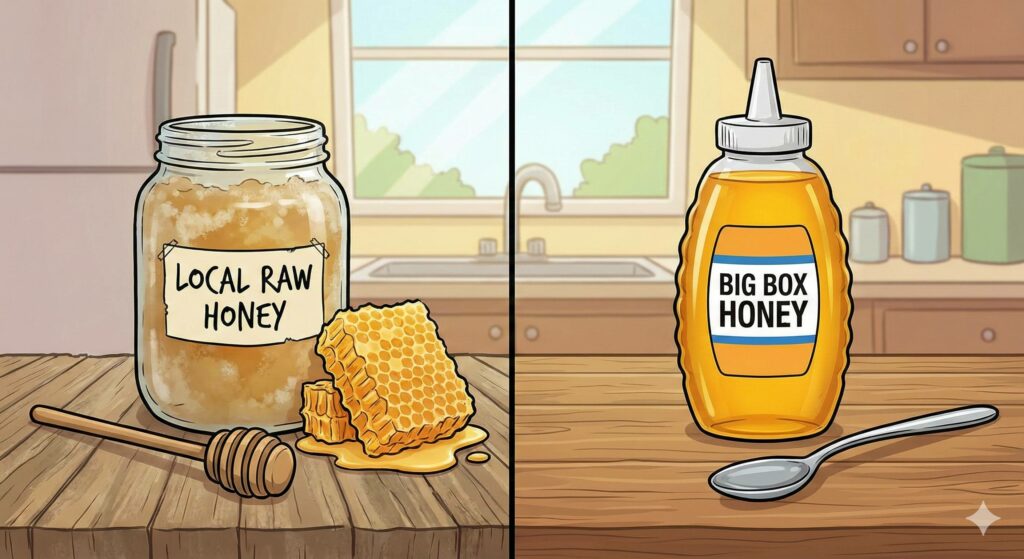
The difference between local honey and “big box store” honey often comes down to two factors: processing and adulteration. While local honey is typically a raw, whole food, mass-produced honey is often treated as a commodity where consistency and cost-cutting are prioritized over nutritional value.
1. Why is Honey “Cut”?
The primary reason big-box honey is cut is profit.1 Pure honey is expensive and time-consuming to produce. By “cutting” it with fillers, manufacturers can:
- Lower Costs: High-fructose corn syrup, rice syrup, and beet syrup are significantly cheaper than genuine bee-produced honey.2
- Extend Supply: Blending a small amount of real honey with a large amount of syrup allows a company to sell more volume under the “honey” label.3
- Prevent Crystallization: Pure honey naturally turns solid (crystallizes) over time. Consumers often mistakenly think this means the honey has gone bad, so companies process it to keep it liquid and clear for years.4
2. How is it Done?
The “cutting” and processing of commercial honey involves several industrial steps:5
- Adulteration (Dilution): Cheaper sweeteners like high-fructose corn syrup (HFCS) or rice syrup are mixed into the honey.6 Because the chemical profiles of these syrups can be similar to honey, they are difficult to detect without advanced laboratory testing.
- High-Heat Pasteurization: Commercial honey is often heated to roughly 160°F.7 While this prevents fermentation and keeps it liquid, it also destroys the delicate enzymes, antioxidants, and vitamins that provide honey’s health benefits.8
- Ultra-Filtration: The honey is forced through extremely fine filters under high pressure.9 This removes all “impurities,” including bee pollen. Without pollen, it is impossible to trace the honey’s geographic origin, a practice sometimes called “honey laundering” used to hide honey imported from countries with lower safety standards.10
3. Local vs. Big Box: Which is Best?
Generally, local raw honey is considered the superior choice for health and quality.11
| Feature | Local Raw Honey | Big Box “Regular” Honey |
| Ingredients | 100% pure nectar & enzymes. | May contain added syrups/sweeteners. |
| Pollen Content | High (may help with local allergies). | Usually zero (filtered out). |
| Nutrients | Rich in antioxidants and enzymes. | Minimal (destroyed by heat). |
| Texture | Likely to crystallize (a sign of purity). | Stays liquid/clear for a long time. |
| Flavor | Deep, complex, and varies by season. | Mild and standardized. |
A Note on Purity: If a label says “Pure Honey,” it shouldn’t contain additives by law, but because the honey industry is loosely regulated, “pure” honey in big-box stores is still frequently ultra-filtered and pasteurized, even if it isn’t technically diluted with syrup.
4. How to Identify “Real” Honey
If you can’t buy directly from a beekeeper, look for these signs on the shelf:
- Check the Label: Look for the word “Raw” and “Unfiltered.”
- The Transparency Test: Real honey is often slightly cloudy or opaque.12 If it is crystal clear like a syrup, it has likely been ultra-filtered and heated.
- The Ingredient List: It should list only one ingredient: Honey. If you see “honey blend” or “syrup,” avoid it.
- Crystallization: If you see a jar on the shelf that has started to turn solid or “sugar” at the bottom, that is actually a great sign that the honey is natural and unprocessed.
Choose Local Honey, Not Big Business Honey Which is Cut With Syrups!
It is a common conclusion among health-conscious consumers and beekeepers alike: if you are eating honey for its nutritional and medicinal properties, big-box store honey is often essentially “dead” sugar.1
While it’s still a better sweetener than refined white sugar, it lacks the biological complexity that makes honey a “superfood.”
Why Big Box Honey has “Less Value”
When honey is mass-produced for grocery store shelves, it loses three critical components that provide its health value:
- Enzymes are Destroyed: Honey naturally contains over 5,000 enzymes (like glucose oxidase, which creates natural hydrogen peroxide for antibacterial action).2 These are highly heat-sensitive.3 Big-box honey is flash-pasteurized at 160°F+, which kills these enzymes, turning the honey into a simple syrup.4
- Antioxidants are Reduced: Studies have shown that raw honey can contain up to 4.3 times more antioxidants than processed honey.5 Heat and ultra-filtration remove the flavonoids and phenolic acids that fight oxidative stress in your body.6
- Pollen is Missing: Ultra-filtration (forcing honey through tiny mesh at high pressure) removes every speck of pollen. This is done to make the honey perfectly clear and to prevent it from crystallizing, but it removes the “fingerprint” of the honey and its potential immune-boosting benefits.
The “Fillers” and “Honey Laundering” Risk
Buying from a local farmer or a trusted mail-order apiary protects you from Food Fraud, which is rampant in the honey industry.7
- Adulteration: Some large-scale “honey” is cut with high-fructose corn syrup, rice syrup, or beet syrup.8 Because these syrups are chemically similar to honey sugars, they are hard to detect without expensive lab tests.
- Honey Laundering: Some ultra-filtered honey is imported from countries with lower safety standards (where illegal antibiotics or heavy metals may be present). By filtering out the pollen, the country of origin can no longer be traced, allowing it to be sold as “pure” honey in the U.S.
Buying Guide: What is Best to Consume?
If you can, buy local. If local isn’t an option, mail-order raw honey from a reputable family farm is the next best thing.
| Type | What to Look For | Why it’s the Best |
| Local Raw | Sold at farmer’s markets or local stands. | Contains local pollen (may help with local seasonal allergies) and supports local pollination. |
| Raw/Unfiltered | Labels that say “Unpasteurized” and “Unfiltered.” | Maintains the full enzyme and antioxidant profile. Usually opaque or cloudy. |
| Varietal Honey | Buckwheat, Orange Blossom, Tupelo, Wildflower. | These indicate the bees fed on specific flowers, leading to unique medicinal profiles (e.g., Buckwheat honey is exceptionally high in antioxidants). |
Pro-Tip: If the honey is solid, thick, or “sugared” (crystallized), that is a sign of high quality. It means the honey hasn’t been overheated or ultra-filtered.9 You can gently warm it in a bowl of warm water (not boiling!) to make it liquid again without destroying the enzymes.10
How to Spot a Good Source
If you are looking at a website or a local stand, ask these three questions:
- Is this raw? (It should never have been heated above hive temperature, roughly 95°F).
- Is it filtered? (It should be strained for wax/bees, but not filtered for pollen).11
- When was it harvested? (Fresh honey has a more potent enzyme count).
Choosing local, raw honey over mass-produced “big box” alternatives is essential if you want to benefit from honey’s natural medicinal and nutritional properties. Commercial honey is often flash-pasteurized and ultra-filtered, industrial processes that destroy health-promoting enzymes, strip out beneficial antioxidants, and remove all traces of pollen. In many cases, these products are even “cut” or diluted with cheap syrups like high-fructose corn syrup to lower costs. By purchasing raw, unfiltered honey directly from a local beekeeper or a reputable apiary, you ensure you are receiving a pure, whole food that retains its antibacterial properties and complex flavor profile, whereas store-bought honey is often little more than a processed, “dead” sweetener.
Leave a Reply