

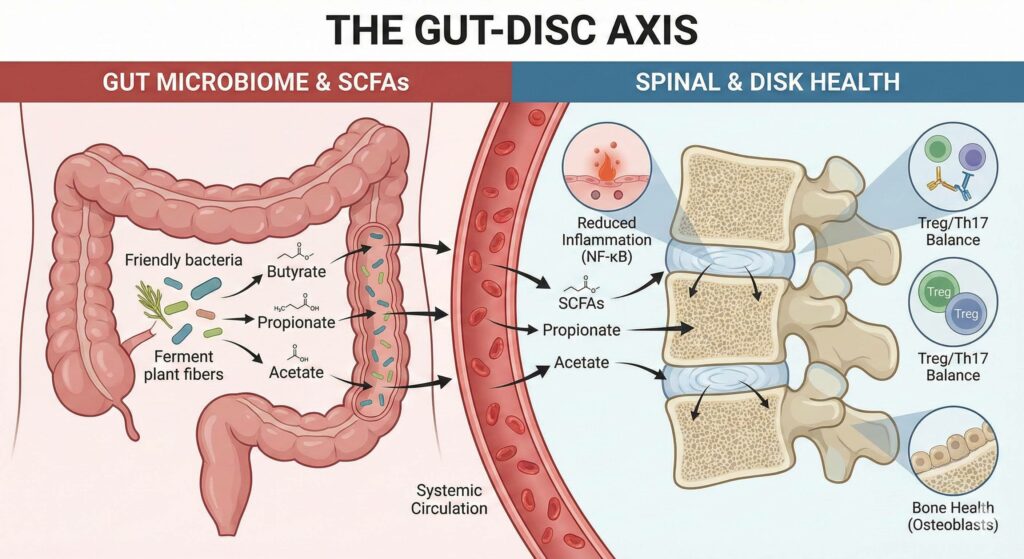
The connection between the gut and the spine is a rapidly emerging field of study known as the “Gut-Disc Axis” or the “Gut-Spinal Cord-Immune Axis.” Short-Chain Fatty Acids (SCFAs) – primarily acetate, propionate, and butyrate – act as the primary chemical messengers that bridge the gap between your microbiome and the health of your intervertebral discs.
1. The Gut-Disc Axis: Core Mechanisms
Intervertebral discs are “immune-privileged” and avascular (lacking blood vessels), meaning they rely on the diffusion of nutrients and systemic signals from the surrounding environment. SCFAs influence this environment through three primary pathways:
- Systemic Inflammation Control: Chronic low-grade inflammation is a primary driver of Intervertebral Disc Degeneration (IDD). SCFAs, especially Butyrate, inhibit the NF-κB signaling pathway, which reduces the production of pro-inflammatory cytokines like TNF-α and IL-1β. These cytokines are known to degrade the extracellular matrix of the disc.
- The Treg/Th17 Balance: SCFAs promote the expansion of Regulatory T cells (Tregs). Research suggests that these anti-inflammatory cells can actually migrate from the gut to the spinal cord region, where they dampen local immune responses and promote a repair-friendly environment.
- Vertebral Bone Health: The “Gut-Bone Axis” directly affects the spine. SCFAs inhibit osteoclasts (cells that break down bone) and support osteoblasts (cells that build bone). Stronger vertebral endplates ensure better nutrient delivery to the discs via diffusion.
2. SCFA Impact on Spinal Integrity
Recent research has highlighted specific ways that SCFA production – or the lack thereof – affects spinal structures:
| Mechanism | Effect on Spinal/Disk Health |
| Microglial Regulation | SCFAs help maintain “resting” microglia in the spinal cord, preventing the “over-activation” that leads to neuropathic pain and neuroinflammation. |
| Barrier Integrity | By strengthening the gut barrier, SCFAs prevent “leaky gut,” which stops bacterial toxins (like LPS) from entering the bloodstream and triggering systemic disc-thinning inflammation. |
| Extracellular Matrix (ECM) | SCFAs may help preserve the proteoglycan content in the Nucleus Pulposus (the jelly-like center of the disc), which is essential for maintaining disc height and shock absorption. |
3. Therapeutic Potential of Specific SCFAs
While all three main SCFAs are beneficial, they play slightly different roles in spinal health:
- Butyrate: Often considered the most potent for the spine. It is a powerful HDAC inhibitor, meaning it can “turn off” genes associated with cellular senescence (aging) in disc cells.
- Propionate: Influences systemic metabolism and has been shown to reduce bone resorption, potentially protecting the vertebral bodies from thinning.
- Acetate: Can cross the blood-brain (and blood-spinal) barrier most easily, where it acts as a signaling molecule for microglial homeostasis and central pain processing.
Research Note: Studies in animal models have shown that restoring SCFA-producing bacteria (like Faecalibacterium or Lachnospiraceae) can significantly improve locomotor recovery after spinal injury and slow the progression of disc narrowing.
Summary:
Short-chain fatty acids (SCFAs), particularly butyrate, serve as critical mediators in the “gut-disc axis” by regulating systemic inflammation and maintaining the structural integrity of the spine. Produced by the fermentation of dietary fibers, these metabolites cross the gut barrier to inhibit pro-inflammatory signaling pathways, such as NF-κB, which are responsible for the degradation of the intervertebral disc’s extracellular matrix. Furthermore, SCFAs support vertebral bone density and modulate immune responses within the spinal cord environment, potentially slowing the progression of disc degeneration and reducing neuroinflammation. By strengthening the gut-spinal connection, SCFAs provide a metabolic framework for preserving disc height and overall spinal longevity.
Leave a Reply