

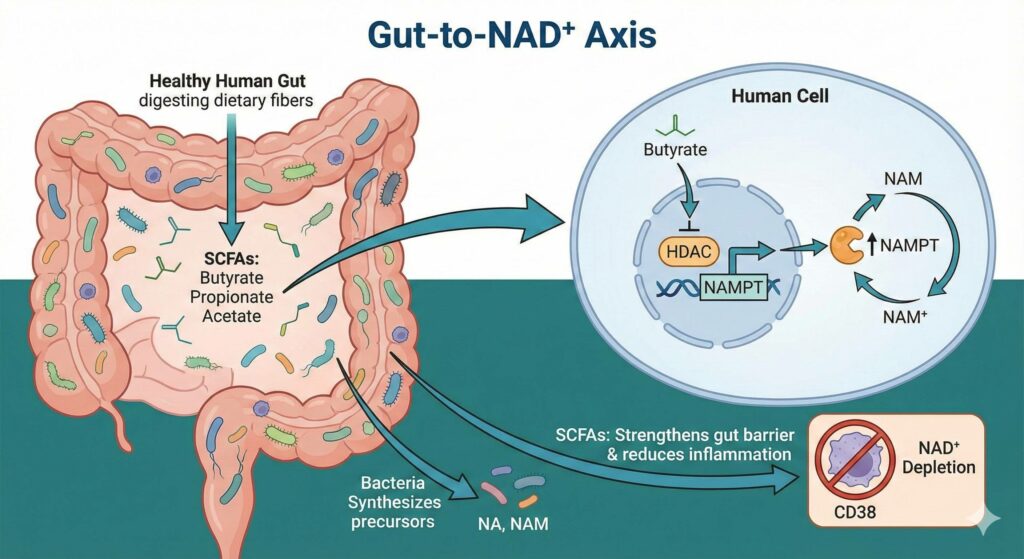
The connection between gut health and NAD+ (Nicotinamide Adenine Dinucleotide) is one of the most exciting frontiers in metabolic science. While we often think of NAD+ as something we must “take” (like NMN or NR supplements), your gut microbiome acts as a sophisticated bioreactor that can significantly influence your internal NAD+ levels.1
The production of Short-Chain Fatty Acids (SCFAs) – specifically butyrate, propionate, and acetate – boosts NAD+ through three primary mechanisms:
1. Upregulating the “Salvage Pathway” via NAMPT
The most direct link between SCFAs and NAD+ is the Salvage Pathway. Most of the NAD+ in your body is recycled from a precursor called nicotinamide (NAM).2 The “bottleneck” or rate-limiting enzyme in this process is NAMPT (nicotinamide phosphoribosyltransferase).3
- The SCFA Trigger: Butyrate acts as a Histone Deacetylase (HDAC) inhibitor.4 By inhibiting HDACs, butyrate changes the way your DNA is packaged, effectively “turning on” specific genes.5
- The Result: Studies show that butyrate-induced HDAC inhibition significantly increases the expression of the NAMPT gene. More NAMPT means your cells become much more efficient at recycling NAM back into NAD+, effectively raising your systemic levels.
2. Plugging the “NAD+ Sink” (Inflammation Control)
One of the biggest reasons NAD+ levels decline with age or poor health is not just a lack of production, but an increase in consumption.
- The Inflammatory Drain: When gut health is poor (dysbiosis), the gut barrier becomes “leaky,” allowing LPS (lipopolysaccharides) from bacteria to enter the bloodstream. This triggers systemic inflammation.
- CD38 Activation: In response to this inflammation, your immune cells increase the production of an enzyme called CD38. This enzyme is a voracious “sink” for NAD+, destroying it to fuel the inflammatory response.
- The SCFA Shield: By strengthening the gut barrier and reducing systemic inflammation, SCFAs (particularly butyrate) lower CD38 activity. This “plugs the sink,” allowing your NAD+ levels to remain high instead of being wasted.
3. Direct Microbial Synthesis of Precursors
Beyond SCFAs, a healthy and diverse microbiome can actually manufacture NAD+ precursors from the food you eat.
- De Novo Synthesis: Certain beneficial bacteria can synthesize Nicotinic Acid (NA) and Nicotinamide (NAM) from the amino acid tryptophan.
- Microbial Conversion: Research suggests that certain gut microbes can convert oral Nicotinamide Riboside (NR) into Nicotinic Acid, which the body then uses via the Preiss-Handler pathway to create NAD+.
Summary of the Gut-NAD+ Connection
| Mechanism | Role of SCFAs/Gut Health | Impact on NAD+ |
| NAMPT Expression | Butyrate inhibits HDACs to turn on the NAMPT gene. | Increases recycling (Salvage Pathway). |
| Inflammation (CD38) | SCFAs strengthen the gut barrier and lower LPS. | Prevents “wasting” NAD+ on inflammation. |
| Precursor Synthesis | Diverse microbes synthesize NA/NAM from diet. | Provides raw materials for production. |
| Mitochondrial Health | SCFAs activate SIRT1 and PGC-1A. | Improves the efficiency of NAD+/NADH ratios. |
Practical Application
To leverage this “gut-to-NAD” boost, the focus is on fermentable fibers (prebiotics) that feed SCFA-producing bacteria.6 When these bacteria thrive, they produce the butyrate necessary to activate the NAMPT recycling system.
The symbiotic relationship between gut health and NAD+ production centers on the ability of Short-Chain Fatty Acids (SCFAs) to optimize both the synthesis and preservation of this vital coenzyme. By acting as HDAC inhibitors, SCFAs like butyrate upregulate the expression of the NAMPT enzyme, which is the primary driver of the NAD+ salvage pathway, allowing cells to recycle precursors more efficiently. Simultaneously, a healthy gut microbiome reinforces the intestinal barrier, preventing the leakage of inflammatory endotoxins that would otherwise trigger CD38, an enzyme known to aggressively deplete NAD+ stores. Essentially, a robust gut environment provides a “double win” for cellular energy: it increases the internal machinery’s ability to produce NAD+ while shielding it from being wasted on systemic inflammation. A diet high in soluble fiber (inulin, acacia fiber, and Pure Cacao Powder) can help seal the gut and improve energy!
Leave a Reply