

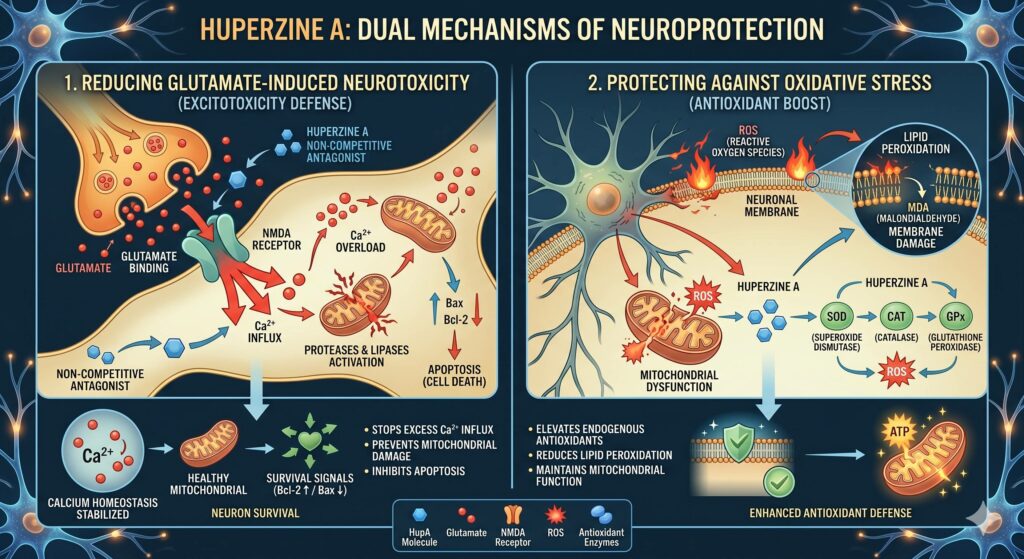
 Huperzine A (HupA) is a naturally occurring sesquiterpene alkaloid extracted from the firmoss Huperzia serrata. While it is most famous for its role as a potent, reversible, and highly selective inhibitor of acetylcholinesterase (AChE), research has increasingly focused on its broader neuroprotective properties—specifically its ability to combat glutamate excitotoxicity and oxidative damage.
1. Reduction of Glutamate-Induced Neurotoxicity
Glutamate is the primary excitatory neurotransmitter in the brain, but excessive levels lead to excitotoxicity, a process where overstimulated neurons become damaged or die. Huperzine A mitigates this through several distinct pathways:
- NMDA Receptor Antagonism: HupA acts as a non-competitive antagonist of the N-methyl-D-aspartate (NMDA) receptor. By blocking the ion channel associated with this receptor, it prevents the massive influx of calcium (Ca2+) into the neuron that typically triggers cell death.
- Regulation of Calcium Homeostasis: Beyond the NMDA receptor, HupA helps stabilize intracellular calcium levels. By preventing calcium “overload,” it protects the mitochondria and prevents the activation of “suicide” enzymes (proteases and lipases) that dissolve cellular structures.
- Inhibition of Apoptosis: Studies have shown that HupA reduces the expression of pro-apoptotic proteins (like Bax) and increases the expression of anti-apoptotic proteins (like Bcl-2), effectively signaling the cell to survive rather than undergo programmed death.
2. Protection Against Oxidative Stress
Oxidative stress occurs when there is an imbalance between the production of reactive oxygen species (ROS) and the body’s ability to detoxify them. Huperzine A functions as a neuroprotective agent by enhancing the brain’s internal defense systems:
- Enhancing Antioxidant Enzymes: Research indicates that HupA can increase the activity of key endogenous antioxidants, including Superoxide Dismutase (SOD), Catalase (CAT), and Glutathione Peroxidase (GPx).
- Mitochondrial Protection: The mitochondria are the primary site of ROS production. HupA has been shown to protect mitochondrial membrane integrity and improve ATP production, which reduces the leakage of free radicals into the cytoplasm.
- Reduction of Lipid Peroxidation: HupA significantly lowers levels of Malondialdehyde (MDA), a marker of oxidative damage to the fatty acids in cell membranes. By preserving these membranes, HupA maintains the structural integrity of neurons.
3. Comparative Mechanisms and Clinical Research
In various animal models and in vitro (cell culture) studies, Huperzine A has demonstrated a “multi-target” approach that distinguishes it from many synthetic neuroprotectants:
| Feature | Impact of Huperzine A |
| AChE Inhibition | Increases acetylcholine levels; improves cognitive signaling. |
| Iron Chelation | May reduce iron-induced oxidative stress in the brain. |
| Beta-Amyloid | Shown to reduce the neurotoxicity caused by beta-amyloid plaques. |
| Nerve Growth Factor | May promote the secretion of NGF, aiding in neuronal repair. |
Summary of Key Findings
Most research suggests that the neuroprotective effects of Huperzine A occur at concentrations lower than those required for significant AChE inhibition. This indicates that its ability to protect the brain against glutamate and oxidative stress is an intrinsic property of the molecule, rather than just a side effect of increased acetylcholine.
While Huperzine A is widely used for memory support, its potential as a long-term neuroprotective agent continues to be a major area of study in the context of age-related cognitive decline and acute brain injury.
Summary:
Huperzine A counters glutamate-induced neurotoxicity primarily by functioning as a non-competitive NMDA receptor antagonist. By blocking the overactivation of these receptors, it prevents the massive, destructive influx of calcium into neurons that otherwise triggers excitotoxicity. This preservation of calcium homeostasis protects vital mitochondrial structures and actively suppresses apoptotic (programmed cell death) pathways, shifting cellular signaling toward survival even when exposed to toxic levels of excitatory neurotransmitters.
Beyond blocking glutamate damage, Huperzine A defends brain tissue from oxidative stress by reinforcing the body’s internal antioxidant networks. It significantly elevates the activity of key protective enzymes-such as superoxide dismutase (SOD) and glutathione peroxidase-which neutralizes free radicals and drastically reduces lipid peroxidation. Because these neuroprotective and mitochondrial benefits occur at concentrations lower than those needed to alter acetylcholine levels, Huperzine A stands out as a highly effective, independent multi-target shield against cellular damage and cognitive decline.
Leave a Reply