

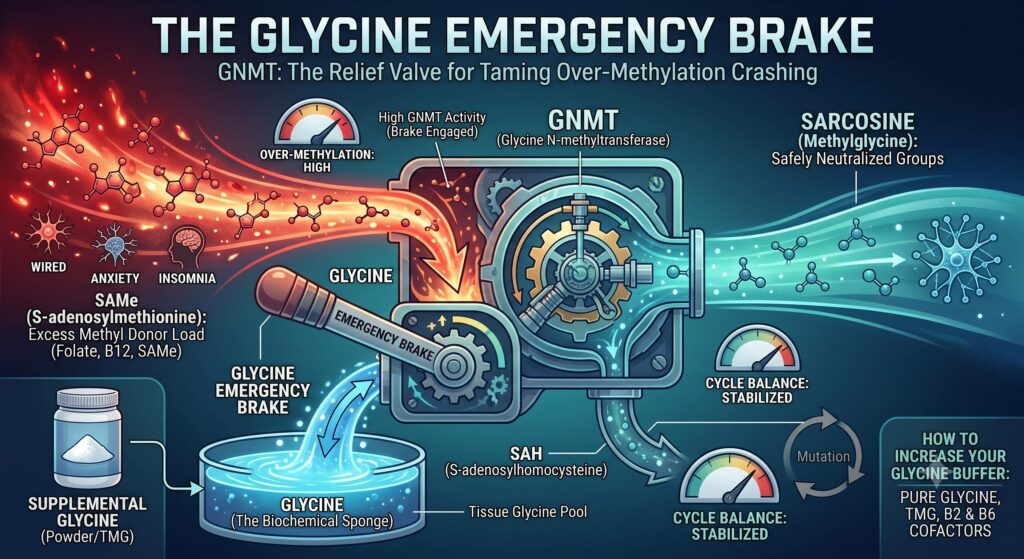
While the wellness world is fixated on pushing the methylation gas pedal, few talk about what happens when the engine redlines. Driving the methylation cycle too hard with aggressive doses of methylfolate (5-MTHF), methyl-B12, or SAMe can overwhelm the body’s metabolic capacity, leading to a state of acute over-methylation.
When this happens, the nervous system gets flooded, causing intense, jittery anxiety, a racing mind, and sudden insomnia. This isn’t a “detox reaction” – it is a system-wide buffer failure.
The GNMT Paradox: How the Brake Fails
At the center of this balance is the enzyme Glycine N-methyltransferase (GNMT). Think of GNMT as an overflow valve for your methyl pool. When S-adenosylmethionine (SAMe) levels spike too high, GNMT steps in to neutralize the excess by attaching a methyl group to glycine, converting it into safely excretable sarcosine (methylglycine).
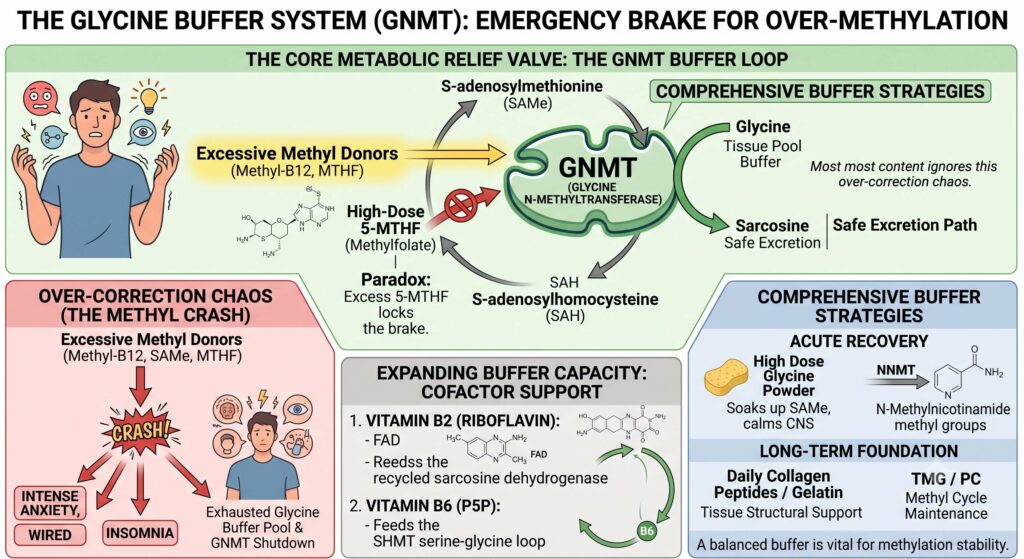
As shown in the metabolic pathway above, this system operates on a tight feedback loop. However, a major biochemical paradox exists that trips many people up:
The 5-MTHF Trap: 5-MTHF (methylfolate) is a direct allosteric inhibitor of GNMT.
Under normal physiological conditions, this prevents the body from wasting precious methyl groups when folate is low. But when someone takes massive, unbuffered supplemental doses of methylfolate, they are doing two opposing things simultaneously: they are rapidly forcing the production of SAMe while actively locking up the GNMT emergency brake.
With the brake disabled and SAMe rising unchecked, the body rapidly drains its tissue stores of glycine trying to keep up. Once that localized glycine pool is exhausted, the buffer system collapses.
Blueprint to Expand and Strengthen the Glycine Buffer
To handle a high methyl load without crashing, the buffer system requires both the primary raw substrate (glycine) and the specific cofactors that keep the cycle spinning smoothly.
1. Direct vs. Indirect Glycine Strategies
- Pure Glycine Powder (The Acute Solution): For immediate relief from an over-methylated “wired” state, pure free-form glycine is the most effective tool. Taking 3 to 5 grams dissolved in water acts as an immediate biochemical sponge, giving GNMT the exact substrate it needs to clear excess SAMe. Because glycine is also an inhibitory neurotransmitter in the central nervous system, it pulls double duty by calming the nervous system directly.
- Dietary Collagen and Gelatin (The Foundational Solution): Collagen peptides are roughly 33% glycine. Consuming 10-20 grams daily provides a steady, time-released pool of amino acids to rebuild peripheral tissue stores, ensuring the baseline buffer capacity is consistently high.
2. The Nuance of TMG (Betaine) and Choline
- TMG for Maintenance, Not Acute Crashes: Trimethylglycine (TMG) eventually degrades down into dimethylglycine (DMG) and then into glycine. However, TMG is a potent methyl donor via the BHMT pathway. Using TMG to stop an over-methylation crash can backfire by initially adding fuel to the fire. Save TMG for long-term cycle stabilization once the acute sensitivity is corrected.
- Phosphatidylcholine: Feeds the slower, upstream side of the liver’s methylation pathways, providing a steady structural source of choline that converts to betaine naturally without shocking the system.
3. Critical Enzymatic Cofactors
- Vitamin B2 (Riboflavin): As seen in the pathway loop, once glycine is turned into sarcosine, that sarcosine must eventually be converted back into glycine or processed through folate pathways via sarcosine dehydrogenase—an enzyme completely dependent on flavin adenine dinucleotide (FAD), which comes from Vitamin B2. Without adequate B2, the recycling loop stalls.
- Vitamin B6 (Pyridoxal 5-Phosphate): B6 is the required cofactor for SHMT (Serine hydroxymethyltransferase), the enzyme that shuttles amino acids back and forth between glycine and serine. It keeps the substrate pool fluid and reactive.
The Acute “Kill Switch”
If someone has completely overshot their limit and is experiencing severe panic or insomnia from methyl donors, clinicians frequently use high-dose Niacin (Vitamin B3) alongside pure glycine. Nicotinic acid utilizes a parallel clearance pathway (NNMT), which rapidly consumes methyl groups to convert niacin into N-methylnicotinamide, forcing an immediate drop in active SAMe levels.
Aggressively forcing the methylation cycle with high doses of methylfolate (5-MTHF), methyl-B12, or SAMe can easily over-correct the system and trigger acute over-methylation, a chaotic state that mainstream wellness content largely ignores. When the cycle redlines, it overwhelms the body’s built-in “emergency brake” – the enzyme Glycine N-methyltransferase (GNMT) – which normally functions as a critical relief valve by pairing excess SAMe with glycine to convert it into safely excretable sarcosine. However, a frustrating biochemical paradox occurs because excessive 5-MTHF directly inhibits GNMT; this effectively jams the brake, rapidly drains the localized glycine pool, and causes an acute system crash characterized by intense anxiety, insomnia, and a profoundly jittery, “wired” feeling.
Resolving an acute crash and systematically expanding the body’s glycine buffer capacity requires a dual approach of direct substrate loading and enzymatic cofactor support. For immediate relief, taking pure free-form glycine powder acts as an instant biochemical sponge to soak up excess SAMe while leveraging glycine’s natural role as an inhibitory neurotransmitter to calm the nervous system. To build long-term baseline resilience, daily dietary collagen or gelatin should be paired with Vitamin B2 (Riboflavin), which is required to recycle sarcosine back into glycine, and Vitamin B6 (P5P) to optimize the serine-glycine shuttle. Crucially, while TMG (betaine) is excellent for long-term maintenance, it should be avoided during an acute crash to prevent accidentally feeding the very pathways causing the over-methylation spike.
Leave a Reply