Vitamins and Their Uses

  • Home
  • Features
  • Commentary
  • Shop For Vitamins 1-800-877-8702
  • Facebook
  • Google+
  • LinkedIn
  • Twitter
  • Cookie Policy (UK)
Home » Features » Can The Acidic Environment That SCFAs Produce in The Colon Slow Down The Absorption of Pesticides And PFAs?

Can The Acidic Environment That SCFAs Produce in The Colon Slow Down The Absorption of Pesticides And PFAs?

December 12, 2025 By Darrell Miller

SCFAs and an acidic colon environment and its effects on Pesticides and PFAs

This is a complex biological question where the answer depends on whether you look at the chemistry of the toxins or the biology of the gut wall.

The short answer is: Physically, yes, but chemically, it might actually do the opposite.

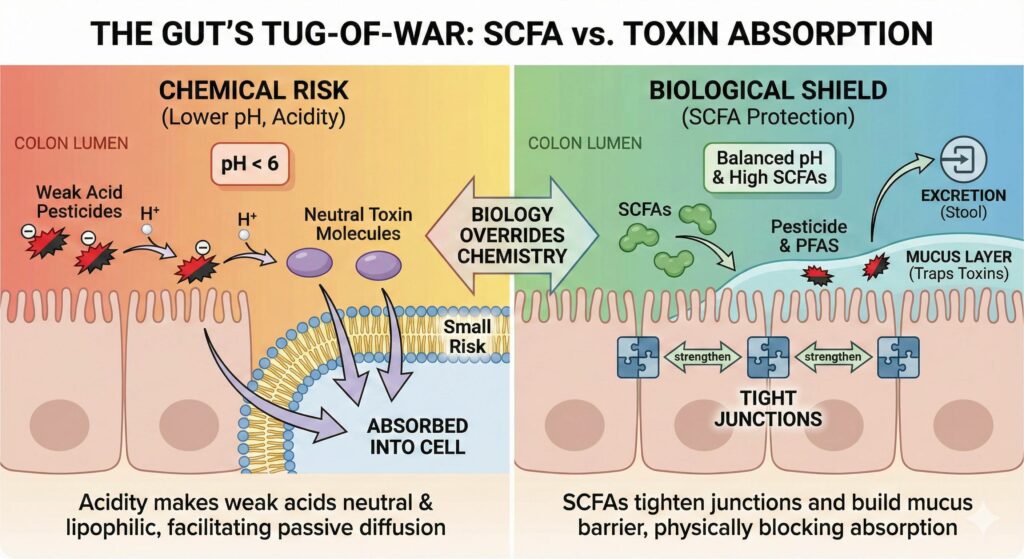
While SCFAs (Short-Chain Fatty Acids) are incredibly protective, the acidity they produce (lowering the pH) can theoretically make certain pesticides easier to absorb. However, SCFAs counteract this by physically strengthening the gut lining to block those toxins.

Here is the detailed breakdown of this “tug-of-war” between chemistry and biology.

1. The Chemical Risk: Acidity Can Increase Absorption

Many common pesticides (like 2,4-D and Glyphosate) and some environmental toxins are classified chemically as weak acids.

  • The Rule of Absorption: For a chemical to pass through the fatty wall of a cell (the cell membrane), it usually needs to be neutral (non-ionized). If it has a charge (ionized), it bounces off the fatty membrane.
  • The Acid Effect: When you put a “weak acid” pesticide in an acidic environment (like a colon rich in SCFAs), the acidity forces the pesticide to hold onto its protons. This turns it into a neutral molecule.
  • The Result: In a more acidic colon, weak acid pesticides become more “lipophilic” (fat-loving) and can theoretically drift across the gut wall easier than they would in a neutral or alkaline environment.

Note on PFAS: Most PFAS are “strong acids” with an extremely low pKa (often < 1). This means they stay negatively charged (ionized) even in an acidic colon. Therefore, the acidity produced by SCFAs likely does not significantly change their chemical absorption rate; they are absorbed through different active transport channels.

2. The Biological Shield: How SCFAs Stop the Absorption

If chemistry were the only factor, a healthy (acidic) gut might absorb more pesticide. However, biology overrides chemistry. The SCFAs (especially Butyrate) trigger biological mechanisms that physicaly lock the doors of the colon, preventing toxins from passing through the gaps between cells.

  • Tight Junction Reinforcement:
    The lining of your colon is made of cells standing shoulder-to-shoulder. The gaps between them are sealed by proteins called “Tight Junctions.” Toxins often slip through these gaps (paracellular transport). SCFAs signal your cells to produce more “glue” proteins (like ZO-1 and Occludin), tightening these seals and physically blocking large toxin molecules.
  • Mucin Production:
    SCFAs stimulate the Goblet cells to produce more mucin (mucus). This creates a thick, physical barrier on top of the gut lining. Pesticides and PFAS can get trapped in this mucus layer and be excreted in stool rather than touching the gut wall.
  • Direct Binding:
    The specific bacteria that produce SCFAs (like Bifidobacteria) can sometimes bind directly to toxins like PFAS and pesticides, holding them in the gut until they are pooped out.

Summary of the Mechanism

Mechanism Effect on Toxin Absorption Why?
Lower pH (Acidity) Increases (Risk) Converts weak acid pesticides into a neutral form that slides through cell walls easier.
Tight Junctions Decreases (Protective) SCFAs tighten the seal between cells, preventing toxins from leaking through gaps.
Mucus Layer Decreases (Protective) SCFAs build a thicker mucus shield that traps toxins before they reach the cells.

The Verdict

The acidic environment itself is not the shield; it is actually a potential liability for weak acid absorption. However, the SCFAs themselves are the shield.

The benefits of SCFAs (building a fortress-like gut barrier) vastly outweigh the small risk of increased chemical solubility. A “leaky gut” (low SCFA) will absorb far more toxins through the open gaps between cells than a healthy, acidic gut would absorb through chemical diffusion.

Share this post: on Twitter on Facebook

Related posts:

  1. Understanding Magnesium Glycinate: Health Benefits, Dosage, FAQ, and Precautions
  2. What are the benefits of Short-Chain Fatty Acids and Butyrate that is produced by friendly bacteria?
  3. Can SCFAs Help Build A Healthy Stomach Lining?
  4. Can SCFAs Help The Body Fight Macular Degeneration And Cataracts?
  5. Can SCFAs Help The Body Eliminate Visceral Fat, The Fat Around Organs?
  6. Can SCFAs Strengthen Bone Marrow and Red Blood Cells Production and Formation?
  7. Can SCFAs Strengthen The Heart And Protect The Cardiovascular System?
  8. Can SCFAs Help The Pancreas Function?

Filed Under: Features Leave a Comment

Leave a Reply Cancel reply

Your email address will not be published. Required fields are marked *


  1. Boost SCFAs with Prebiotic Fiber!

Want To Learn More About Vitamins, Nutrition And More? Subscribe!

*  Your Email Address:
*  Preferred Format:
    First Name:
*  Enter the security code shown:

Email marketing by Interspire

Categories

POPULAR READS

300px-Rumex_acetosella_38427.jpg

Health Benefits of Ojibwa Comparable to Essiac Tea

320px-Rheumatoid_Arthritis.jpg

What Are The Health Benefits Of Curamed?

All You Need To Know About Serrapaptase

Why Is Solaray A Great Vitamin And Herb Company?

Archives

  • December 2025
  • November 2025
  • September 2025
  • August 2025
  • July 2025
  • May 2025
  • January 2025
  • September 2024
  • August 2024
  • July 2024
  • June 2024
  • May 2024
  • March 2024
  • January 2024
  • November 2023
  • October 2023
  • July 2023
  • June 2023
  • May 2023
  • April 2023
  • March 2023
  • February 2023
  • January 2023
  • December 2022
  • November 2022
  • October 2022
  • September 2022
  • August 2022
  • July 2022
  • June 2022
  • May 2022
  • April 2022
  • March 2022
  • February 2022
  • January 2022
  • December 2021
  • October 2021
  • September 2021
  • August 2021
  • July 2021
  • June 2021
  • May 2021
  • April 2021
  • March 2021
  • February 2021
  • January 2021
  • December 2020
  • November 2020
  • October 2020
  • September 2020
  • August 2020
  • July 2020
  • June 2020
  • May 2020
  • April 2020
  • March 2020
  • February 2020
  • January 2020
  • December 2019
  • November 2019
  • October 2019
  • September 2019
  • August 2019
  • July 2019
  • June 2019
  • May 2019
  • April 2019
  • March 2019
  • February 2019
  • January 2019
  • December 2018
  • November 2018
  • October 2018
  • September 2018
  • August 2018
  • July 2018
  • June 2018
  • May 2018
  • April 2018
  • March 2018
  • February 2018
  • January 2018
  • December 2017
  • November 2017
  • October 2017
  • September 2017
  • August 2017
  • July 2017
  • June 2017
  • May 2017
  • April 2017
  • March 2017
  • February 2017
  • January 2017
  • December 2016
  • November 2016
  • October 2016
  • September 2016
  • August 2016
  • July 2016
  • June 2016
  • May 2016
  • April 2016
  • March 2016
  • February 2016
  • January 2016
  • December 2015
  • November 2015
  • October 2015
  • September 2015
  • August 2015
  • July 2015
  • June 2015
  • May 2015
  • April 2015
  • February 2015
  • January 2015
  • December 2014
  • November 2014
  • October 2014
  • September 2014
  • August 2014
  • July 2014
  • June 2014
  • May 2014
  • April 2014
  • March 2014
  • February 2014
  • January 2014
  • December 2013
  • November 2013
  • October 2013
  • September 2013
  • August 2013
  • July 2013
  • June 2013
  • May 2013
  • March 2013
  • January 2013
  • December 2012
  • November 2012
  • October 2012
  • September 2012
  • August 2012
  • July 2012
  • June 2012
  • May 2012
  • April 2012
  • March 2012
  • December 2011
  • November 2011
  • October 2011
  • September 2011
  • August 2011
  • July 2011
  • June 2011
  • May 2011
  • April 2011
  • March 2011
  • February 2011
  • January 2011
  • December 2010
About Us · Contact Us · Shop Now
Copyright © 2025 · VitanetOnline.com