

Can soluble fiber block ammonia absorption in the gut?
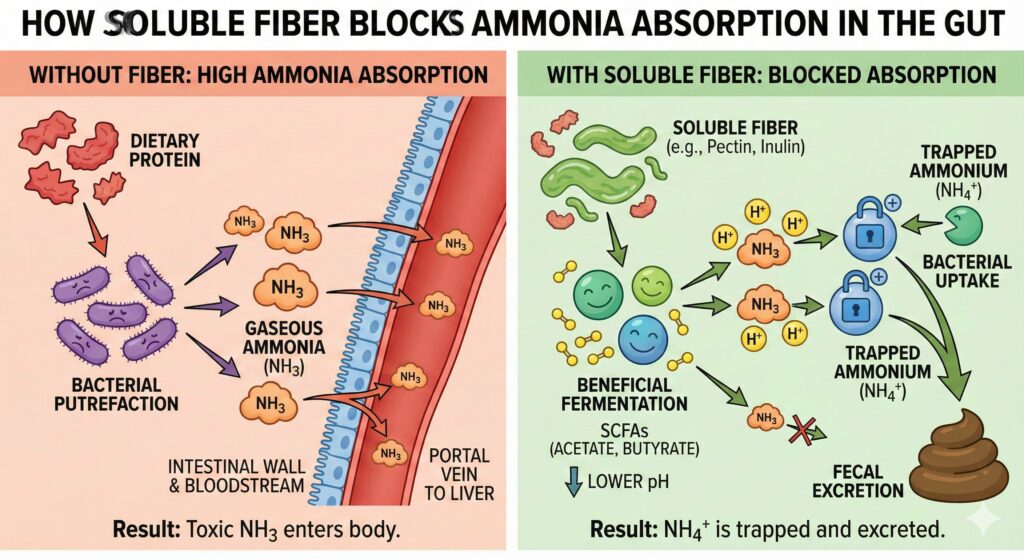
Yes, soluble fiber can effectively reduce the absorption of ammonia from the gut into the bloodstream. It does this through several distinct biological mechanisms, primarily by altering the environment of the colon and the behavior of gut bacteria.
The reduction of ammonia is a key reason why high-fiber diets and “prebiotic” fibers (like lactulose or certain soluble fibers) are used clinically to manage conditions like hepatic encephalopathy.
1. Acidifying the Gut (The “Ion Trapping” Effect)
When you consume soluble fiber, your gut bacteria ferment it to produce Short-Chain Fatty Acids (SCFAs) like acetate, propionate, and butyrate. These acids lower the pH (increase the acidity) of the colon.
- The Science: In a more acidic environment, gaseous ammonia (NH3) – which is easily absorbed through the intestinal wall – is converted into the ammonium ion (NH4+).
- The Result: Unlike the gas, the ammonium ion is “trapped” because it cannot easily cross the cell membranes of the gut lining. It remains in the stool and is eventually excreted.
2. Shifting Bacterial Metabolism
Bacteria in your gut can get energy from either carbohydrates (fiber) or proteins.
- Without Fiber: Bacteria resort to “protein fermentation” (putrefaction), which produces toxic byproducts, including ammonia.
- With Fiber: When soluble fiber is present, bacteria prioritize it as an energy source. This suppresses the breakdown of proteins, thereby reducing the initial production of ammonia in the gut.
3. Increasing “Bacterial Trapping” of Nitrogen
Soluble fiber acts as a “prebiotic” fertilizer, causing beneficial bacteria to multiply rapidly.
- Nitrogen Utilization: To build new cells, these growing bacteria need nitrogen. They actually “vacuum up” available ammonia from the gut lumen to use as a raw material for their own protein synthesis.
- Excretion: The nitrogen (formerly ammonia) is now locked inside the bacteria and is carried out of the body in the feces rather than being absorbed into the portal vein.
4. Speeding Up Transit Time
Fiber generally increases the bulk and speed of waste moving through the colon. By decreasing “colonic transit time,” there is simply less time for the ammonia produced in the gut to sit against the intestinal wall and be absorbed into the blood.
Comparison of Fiber Effects on Ammonia
| Mechanism | Action | Primary Outcome |
| Fermentation | Produces SCFAs, lowering pH | Converts NH3 to NH4+, preventing absorption. |
| Prebiotic Effect | Stimulates bacterial growth | Bacteria consume ammonia to build cell walls. |
| Substrate Shift | Prioritizes fiber over protein | Reduces the production of ammonia from protein. |
| Motility | Decreases transit time | Limits the window for ammonia to enter the blood. |
Note: This process is highly relevant for liver health. In a healthy body, the liver clears the ammonia that does get absorbed. However, if the liver is compromised, the “blocking” effect of soluble fiber becomes a critical line of defense for the brain and nervous system.
Which specific types of soluble fiber (like pectin, inulin, or psyllium) are most effective for this purpose?
While all soluble fibers help to some degree, they are not all created equal when it comes to “blocking” ammonia. The most effective fibers are those that are highly fermentable, as these produce the highest concentration of Short-Chain Fatty Acids (SCFAs), which are the key to acidifying the gut and trapping ammonia.
1. The “Heavy Hitters”: Pectin and Inulin
These are considered among the most effective for ammonia reduction because they are almost 100% fermented by gut bacteria.
- Pectin: Found in apples and citrus peels, pectin is exceptionally good at lowering colonic pH. Studies suggest it is one of the most efficient fibers for converting gaseous ammonia (NH3) into the trapped ammonium ion (NH4+).
- Inulin (FOS): A prebiotic fiber found in chicory root and onions. It is a favorite “food” for Bifidobacteria. Because it stimulates such rapid bacterial growth, it excels at the “bacterial trapping” mechanism – the growing bacteria consume the ammonia to build their own cellular proteins.
2. The “Dual Action” Fiber: Psyllium Husk
Psyllium is unique because it is only partially fermented.
- The Pro: It is the “king” of transit time. If your goal is to physically move ammonia out of the system quickly before it can be absorbed, psyllium is excellent.
- The Con: Because it doesn’t ferment as completely as pectin or inulin, it may not lower the gut’s pH as significantly. It is often used in combination with more fermentable fibers for a “sweep and trap” effect.
3. The Clinical Gold Standard: Lactulose
While technically a synthetic sugar, Lactulose acts exactly like a soluble fiber in the gut. It is the primary medical treatment for high ammonia (hepatic encephalopathy).
- It is non-absorbable, meaning it reaches the colon intact.
- It is fermented so aggressively that it creates a potent acidic environment, making it the most “reliable” way to block ammonia absorption in a medical context.
Comparison Table: Efficiency for Ammonia Reduction
| Fiber Type | Fermentability | Primary Mechanism | Ammonia Blocking Power |
| Pectin | High | pH Lowering (Ion Trapping) | ***** |
| Inulin / FOS | High | Bacterial Nitrogen Uptake | **** |
| Guar Gum | High | pH Lowering | **** |
| Psyllium | Low/Medium | Increased Transit Speed | *** |
| Cellulose | Very Low | Physical Bulk Only | * |
Summary Recommendation
If the goal is specifically to lower ammonia levels, a combination approach is usually most effective:
- A highly fermentable fiber (like Pectin or Inulin) to chemically trap the ammonia via pH changes.
- A bulking fiber (like Psyllium) to ensure that the trapped ammonia is excreted quickly.
Precaution: When starting highly fermentable fibers like inulin or pectin, it is important to start with very small doses (e.g., 1-2 grams) and increase slowly. Because they ferment so quickly, they can cause significant gas and bloating if the microbiome isn’t accustomed to them.
Leave a Reply