

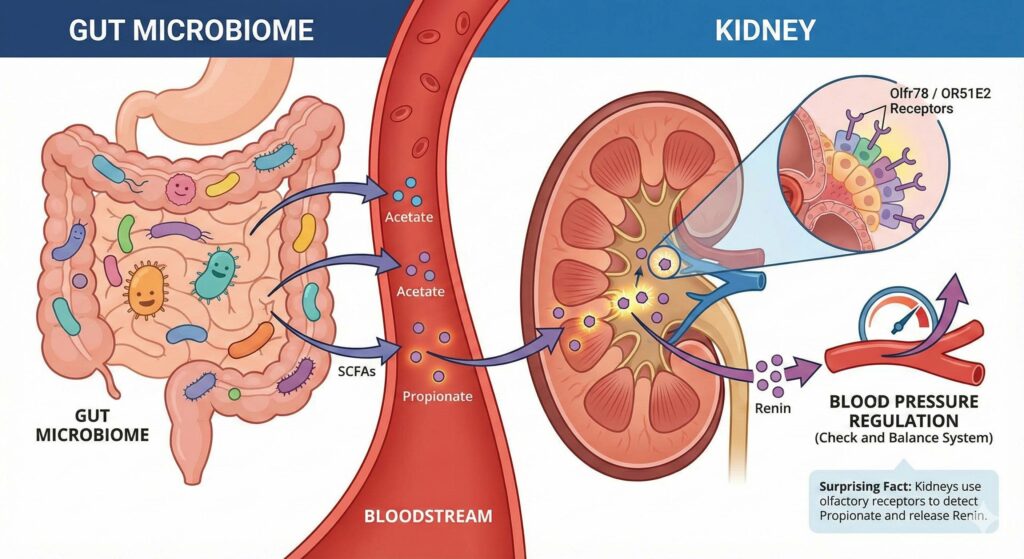
The Kidneys Can “Smell” Short-Chain Fatty Acids
It sounds like science fiction, but your kidneys possess olfactory receptors – the same type of sensors found in your nose – specifically tuned to detect Short-Chain Fatty Acids (SCFAs) circulating in your blood.
Here is the breakdown of this fascinating mechanism:
1. The Receptor: Olfr78 (OR51E2)
Scientists discovered that a specific olfactory receptor, Olfr78 (in mice) or OR51E2 (in humans), is highly expressed in the juxtaglomerular apparatus of the kidney. This is the control center where the kidney regulates blood pressure.
2. The Trigger: Propionate
While Acetate is the most abundant SCFA, this specific receptor is most sensitive to Propionate. When Propionate is produced by your gut bacteria and enters the bloodstream, it eventually reaches the kidneys and binds to these “smell” receptors.
3. The Surprising Effect: The Blood Pressure Paradox
You generally hear that SCFAs lower blood pressure (by relaxing blood vessels). However, when Propionate binds to these kidney olfactory receptors, it actually triggers the release of renin, a hormone that raises blood pressure.
Why would the body do this?
It seems counterintuitive for a “healthy” gut metabolite to raise blood pressure. However, researchers believe this acts as a sophisticated “Check and Balance” system:
- Mechanism A (Lowering BP): SCFAs bind to GPR41 receptors in the blood vessels, causing vasodilation (lowering pressure).
- Mechanism B (Raising BP): SCFAs bind to Olfr78 in the kidneys, releasing renin (raising pressure).
This tug-of-war ensures that while SCFAs generally promote healthy circulation and lower hypertension, they don’t cause your blood pressure to bottom out (hypotension) after a fiber-rich meal when SCFA production spikes. It is a perfect example of the Gut-Kidney Axis maintaining homeostasis.
Leave a Reply